BRUSSELS: NATO defense ministers gathered Thursday hoping to agree on a new plan to provide long-term security assistance and military training to Ukraine, after Hungary promised not to veto the scheme as long as it’s not forced to take part.
The ministers are meeting over two days at NATO headquarters in Brussels in the last high-level talks before a summit hosted by US President Joe Biden in Washington on July 9-11, where the military organization’s leaders are expected to announce financial support for Ukraine.
Ukraine’s Western allies are trying to bolster their military support as Russian troops launch attacks along the more than 1,000-kilometer (620-mile) front line, taking advantage of a lengthy delay in US military aid. European Union money was also held up by political infighting.
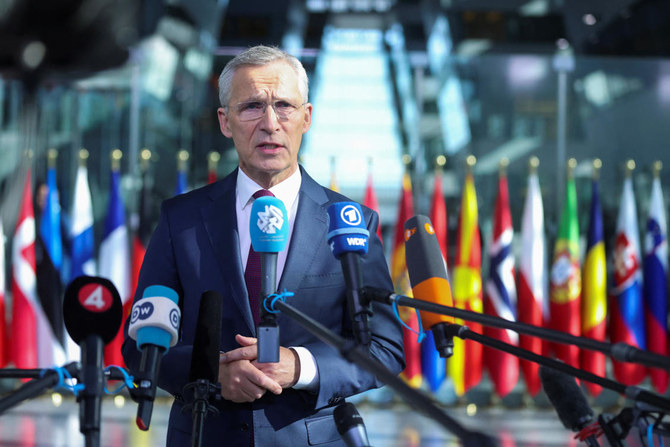
NATO Secretary-General Jens Stoltenberg, who is chairing Thursday’s meeting, said that Ukraine’s beleaguered armed forces need longer-term predictability about the kinds of weapons, ammunition and funds they can expect to receive.
“The whole idea is to minimize the risk for gaps and delays as we saw earlier this year,” Stoltenberg told reporters. The hold-up, he said, “is one of the reasons why the Russians are now able to push and to actually occupy more land in Ukraine.”
Since Russia’s full-fledged invasion in February 2022, Ukraine’s Western backers have routinely met as part of the Ukraine Defense Contact Group, run by the Pentagon, to drum up weapons and ammunition for Kyiv. A fresh meeting was held at NATO headquarters on Thursday.
While those meetings have resulted in significant battlefield support, they have been of an ad-hoc and unpredictable nature. Stoltenberg has spearheaded an effort to have NATO take up some of the slack.
The idea is for the 32-nation military alliance to coordinate the security assistance and training process, partly by using NATO’s command structure and drawing on funds from its common budget.
Stoltenberg said he hopes Biden and his counterparts will agree in Washington to maintain the funding level for military support they have provided Ukraine since Russia launched its full-fledged invasion in February 2022.
He estimates this at around 40 billion euros ($43 billion) worth of equipment each year.
On Wednesday, Hungary announced that it would not veto the plan as long as it’s not forced to take part.
“I asked the Secretary-General to make it clear that all military action outside NATO territory can only be voluntary in nature, according to NATO rules and our traditions,” Prime Minister Viktor Orbán said. “Hungary has received the guarantees we need.”
The world’s biggest security alliance does not send weapons or ammunition to Ukraine as an organization, and has no plans to put troops on the ground. But many of its members give help on a bilateral basis, and jointly provide more than 90 percent of the country’s military support.
The other 31 allies see Russia’s war on Ukraine as an existential security threat to Europe, but most of them, including Biden, have been extremely cautious to ensure that NATO is not drawn into a wider conflict with Russia.
NATO operates on the basis that an attack on any single ally will be met with a response from them all.


![]()

NATO defense ministers thrash out new security aid and training support plan for Ukraine
Short Url
https://arab.news/gjuwu
NATO defense ministers thrash out new security aid and training support plan for Ukraine
- NATO Secretary-General Jens Stoltenberg says Ukraine’s beleaguered armed forces need longer-term predictability about the kinds of weapons


Latest updates


© 2026 SAUDI RESEARCH & PUBLISHING COMPANY, All Rights Reserved And subject to Terms of Use Agreement.