

Thousands of Muslims gather to celebrate Eid across Philippines

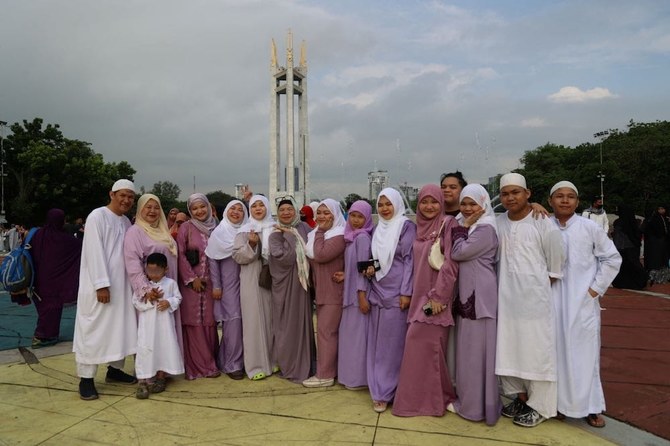
A Filipino Muslim family pose for a photo at the celebration of Eid Al-Adha at the Quezon Memorial Circle in Quezon City on June 16, 2024. (Quezon City Government)
Short Url
Updated 16 June 2024
Follow

Thousands of Muslims gather to celebrate Eid across Philippines

  • Muslims constitute about 10 percent of the majority Catholic population
  • President Marcos declared June 17 a national holiday to observe Eid Al-Adha

MANILA: Filipino Muslims across the country gathered on Sunday for Eid Al-Adha prayers to mark the Feast of Sacrifice.

There are some 12 million Muslims among the nearly 120 million, predominantly Catholic population, according to data from the National Commission for Muslim Filipinos collected in 2024.

They live mostly on the island of Mindanao and the Sulu archipelago in the country’s south, as well as in Manila, constituting the third-largest Muslim community in Southeast Asia after Indonesia and Malaysia.

Earlier this month, President Ferdinand Marcos Jr. declared Monday, June 17 a national holiday to observe Eid Al-Adha, the second of the two main holidays observed in Islam.

In the Philippine capital region, thousands of Muslims braved the rain for Eid prayers, gathering at the Quezon Memorial Circle for a communal prayer that began early in the morning.

“It rained as early as 5 a.m. First it was just drizzles, then there was a downpour, and then the rain stopped. Good thing that we were able to perform the prayer before it rained again,” Nords Maguindanao, a Muslim resident of Quezon city, told Arab News.

“There were thousands who came to celebrate Eid Al-Adha. The heavy rain did not stop us from congregating … Today we literally had to endure the rain, sacrifice our time and patience. The bad weather was really a test of patience. But overall what is important is that families are united on Eid.”

Maguindanao, who was with his wife and children, has attended the gatherings at Quezon Memorial Circle for years. It is one of the major venues for Eid celebrations in the area, the other being the Quirino Grandstand in Manila.

“The unity of Muslims in Quezon City was shown through this Eid prayer because of the overwhelming attendance of the city’s Muslim constituents,” he said.

Ali Macabalang, a local journalist from Kidapawan City in the country’s south, told Arab News that he gathered with hundreds of other Muslims at a small park to celebrate Eid this year.

“Eid Al-Adha for me is the very moment of performing or seeking atonement and renewal of connections to the Almighty Creator,” Macabalang said.

“After the prayer, the Imam delivered a sermon reminding Muslims of their duties not only to God but to the community, then to themselves. After that, families partake of the food, which is the basic component of every celebration.”

Eid Al-Adha commemorates the Prophet Ibrahim’s test of faith when he was commanded by God to sacrifice his son, and also marks the culmination of Hajj, the annual pilgrimage that is one of the five pillars of Islam.

In Cotabato City, the main city of the Bangsamoro Autonomous Region in Muslim Mindanao, local authorities celebrated the holiday with reflections on their struggles over the years.

Bangsamoro, the only Muslim-majority territory in the Philippines covering central Mindanao, was until 2014 at the heart of a four-decades-long separatist struggle. The BARMM was formed in 2019 as part of the region’s transition to autonomy, which will culminate in 2025, when it will elect its legislature and executive.

“Today is a moment for every believer to remain true to our core values: that, amidst the challenges of life, the sacrifices we endure hold profound meaning and wisdom,” the BARMM’s chief minister, Murad Ebrahim, said.

“It is through the sacrifices and obedience of the Bangsamoro people that we have progressed in our struggle for justice and equality.”


Ethiopia embraces big projects but risks another war by seeking access to the sea

Updated 6 sec ago
Follow

Ethiopia embraces big projects but risks another war by seeking access to the sea

Ethiopia ‘s prime minister loves big projects. With a mega-dam completed on the Nile, Abiy Ahmed now plans Africa’s largest airport and a nuclear power plant. But the threat of war is back as the landlocked nation seeks its most audacious feat yet: access to the sea.
The prime minister hailed the country’s transformation in a parliamentary address in late October. The capital, Addis Ababa, has seen a development boom. The Grand Ethiopian Renaissance Dam was inaugurated in July. Abiy has called it a “harbinger of tomorrow’s dawn” that will end the reliance on foreign aid for Africa’s second most populous nation. The country has been one of the world’s biggest aid recipients.
But multiple challenges lie ahead that could badly damage the economy, which has seen some of the strongest growth on the continent.
Eritrea
Abiy’s government is determined to regain access to the Red Sea, which Ethiopia lost when Eritrea seceded in 1993 after decades of guerrilla warfare.
The countries made peace in recent years, bringing Abiy a Nobel Peace Prize, then teamed up for a devastating war against Ethiopia’s Tigray region. Now tensions have returned.
In June, Eritrea accused Ethiopia of having a “long-brewing war agenda” aimed at seizing its Red Sea ports. Ethiopia insists it wants to gain sea access peacefully.
Ethiopia recently claimed Eritrea was “actively preparing to wage war against it.” It has also accused Eritrea of supporting Ethiopian rebel groups.
Magus Taylor, deputy Horn of Africa director at the International Crisis Group, described the tensions as concerning.
“There’s a possibility of mistakes or miscalculation,” he said. “And the situation could deteriorate further in the coming months.”
Egypt
Egypt relies on the Nile for nearly all its drinking water and fiercely opposed the Grand Ethiopian Renaissance Dam, asserting that it would threaten the supply. Egypt and Ethiopia have held several rounds of inconclusive talks to regulate the use of the dam, especially in times of drought.
Since the dam’s inauguration, Cairo has toughened its rhetoric against Ethiopia. In September, it said it reserved “the right to take all necessary measures … to defend the existential interests of its people.”
Ethiopia says the dam is critical for its development as it seeks to lift millions of people out of poverty.
Egypt has also sought to exploit tensions between Ethiopia and its neighbors. It has bolstered security ties with Eritrea and signed a security pact with Somalia, which last year reacted furiously when Ethiopia signed a port deal with the breakaway region of Somaliland, over which Somalia claims sovereignty.
Ethnic conflicts

The war in Ethiopia’s Tigray region ended with a peace deal in late 2022, but the country’s two largest regions — Amhara and Oromia — are wracked by ethnic-based insurgencies that threaten internal security.
Both the group of loosely organized militias called Fano in Amhara, and the Oromo Liberation Army Oromia, claim to represent those oppressed by the federal government.
Witnesses have reported massacres and other extrajudicial killings by all sides. Kidnapping for ransom has become commonplace, and humanitarian aid groups struggle to deliver supplies.
Amnesty International has described the cycle of violence as a “revolving door of injustices.”
Meanwhile, the peace deal for Tigray risks unraveling. Southern areas of Tigray have seen clashes between regional forces and local militias aligned with the federal government. Tigray’s rulers accused the federal government of “openly breaching” the agreement after a drone strike hit its forces.
Abiy’s government now accuses Tigray’s rulers of colluding with Eritrea.
Economic inequality
The insecurity contrasts starkly with the mood in Addis Ababa, where Abiy has spent billions of dollars on a face lift that has included creating bike lanes, a conference center, parks and museums.
The prime minister wants to turn the capital, already home to the African Union continental body and one of Africa’s busiest airports, into a hub for international tourists and investors.
He has floated Ethiopia’s currency, opened the banking sector and launched a stock exchange — all dramatic steps for a country where the economy has long been state-owned and state-managed.
The reforms helped Ethiopia secure a $3.4 billion bailout from the International Monetary Fund last year. But investors are wary about Ethiopia’s internal insecurity and tensions with its neighbors.
Poverty, meanwhile, has risen alarmingly. About 43 percent of Ethiopians now live under the poverty line, up from 33 percent in 2016, two years before Abiy took power, according to the World Bank. That’s due in part to rising food and fuel prices as well as defense spending taking up more of Ethiopia’s budget.
The sense of prosperity prevailing in Addis Ababa is not shared by Ethiopia’s regions, said Taylor with the International Crisis Group.
“Abiy has a firm grip on the country at the center, but then you have these periphery conflicts partly based on feelings of injustice – that they are poor and the center is rich,” he said. “So we expect this kind of instability to continue in these areas.”