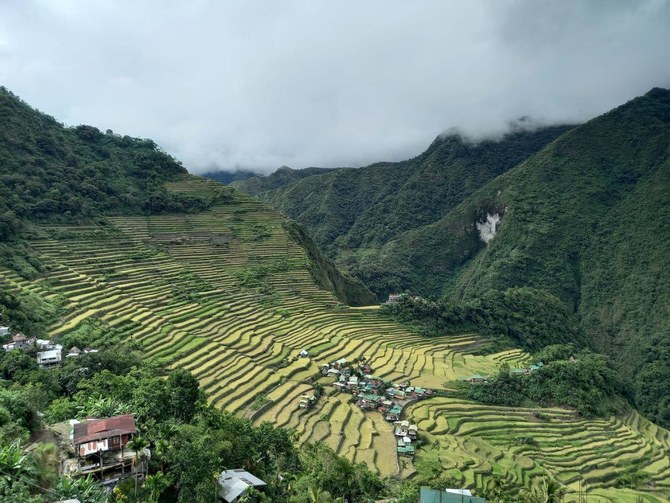

Perched on the side of mountains in the Cordillera region, about 250 km north of Manila on Luzon island, enormous green steps rise to a height of 1,500 meters, funneling water from the mountaintop forests down to the rice terraces below.
Known in the Philippines as a “stairway to heaven,” the Ifugao rice terraces are a UNESCO World Heritage Site and a 2,000-year-old indigenous engineering feat that is increasingly under threat due to climate change.
The ancestors of the indigenous Ifugao people carved the terraces by hand to irrigate their rice crops, which even now are a staple in the province.
This masterpiece of ancient agricultural engineering entered the UNESCO World Heritage list in 1995 and is often referred to as the “Eighth Wonder of the World” — and one of its most endangered. In May, one of the sites in Batad village collapsed after heavy rains, causing a landslide that damaged 12 terraces.
“At present, risks of damage to the rice terraces and to local culture are exacerbated due to increased temperatures, erratic rainfall, poverty, and demographic shifts, just to name a few examples,” Marlon Martin, a member of the Ifugao ethnic group and executive of the Save the Ifugao Terraces Movement, told Arab News.
“This makes loss and disruption of life in the terraces a strong possibility. As a result, you can see the landscape rapidly changing. These same vulnerabilities may cause the loss of traditions, indigenous knowledge, and intangible identity that connects the Ifugao to their ancestral lands and forebears.”
Aside from Batad, similar steep terraces can also be found in nearby Banaue, Mayoyao, Hapao and Kiangan. Covering about 10,360 sq. km, the extensive network would be at least 20,000 km in length — half the Earth’s circumference — if laid end to end.
Ancient engineers created the highland paddies by making walls with stones and mud. The terraces are designed to retain and also channel water to the steps below, immersing the paddies all year round.
The Ifugao see the terraces as integral to their identity and culture.
“People maintain the terraces because, primarily, it is of significant value to them as a people and as a culture. The terraces link them to their ancestors. It brings them together as a community, and this is how they keep traditional knowledge alive,” Martin said.
“People need to understand that these are not built monuments like Memphis and its Necropolis or the Great Wall, and that when you do restoration, you are already done. Year in and year out, Ifugao farmers need to restore, repair, and maintain the terraces.”
Yet the costs of maintaining the terraces are increasingly high, with erratic weather and effects of the changing climate making their cultivation economically unfeasible.
“Damages to paddy walls induced by drought and torrential rains associated with climate change make maintenance not worth the economic benefit. Were it not for the other values of the terraces, this alone would discourage people,” Martin said.
As part of the Preserving Legacies project, he has conducted a year-long study assessing the terraces’ climate vulnerability, and believes it is time for the government to step in to prevent the sites from being abandoned and losing UNESCO status.
“The government needs to subsidize rice terrace farmers,” he said. “Heritage, economics, socio-cultural solidarity, and a source of indigenous knowledge are key to the preservation of the terraces.”
For Raymond Macapagal, assistant professor at the University of the Philippines’ Center for International Studies and manager of the Batad Kadangyan Ethnic Lodges Project — a community-based tourism enterprise at the UNESCO site — a key strategy is to create opportunities for young people.
Over the past two decades, the younger generation’s migration to cities in search of other work has resulted in 30 percent of the terraces being abandoned. Developing tourism was one way to provide alternative sources of income.
“They will have a deeper understanding of the challenges and solutions in the complex task of safeguarding the terraces. They will also be more motivated to protect the landscape that provides their livelihood,” Macapagal said.
The rice terraces, featured on the Philippines’ 20-peso banknotes, are also a part and witness to the region’s long human history and remnants of millennia-old indigenous heritage.
“The significance of the Ifugao rice terraces to the Ifugao people, I believe, can be rooted in how it represents indigenous cultural heritage that has resisted centuries of colonization,” Macapagal said.
“It demonstrates the harmonious interaction of humans, gods, and nature in order to come up with an outstanding cultural landscape that is admired throughout the world.”