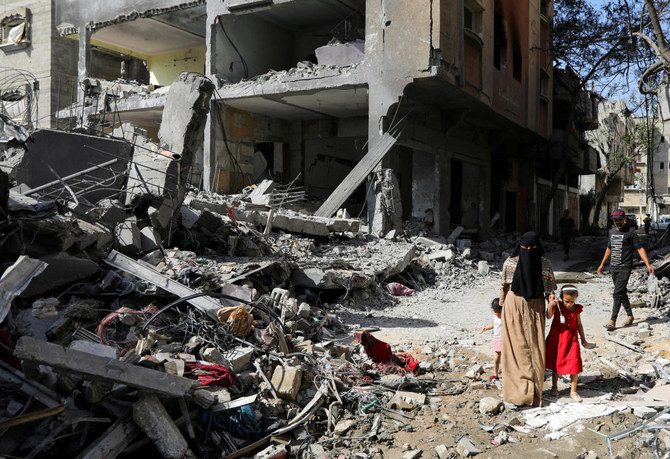
Islamic Jihad says only way to free Israeli hostages is Gaza withdrawal, prisoner deal

The armed wing of Palestinian Islamic Jihad said on Saturday the only way to return Israeli hostages is through Israel's withdrawal from Gaza, ending its offensive and reaching a deal for exchanging Israeli hostages for Palestinian prisoners. (Reuters/File)
Short Url
Updated 15 June 2024
Follow

Islamic Jihad says only way to free Israeli hostages is Gaza withdrawal, prisoner deal

  • The spokesman of Al-Quds Brigades made the remarks in a video posted on Telegram
  • Islamic Jihad is a smaller ally of Hamas

CAIRO: The armed wing of Palestinian Islamic Jihad said on Saturday the only way to return Israeli hostages is through Israel’s withdrawal from Gaza, ending its offensive and reaching a deal for exchanging Israeli hostages for Palestinian prisoners.
The spokesman of Al-Quds Brigades, the armed wing of the Palestinian group, made the remarks in a video posted on Telegram.
Islamic Jihad is a smaller ally of the militant Islamist group Hamas, which led a rampage in southern Israel on Oct. 7 in which 1,200 people were killed and over 250 taken hostage, according to Israeli tallies. More than 100 hostages are believed to remain captive in Gaza, although at least 40 have been declared dead in absentia by Israeli authorities.
At least 37,296 Palestinians have been killed in Israel’s military campaign to eliminate Hamas, according to the Gaza health ministry.


Morocco to secure 60% of water needs from desalination

Nizar Baraka. (AFP)
Updated 56 min 59 sec ago
Follow

Morocco to secure 60% of water needs from desalination

  • Rabat boosts investment in facilities powered by renewable energy, minister tells Marrakech conference

MARRAKECH: Morocco, which has endured seven years of drought, plans to supply 60 percent of its drinking water from treated seawater by 2030, up from 25 percent, its water minister said, as Rabat accelerates investment in desalination plants powered by renewable energy.

The push is crucial to ensure a steady water supply and to maintain Morocco’s status as a key producer and exporter of fresh produce amid climate change, as droughts have dried up some of its main water reservoirs and depleted underground resources.

FASTFACT

The plant will have a capacity of 350 million cubic meters and will supply urban centers in Morocco’s food basket as well as farmlands.

The North African country plans to produce 1.7 billion cubic meters of desalinated water annually by 2030 from projects under construction and plants for which it will hold tenders starting next year, Nizar Baraka said on the sidelines of the World Water Congress in Marrakech.
The largest plant — with planned investment of about 10 billion dirhams ($1 billion) — will be located near Tiznit, 615 km south of the capital Rabat. 
It will have a capacity of 350 million cubic meters and will supply urban centers in the country’s food basket as well as farmlands, he said.
“Studies are underway as part of preparations for the plant’s tender, to be announced by mid next year,” Baraka said.
Besides the northern cities of Nador and Tangier, plants are also planned in Rabat in partnership with the French group Veolia, as well as in Tantan, where the government is considering building a port dedicated to green hydrogen and ammonia exports, Baraka said.
Morocco currently operates 17 desalination plants producing 345 million cubic meters annually. 
Four additional plants are under construction with a combined capacity of 540 million cubic meters, scheduled to be ready by 2027, including a major facility in Casablanca, the country’s most populous city.
“All new desalination plants will be powered by renewable energy,” Baraka said.
Morocco has also faced rising temperatures and worsening evaporation in dams. 
To counter this, it installed floating solar panels on a dam near Tangier to reduce evaporation, which accounts for 30 percent of the country’s surface water loss, according to the minister.
“The experiment will be expanded to include dams in the south and mountainous regions,” Baraka said.