

Pakistan, Bangladesh discuss military education, joint training to deepen defense cooperation

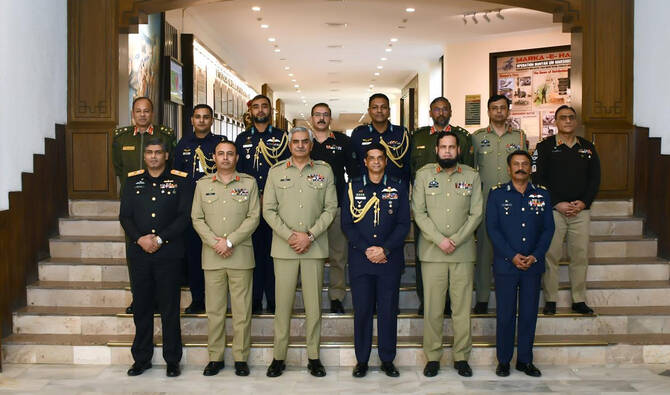
Bangladesh Air Force Chief Air Chief Marshal Hasan Mahmood Khan (third right - front row) poses for a group photo along with Pakistani officials at the National Defense University in Islamabad, Pakistan, on January 9, 2026. (ISPR)
Short Url
Updated 09 January 2026
Follow

Pakistan, Bangladesh discuss military education, joint training to deepen defense cooperation

  • The development comes during Bangladeshi air chief’s visit to Pakistan amid warming relations between the countries
  • The two sides this week also held talks on possible procurement of ⁠JF-17, combat aircraft jointly developed with China

ISLAMABAD: Top Pakistani and Bangladeshi commanders met in Islamabad and discussed military education and joint training to deepen bilateral defense cooperation, the Pakistani military said late Thursday, amid warming relations between the two countries.

The statement by the Inter-Services Public Relations (ISPR) came after Bangladesh Air Force Chief Air Chief Marshal Hasan Mahmood Khan’s visit to the National Defense University in Islamabad being an alumnus National Security and War Course 2010-11.

The visiting dignitary called on NDU President Lt. Gen. Babar Iftikhar and discussed defense cooperation between the two countries among affairs of mutual interest.

“Both sides reaffirmed the importance of military-to-military engagement, particularly in the domain of professional military education and joint training,” the ISPR said.

“The visit underscores the strong historical ties between Pakistan and Bangladesh and reflects a shared resolve to deepen defense cooperation and training.”

Pakistan and Bangladesh were part of the same country until Bangladesh’s secession following a bloody civil war in 1971, an event that long cast a shadow over bilateral ties. Both countries have moved closer since August 2024, following the ouster of former premier Sheikh Hasina in a violent uprising.

Islamabad has stepped up efforts to rebuild relations with Bangladesh as ties between Dhaka and New Delhi remain strained over India’s decision to grant asylum to Hasina after she fled the country.

Air Chief Marshal Khan, who arrived in Pakistan this week, has met top military commanders, including Chief of Defense Forces Field Marshal Asim Munir, during his visit.

“Matters of mutual interest, regional security dynamics and avenues for enhancing bilateral defense and military cooperation were discussed,” the ISPR said, following his meeting with Munir.

On Wednesday, Pakistan’s Air Chief Marshal Zaheer Ahmed Baber Sidhu and Khan held talks on the possible procurement of ‌the ⁠JF-17 ​Thunder, ‌a multi-role combat aircraft jointly developed with China, in Islamabad.


Pakistan assembly speaker warns opposition against anti-state remarks in parliament

Updated 17 January 2026
Follow

Pakistan assembly speaker warns opposition against anti-state remarks in parliament

  • Ayaz Sadiq says criticism of judiciary and armed forces will not be allowed on assembly floor
  • He calls violence during protests unacceptable, vows neutrality as National Assembly speaker

ISLAMABAD: Pakistan’s National Assembly Speaker Sardar Ayaz Sadiq said on Saturday that opposition lawmakers would not be allowed to speak against Pakistan, the judiciary or the armed forces on the floor of parliament, calling such remarks unacceptable.

Speaking to reporters during a visit to the eastern city of Lahore, Sadiq said parliamentary debate must remain within constitutional and legal limits, while reiterating his commitment to act impartially as speaker.

“No one will be allowed to speak against Pakistan, the judiciary or the armed forces on the floor of the National Assembly,” Sadiq said. “Negative or controversial remarks about judges or the armed forces are unacceptable.”

His comments come amid heightened political tensions after opposition groups held protests in the past, criticizing state institutions and targeting government and military properties.

The speaker said peaceful protest was a democratic right but drew a sharp line at violence and vandalism.

“Protest is the right of every citizen in a democratic society, but it must remain peaceful and within the bounds of the constitution and the law,” he continued, adding that arson, damage to property and the use of sticks or weapons in the name of protest were “unacceptable” and posed a threat to the rule of law.

“No opposition lawmaker will be allowed to speak on the National Assembly floor if they speak against Pakistan,” Sadiq said.

The speaker also noted the country’s economic indicators were gradually improving, citing an increase in foreign exchange reserves, and said Pakistan had further strengthened relations with countries including the United States, China, Russia, Türkiye and Saudi Arabia.