

Pakistan opposition rejects budget 2024-2025, disputes key figures

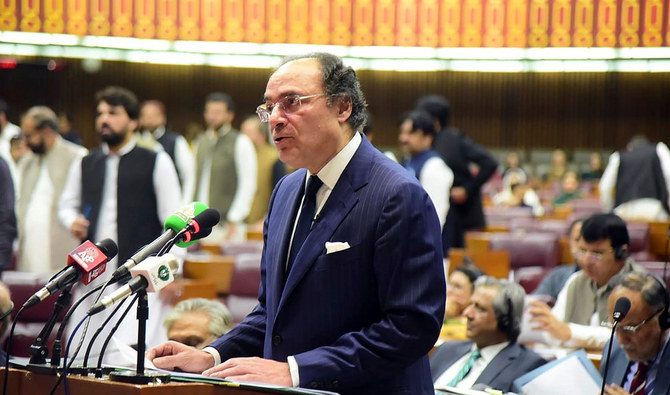
In this photo released by the Pakistan Finance Ministry Press Service, Pakistan’s Finance Minister Muhammad Aurangzeb speaks and parented, the Federal Budget before the National Assembly of Pakistan, in Islamabad on June 12, 2024. (Photo courtesy: Finance Ministry Press Service)
Short Url
Updated 16 June 2024
Follow

Pakistan opposition rejects budget 2024-2025, disputes key figures

  • Finance Minister Aurangzeb presented $67.76 billion budget in parliament on Wednesday 
  • Opposition lawmakers allege government did not provide budget documents for their review

ISLAMABAD: Pakistan’s opposition lawmakers on Wednesday rejected the federal budget for the year 2024-25, alleging that the government had not fulfilled its constitutional requirements of providing budget documents for them to review and disputing key figures provided by Finance Minister Muhammad Aurangzeb. 
The finance minister unveiled the much-awaited Rs18.877 trillion ($67.76 billion) federal budget for FY 2024-25 that set an ambitious revenue collection target of Rs13 trillion ($46.66 billion). The budget is expected to play a pivotal role in Pakistan’s negotiations with the International Monetary Fund (IMF) to unlock yet another loan program. 
Opposition lawmakers from the Sunni Ittehad Council (SIC), backed by independent candidates affiliated with jailed former prime minister Imran Khan, protested during Aurangzeb’s speech. 
As they shouted slogans, the SIC lawmakers carried placards with “Release Imran Khan” written all over them. Throughout most of the finance minister’s speech, opposition lawmakers gathered in front of the Speaker’s dais and kept shouting anti-government slogans.
“A fake budget has been presented today, we reject it completely,” Omar Ayub Khan, the leader of the opposition in the National Assembly, told reporters after the budget session.
“This is a joke with the nation and Pakistan.”
He described the budget as “illegal and unconstitutional,” saying the government had not provided budget documents for the opposition lawmakers’ perusal. He said it was possible the government would change important figures in the document by the next National Assembly session to be held on June 20.
“I want to categorically say here that today for the first time in the parliament, glaring constitutional violation has taken place during the budget,” he said. 
He disputed the government’s figures that said the gross domestic product (GDP) had grown by 2.38 percent, the agriculture sector by 6.25 percent, and the industrial and services sectors had each grown by 2.1 percent in the outgoing fiscal year.
“The budget they are presenting, this is not the real growth rate,” he alleged. 
Meanwhile, Aurangzeb credited the government’s policies for stabilizing the country’s economy. He noted that Pakistan’s reserves were no longer in a precarious situation and that the country’s economic indicators were improving. 
“Mr. Speaker, I think that despite political and economic challenges, our progress on the economic front in the past one year has been impressive,” the finance minister had said in his budget speech.


 However, SIC lawmaker Shandana Gulzar Khan said the public should have derived the maximum benefit from the government’s budget. Instead, she said they would have to pay heavy taxes. 
“You want to fix this country, you give this country to the people,” Gulzar told Arab News.
“Those who are paying taxes, you ensure that they get the maximum share of the budget, that they are able to send their children to school, that they are able to eat three times a day and they have access to a health card,” she added.


UN says 270,000 Afghans have returned from Iran, Pakistan this year

Updated 10 March 2026
Follow

UN says 270,000 Afghans have returned from Iran, Pakistan this year

  • UNHCR says 110,000 Afghans returned from Iran while 160,000 returned from Pakistan since start of 2026
  • Return numbers seem to have risen since Gulf war erupted on Feb. 28, says UNHCR official in Afghanistan

GENEVA: Some 270,000 Afghans have returned to their country from Pakistan and Iran so far this year, the UN said Tuesday, warning that the escalating Middle East war risked pushing the numbers higher.

UNHCR, the United Nations’ refugee agency, said that 110,000 Afghans had returned from Iran and another 160,000 had returned from Pakistan since the start of 2026.

And the numbers seem to have risen since the Middle East erupted on February 28, with the United States and Israel unleashing a barrage of strikes on Iran, and Tehran responding with drone and missile strikes on Israeli and US interests across the region.

Since then, there have been some 1,700 returns from Iran to Afghanistan each day, Arafat Jamal, UNHCR’s representative in Afghanistan, told reporters in Geneva.

Speaking from Islam Qala, on the Afghan-Iranian border, he said the situation there was “deceptively calm.”

“Returns are orderly but freighted with tension and apprehension,” he said, adding that with the hostilities elsewhere escalating, “I do fear there is more to come.”

“We are preparing for massive returns.”

He pointed out that Afghanistan was “facing the ramifications of what is happening with Iran,” while clashes have erupted along the Afghan border with Pakistan.

The new Middle East war, he warned, was “layering itself on top of an existing war on another frontier,” Jamal said.

UNHCR highlighted that the latest crises came after returns to Afghanistan had already been “exceptionally high” in recent years.

More than five million Afghans had returned from neighboring countries in the past two years, including 1.9 million returning from Iran last year alone.

Jamal warned that “many Afghan families are now facing cycles of displacement: first forced to flee Afghanistan, later displaced again inside Iran due to conflict, and now returning once more to Afghanistan.”

“And upon return in Afghanistan, the triply-displaced enter a spiral of precarity and uncertainty.”
Returns from Pakistan had meanwhile stabilized in recent weeks, as the main crossing point at Torkham remained closed due to the tensions there, Jamal said.

But he warned that “movements could increase sharply once the border reopens.”

UNHCR and the UN children’s agency UNICEF said Tuesday they were working to strengthen their capacity to operate at the borders and within Afghanistan.

But “given the scale of returns and the financial constraints facing humanitarian operations, additional support will be needed if arrivals increase,” UNHCR said, without specifying the amount needed.