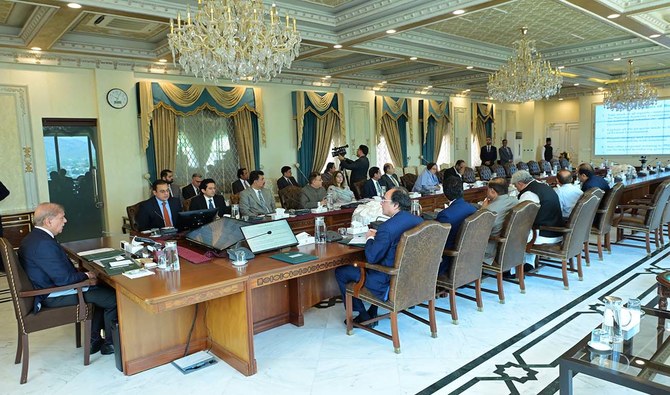
ISLAMABAD: A high-level committee tasked with finding ways to rationalize the government structure and expenses suggested a contributory pension system for public sector employees while presenting its preliminary report to Prime Minister Shehbaz Sharif at a meeting focusing on the two objectives in Islamabad on Wednesday.
The development took place right ahead of the federal budget, scheduled to be presented by Finance Minister Muhammad Aurangzeb in the National Assembly later today.
Pakistan faces large, persistent fiscal deficits that contribute to macroeconomic instability and crowd out public and private investment.
The issue has also become significant in the context of the government’s efforts to secure another International Monetary Fund (IMF) bailout since a reduction in the government’s expenses can help reallocate funds to address more pressing economic issues.
“The initial report offered short-term and mid-term recommendations,” said a statement circulated by the PM Office after the meeting. “The committee recommended shutting down some public institutions, merging several, and transferring some to the provinces.”
“All vacant positions which have been unfilled for more than a year should be eliminated to save national funds,” the statement continued. “The committee also recommended introducing a contributory pension system for newly recruited government employees.”
The report also suggested the government impose restrictions on unnecessary official travel and promote teleconferencing.
Subsequently, the prime minister constituted a high-powered committee, asking its members to present a comprehensive action plan within 10 weeks.
He said the committee should utilize the best international practices to provide solid recommendations.
Sharif also expressed hope the committee’s recommendations would save the nation billions of rupees.
The committee that worked on the preliminary report was headed by the deputy chairman of the Planning Commission and had experts like Dr. Qaiser Bengali, Dr. Farukh Saleem and Muhammad Naveed Iftikhar.


![]()

Pakistan mulls contributory pension system to curtail expenditure amid IMF loan talks
Short Url
https://arab.news/v39k5
Pakistan mulls contributory pension system to curtail expenditure amid IMF loan talks
- A high-level committee presents its report to PM Sharif, recommending closure of some public institutions
- The committee says all vacant positions that have been unfilled for more than a year should be eliminated
Latest updates


© 2026 SAUDI RESEARCH & PUBLISHING COMPANY, All Rights Reserved And subject to Terms of Use Agreement.