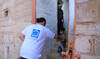
RIYADH: By the time pilgrims reach Mina, for many fatigue will have settled in quietly. Hours of walking under the sun, waves of people moving in every direction, and the emotional intensity of Hajj can blur even the simplest details. A tent number is forgotten. A familiar face disappears into the crowd. A phone battery dies. In one of the largest annual gatherings on Earth, getting separated can happen in a matter of seconds.
“My son, I can’t continue.”
Those are the words that Bakur Hemdi still remembers years later, spoken by an elderly Egyptian pilgrim he helped during Hajj. Among the many memories he carries from years of volunteering, he says the moments that stayed with him most were not the rituals themselves, but the people who had lost their way.
For many pilgrims, Hajj is the spiritual journey of a lifetime. Yet beneath the prayers and rituals, another reality quietly unfolds every year: people get lost.
In a gathering where nearly two million people move simultaneously between Makkah, Mina, Muzdalifah and Arafat, separation is almost inevitable.
Elderly pilgrims lose sight of family members in dense crowds. Language barriers create confusion. Heat exhaustion causes disorientation. Some pilgrims become overwhelmed after walking long distances, while others simply take a wrong turn among the endless rows of tents and pathways.
But behind the scenes, another movement unfolds alongside the pilgrimage itself: an enormous effort dedicated to helping people find their way back.
Saudi authorities have expanded Hajj operations through advanced crowd management systems, monitoring supported by artificial intelligence and around-the-clock control centers to organize pilgrim movement and improve safety at the holy sites. According to official reports on preparations this year, digital systems linked through the Nusuk platform and smart identification cards with QR codes are helping authorities identify pilgrims and reconnect them with their groups more efficiently.
Yet for all the technology shaping Hajj, many of the most important moments still happen face to face.
Hemdi remembers one of them vividly.
It was during the 2013 Hajj season. His camp was hosting Egyptian pilgrims, and he had gone to visit a friend staying nearly two kilometers away. On his way back, he noticed a scout with an elderly Egyptian woman who appeared exhausted and disoriented.
“The scout asked if I knew where her camp was,” Hemdi recalled.
He checked her Hajj card and immediately recognized the area where she belonged.
As they started walking, the heat grew increasingly difficult. It was nearly noon and temperatures were intense.
After some distance, she looked at him and quietly said, “My son, I can’t continue.”
Hemdi found a wheelchair at a nearby medical center and pushed her through Mina until they reached her camp.
“Once we arrived, she kept praying for me and asking about my age and studies,” he said. “I was in my third year of university then. It was a very touching experience.”
For volunteers, these encounters often become deeply personal.
Near the Grand Mosque and in Mina’s vast tent city, volunteers, security personnel, scouts and medical workers become translators, guides and emotional support for pilgrims who suddenly find themselves alone.
Many arrive frightened.
Some do not speak Arabic or English. Others are elderly and unable to explain where they came from. Workers often rely on nationality badges, identification cards, hand gestures and digital information systems to determine where a pilgrim belongs.
According to a volunteer with the Saudi Red Crescent Authority, helping a lost pilgrim begins long before reuniting them with family or their Hajj group. Teams in the field first focus on the pilgrim’s emotional state, recognizing that many people become anxious or distressed after losing contact with companions in crowded conditions.
“The first step is reassurance,” one volunteer said. We help the pilgrim feel safe and ease feelings of fear or stress before moving to the next stage,” said T.J., a volunteer with the Saudi Red Crescent Authority.
Field teams then coordinate with relevant authorities stationed throughout the holy sites to identify the pilgrim and guide them back safely. In many cases, pilgrims are directed to special teams responsible for reunification, including Nusuk teams and guidance services operating throughout Hajj.
Volunteers with the Saudi Red Crescent also serve in areas beyond emergency medical care. Their responsibilities include first aid assistance, supporting ambulance and medical transport teams, providing humanitarian and psychological support, helping cool pilgrims during extreme heat, offering guidance and directions, assisting with translation for different nationalities, and documenting services provided to pilgrims throughout the season.
Hemdi recalls another encounter from the same year involving a Chinese pilgrim.
At the time, translation technology was limited.
The pilgrim approached him, unable to communicate verbally, and opened Google Translate on his phone. On the screen was a short sentence translated into Arabic: “Big problem, I have been lost for six hours.”
“We started communicating through the phone,” Hemdi said. “I would type in Arabic, translate it into Chinese and hand the phone back.”
Back and forth they continued.
Eventually, Hemdi checked the pilgrim’s identification card and discovered that he belonged to one of the East Asian pilgrim groups located some distance away.
Volunteers were typically provided with maps showing camp locations according to nationalities and pilgrim organizations. Using the map and translation app, Hemdi manually typed out directions step by step.
“There was no live translation feature then,” he said. “I had to write everything myself.”
He watched as the pilgrim copied the instructions into his notes application before walking away.
“I sincerely hope he made it safely back.”
Stories like these unfold daily during Hajj, although most never become public knowldge.
Scouts stationed throughout Mina operate guidance centers focused on lost pilgrims. According to Hemdi, every area has designated locations where separated pilgrims can be taken.
“When scouts find someone, they don’t simply point them in a direction,” he said.
He recalled another incident involving a lost woman who was brought to one of the guidance centers.
Some centers have translators for languages spoken by international pilgrims. Once a pilgrim is identified, a scout accompanies them all the way back to their assigned camp.
“There is a formal process,” Hemdi said. “The scout does not leave until the pilgrim has officially entered the camp and the administration confirms they have safely returned.”
Only then is the mission considered complete.
Researchers and officials have explored facial recognition systems and computerized missing-person platforms for years as part of wider efforts to improve safety during Hajj and Umrah. But despite rapid technological advances, human connection remains key.
As millions continue to move through the holy sites this season, stories of separation and reunion will continue unfolding quietly in the background.
For the pilgrims involved, finding a familiar face again among a sea of strangers is unforgettable.