


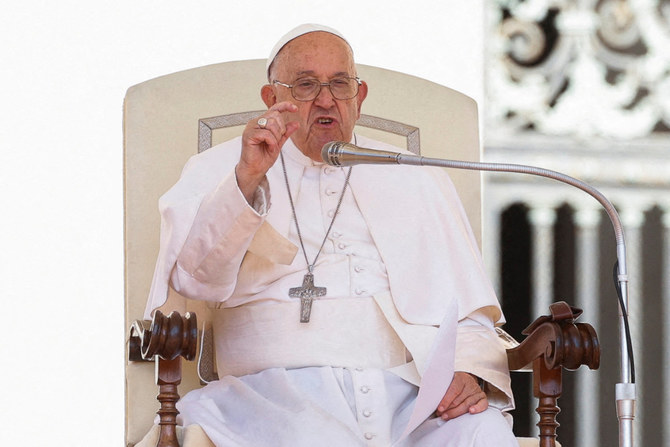

VATICAN CITY: Pope Francis will address G7 leaders on Friday on artificial intelligence, an unprecedented appearance that reflects the Vatican’s growing interest in the new technology, its risks and rewards.
The 87-year-old will become the first head of the Catholic Church to address a G7 summit when he speaks on the second day of the Puglia meeting, to an audience including US President Joe Biden and France’s Emmanuel Macron.
The aging head of a 2,000-year-old institution is not perhaps the most obvious candidate to make a presentation on cutting-edge technology, but the pontiff sees AI as a key challenge for humanity.
“The Church always looks to humans as the center of its mission,” said Paolo Benanti, a Franciscan university professor and member of the UN’s AI advisory body, who directly advises the pope.
“From this perspective it is clear that the AI that interests the Church is not the technical tool, but how the tool can impact on the life of man,” he told AFP.
AI was the theme of the Church’s World Day of Peace on January 1, for which the pontiff published a six-page document.
In it, he welcomed advances in science and technology that have reduced human suffering — and Benanti said AI could act as a “multiplier,” boosting everything from medical research to economic and social wellbeing.
But the pope also warned of risks including disinformation and interference in elections, and that unequal access could increase social and economic inequalities.
Francis — who has himself been the subject of several AI-generated images, including a viral imagine showing him wearing a huge white puffer coat and a large crucifix — called for a binding international treaty to regulate the development and use of AI.
The goal would be to prevent harm and share good practice.
Pope Francis has cautioned that AI offers new freedoms but also the risk of a “technological dictatorship.” (AP/File)
Since the launch of OpenAI’s ChatGPT chatbot, whose capabilities range from digesting complex text to writing poems and computer code, governments have been scrambling to respond to the rapid growth of AI.
The European Union — which attends G7 summits as an unofficial eighth member — earlier this year approved the world’s first comprehensive rules to govern AI.
At a global level, G7 leaders in Japan last year announced a working group on AI’s “responsible” use, tackling issues from copyright to disinformation.
Hosts Italy have made AI a key issue of this year’s summit, which will focus on a “human-centered approach,” particularly its potential impact on jobs, according to a government source.
Italian Prime Minister Giorgia Meloni said in April that the pope’s presence would “make a decisive contribution to defining a regulatory, ethical and cultural framework.”
The Vatican has brought in a range of experts to help its understanding, including Demis Hassabis, head of Google DeepMind, whom it named to its scientific academy in March.
In 2020, it also initiated the Call for AI Ethics, backed by tech firms Microsoft and IBM and later Cisco as well as numerous universities and the UN, designed to promote an ethical approach.

The pope’s address on Friday is likely to call for “attention to be paid to the most vulnerable,” said Eric Salobir, a French priest and head of the executive committee of the Human Technology Foundation.
It would be a call to G7 leaders to take “into account the risks and (draw up) regulation without being alarmist,” he told AFP.
Francis, who has championed the poorest and most marginalized people in society since taking office in 2013, has cautioned that AI offers new freedoms but also the risk of a “technological dictatorship.”
He warned about the dangers of using AI to make important decisions — from social security payments to where to aim autonomous weapons — for which responsibility becomes blurred.
“The pope seems to have a sort of antenna that allows him to perceive where humanity experiences the situations of greatest challenge to itself,” Benanti said.
Opinion
This section contains relevant reference points, placed in (Opinion field)
But will the G7 leaders listen to the pope?
Salobir, author of a book “God and Silicon Valley,” says that besides his influence as a spiritual leader, the pope has power as a neutral observer.
“The fact that there is no ‘Vatican Tech’ is an asset in terms of neutrality — the Church has no hidden agenda, no digital economy, no ‘start-up nation’ to launch, or investments to attract,” he said.
As a result, when the Vatican talks about AI, “it is for the technology itself, what it can do for humans,” he said.
“It may be one of the only states in this situation.”


