PARIS: French President Emmanuel Macron on Wednesday urged moderate politicians from the left and the right to regroup to defeat the far right in the upcoming national legislative elections he had called for after his party’s crushing defeat in the European parliamentary vote.
A somber-looking Macron addressed French voters for the first time since his stunning decision on Sunday to dissolve the National Assembly, France’s lower house of parliament.
His move triggered an early legislative election that will take place in two rounds on June 30 and July 7, three weeks after the far-right National Rally party of Marine Le Pen triumphed at the vote for the European Union Parliament.
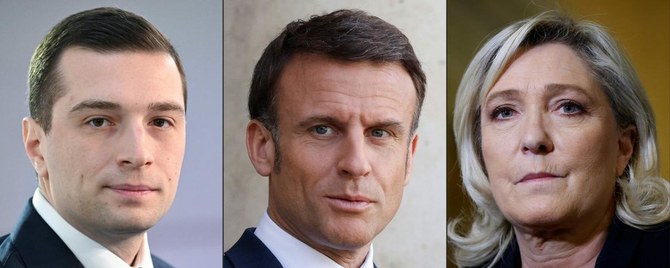
During a press conference on Wednesday, Macron said he decided on the risky move because he could not ignore the new political reality after his pro-European party was handed a chastening defeat and garnered less than half the support of the National Rally with its star leader, Jordan Bardella.
Unlike in his recent national addresses in which Macron focused on Russia’s war in Ukraine and ways Europe should forge a common defense policy, independent of the United States, and shore up trade protections against China, the French president stuck to his country’s internal issues favored by the surging right, including curbing immigration, fighting crime and Islamic separatism in France.
Macron, who has three years left of his second presidential term, hopes voters will band together to contain the far right in national elections in a way they didn’t in European ones. He called on “men and women of goodwill who were able to say ‘no’ to extremes on the left and the right to join together to be able to build a joint project” for the country.
“Things are simple today: we have unnatural alliances at both extremes, who quite agree on nothing except the jobs to be shared, and who will not be able to implement any program,” Macron said during a press conference in Paris.
While he seemed to project the kind of enthusiasm that helped bring him to the presidency in 2017, analysts say French voters are more pessimistic about their future, and see Macron as increasingly out of touch with real life and pocketbook problems.
Macron acknowledged some faults committed by his pro-business centrist party while harshly criticizing parties on the right for teaming up with Le Pen’s National Rally, which has a history of racism and xenophobia. He scathingly called an alliance formed by parties on the left as “unusual and incoherent” after they included the hard-left France Unbowed of Jean-Luc Mélenchon who, Macon said “justified anti-Semitic policies” in the wake of the Israel-Hamas war.
“We’re not perfect, we haven’t done everything right, but we have results... and above all, we know how to act,” Macron said of his Renaissance party, adding that the “far right (is) the main danger” in the upcoming election.
“The question is who will govern the country tomorrow?” he asked. “The far right and a few associates, or the democratic, progressive bloc? That’s the fundamental question.”
The decision to send to the polls voters who just expressed their discontent with Macron’s politics was a risky move that could result in the French far-right leading a government for the first time since World War II.
Potential alliances and France’s two-round voting system in national elections make the outcome of the vote highly uncertain. Macron was adamant in his faith in the French voters’ intent to refuse to choose the extremes of both sides of the political spectrum. He assured that he was not falling into defeatism and said he would serve out his second presidential term regardless of the outcome of the legislative vote.
“I think the French are intelligent, they see what’s being done, what’s coherent and what’s not, and they know what to do,” Macron said. He added: “I don’t believe at all that the worst can happen. You see, I’m an indefatigable optimist.”
He rebuffed accusations that his move to call snap elections would help the far-right take power in France.
“It’s about allowing political forces chosen by the French to be able to govern,” he said, He added that it’s “awkward to think it has to be the extreme right or political extremes. Or maybe you’ve got the spirit of defeat spread everywhere.”
“If that’s what people are afraid of, it’s time now to take action,” he said.
Opposition parties on the left and right have been scrambling to form alliances and field candidates in the early legislative balloting.
While sharp differences between parties remain on either side of the political spectrum, prominent figures calling for a united front appear to have one thing in common: They don’t want to cooperate with Macron.
Despite their divisions, left-wing parties agreed late Monday to form an alliance that includes the Greens, the Socialists, the Communists and the far-left France Unbowed.
National Rally leader Marine Le Pen is working to consolidate power on the right in efforts to translate the European triumph into a national win and come closer to claiming power. Her party is expected to win the most French seats in the European Parliament, potentially as many as 30 of France’s 81.


![]()

French President Macron urges moderate politicians to regroup to defeat the far right in elections
Short Url
https://arab.news/znfbg
French President Macron urges moderate politicians to regroup to defeat the far right in elections
- His move triggered an early legislative election that will take place in two rounds on June 30 and July 7
- Macron said he decided on the risky move because he could not ignore the new political reality after his pro-European party was handed a chastening defeat


Latest updates


Recommended


© 2026 SAUDI RESEARCH & PUBLISHING COMPANY, All Rights Reserved And subject to Terms of Use Agreement.