PARIS: President Emmanuel Macron on Monday said that he was confident French voters would make the “right choice” in snap elections he called after the far right crushed his centrist alliance in Sunday’s EU ballot.
His surprise move came after mainstream centrist parties kept an overall majority in the European Parliament in Sunday’s elections, but the far right notched up a string of high-profile victories in Italy, Austria and France.
In Germany, where the three governing coalition parties also performed dismally, center-left Chancellor Olaf Scholz’s spokesman ruled out a snap vote.
Analysts say Macron has taken the risky gamble of dissolving the national parliament in a bid to keep the far-right National Rally (RN) out of power when his second term ends in 2027.
“I am confident in the capacity of the French people to make the right choice for themselves and for future generations,” Macron wrote on X on Monday.
His announcement of elections for a new National Assembly on June 30, with a second round on July 7, has sparked widespread alarm, even from within the ranks of his party.
“By playing with fire, the head of state could end up by burning himself and dragging the entire country into the fire,” Le Monde wrote in an editorial.
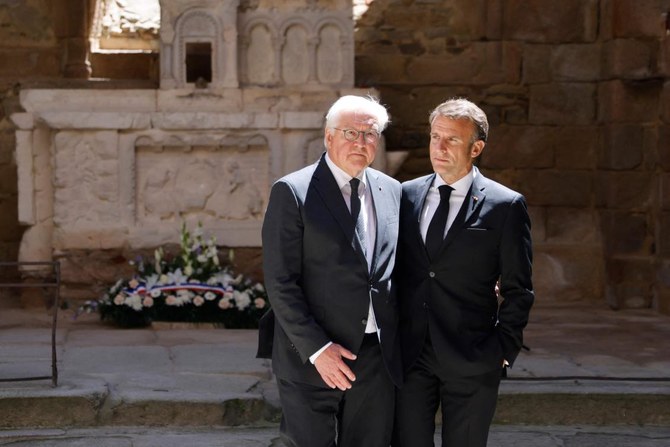
Despite the storm of criticism, Macron appeared unfazed on Monday as he visited the southwestern French village of Oradour-sur-Glane, site of a massacre by Nazi soldiers during World War II, together with German President Frank-Walter Steinmeier.
Steinmeier said: “Let us never forget the damage done in Europe by nationalism and hate.”
Back in Paris, even some Macron allies expressed dissent over his latest announcement.
Lower-house speaker Yael Braun-Pivet, a senior figure within Macron’s party, indicated that forming a coalition with other parties could have been a better “path.”
“The president believed that this path did not exist,” she told television channel France 2.
Meanwhile, Paris Mayor Anne Hidalgo, a Socialist, described the prospect of elections just weeks before the start of the Paris Olympics as “extremely unsettling.”
But International Olympic Committee chief Thomas Bach played down any direct impact on the event.
Uncertainty around the election also sapped market confidence, with Paris’s CAC 40 index closing 1.35 percent lower and the interest rate on French government debt gaining 10 basis points, to 3.22 percent.
In a televised address late on Sunday, Macron warned of the danger of “the rise of nationalists and demagogues” for France and its place in Europe.
He noted that, including the RN, far-right parties in France had managed to take almost 40 percent of the EU Parliament vote.
Macron is hoping to win back the majority he lost in France’s lower house in 2022 legislative elections after winning a second term.
But some fear the anti-immigration RN could instead win, forcing Macron to work in an uncomfortable coalition with a far-right prime minister.
RN vice president Sebastien Chenu said the party’s 28-year-old leader Jordan Bardella would be its contender for the post.
Bardella’s mentor Marine Le Pen, who was runner-up in the last two presidential elections, has remained party leader in parliament and is largely expected to tilt for the top job again in 2027.
The far right came out on top in France, Italy and Austria, and second in Germany and the Netherlands.
The Kremlin, which hopes the far right would take a softer line on Russia over its invasion of Ukraine, said it was “attentively observing” the gains.
The RN came in first with more than 31 percent of votes in France — its score was more than double that of Macron’s list with 14 percent.
The Socialists and hard-left France Unbowed trailed behind with 13 and nine percent each.
Finance Minister Bruno Le Maire warned that the election results would have “consequences of unprecedented seriousness for our nation.”
The team of Foreign Minister Stephane Sejourne, who is also secretary-general of Macron’s Renaissance party, told RTL radio he would be “fully engaged” in the battle for parliament seats as well as his job as minister.
Socialist party chief Olivier Faure called for setting up “a popular front against the far right.”
On the far right, Marion Marechal, deputy head of the Reconquest party founded by pundit Eric Zemmour and seen as even further to the right of the RN, was meeting Marine Le Pen — who is her aunt — and Bardella at the RN headquarters.
Bardella said he had also “stretched out his hand” to the mainstream conservative Republicans party and had spoken with senior members.
Mujtaba Rahman, managing director for Europe at Eurasia Group, said Macron appeared to believe he could defy the polls by confronting France with a choice between the pro-European status quo and a far right that has “a history of admiration for — and funding by — Vladimir Putin.”


![]()

Macron urges French to make ‘right choice’ in election gamble
Short Url
https://arab.news/cc4np
Macron urges French to make ‘right choice’ in election gamble
- Le Monde: ‘By playing with fire, the head of state could end up by burning himself and dragging the entire country into the fire’
- Macron appeared unfazed as he visited the southwestern French village of Oradour-sur-Glane, site of a massacre by Nazi soldiers during World War II, together with German President Frank-Walter Steinmeier


Latest updates




© 2026 SAUDI RESEARCH & PUBLISHING COMPANY, All Rights Reserved And subject to Terms of Use Agreement.