

UN chief says 37,000 West Bank Palestinians displaced in 2025; warns Gaza war threatens two-state solution

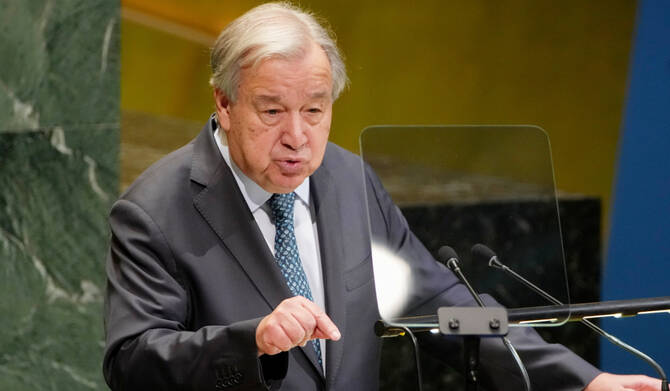
Secretary General Antonio Guterres addresses the 80th session of the United Nations General Assembly, Tuesday, Sept. 23, 2025, at UN headquarters. (AP file poto)
Short Url
Updated 04 February 2026
Follow

UN chief says 37,000 West Bank Palestinians displaced in 2025; warns Gaza war threatens two-state solution

  • ‘We enter 2026 with the clock ticking louder than ever. Will the year ahead bend towards peace or slip into the abyss of despair?” asks Secretary-General Antonio Guterres
  • Illegal settlement expansions, demolitions, displacements and evictions in the West Bank are accelerating, he says

NEW YORK CITY: More than 37,000 Palestinians were displaced in the occupied West Bank during 2025, a year in which there were also record-high levels of violence committed by Israeli settlers, UN secretary-General Antonio Guterres said on Tuesday.
The situation on the ground was rapidly eroding the prospects for a two-state solution, he warned.
“We enter 2026 with the clock ticking louder than ever,” Guterres told the opening session of the UN Committee on the Exercise of the Inalienable Rights of the Palestinian People. 
“Will the year ahead bend towards peace or slip into the abyss of despair?”
Illegal settlement expansions, demolitions, displacements and evictions in the West Bank were accelerating, said Guterres, who described the Israeli actions as destabilizing in nature and unlawful under international law.
“The recently published tender by Israel for 3,401 housing units in the E1 area (of the West Bank), alongside continued demolitions, is profoundly alarming,” he added.
“If carried forward, it would sever the northern and southern West Bank, undermine territorial contiguity, and strike a severe blow to the viability of a two-state solution.”
Turning to the situation in Gaza, Guterres said Palestinians there continued to endure “grave suffering.” More than 500 have been killed since the truce between Israel and Hamas in October, he noted.
“I urge all parties to implement the (ceasefire) agreement in full, exercise maximum restraint, and comply with international law and UN resolutions,” he said.
He called for the rapid and unimpeded delivery of humanitarian aid at scale, including through the Rafah border crossing between Gaza and Egypt, which Israel reopened on Monday.
Guterres criticized Israeli authorities for the continued suspension of international non-governmental organizations that provide aid, which he said “defies humanitarian principles, undermines fragile progress, and worsens the suffering of civilians.”
Regarding the future of Gaza, he said any sustainable solution must include governance of the territory and the West Bank, including East Jerusalem, by a unified and internationally recognized Palestinian government.
“Gaza is and must remain an integral part of a Palestinian state,” Guterres added.
He also reaffirmed his support for the UN Relief and Works Agency for Palestine Refugees, and condemned recent Israeli legislation and other actions he said impeded the ability of the agency to operate, including moves to demolish its Sheikh Jarrah compound in occupied East Jerusalem.
“Let me be clear: UNRWA premises are United Nations premises,” he said. “They are inviolable and immune from any form of interference.”
Guterres described public threats against UNRWA staff as “utterly abhorrent,” and said Israel was obliged under international law to respect the privileges and immunities of the UN.
He also reiterated that an end to Israeli occupation of Palestinian territory was essential.
“There is only one viable route (to peace): the two-state solution, in line with international law and relevant United Nations resolutions,” he said, as he called on the international community to act “with clarity, unity and determination” on the issue.


New Zealand mosque shooter seeks to discard his guilty pleas, saying prison made him irrational

Updated 2 sec ago
Follow

New Zealand mosque shooter seeks to discard his guilty pleas, saying prison made him irrational

WELLINGTON: The man who killed 51 Muslim worshipers at two mosques in New Zealand’s deadliest mass shooting told an appeals court Monday that he felt forced to admit to the crimes because of “irrationality” due to harsh prison conditions, as he sought to have his guilty pleas discarded.
A panel of three judges at the Court of Appeal in Wellington will hear five days of evidence about Brenton Tarrant’s claim that he was not fit to plead to the terrorism, murder and attempted murder charges he faced after the 2019 attack in the city of Christchurch. If his bid is successful, his case would return to court for a trial, which was averted in March 2020 when he admitted to the hate-fueled shooting.
He is also seeking to appeal his sentence of life without the chance of parole, which had never been imposed in New Zealand before. Tarrant’s evidence Monday about his mental state when he pleaded guilty was the first time he had spoken substantively in a public setting since he livestreamed the 2019 massacre on Facebook.
Shooter says he suffered “nervous exhaustion”
The Australian man, a self-declared white supremacist, migrated to New Zealand with a view to committing the massacre, which he planned in detail. He amassed a cache of semiautomatic weapons, took steps to avoid detection and wrote a lengthy manifesto before he drove from Dunedin to Christchurch in March 2019 and opened fire at two mosques.
Along with 51 people killed, the youngest a 3-year-old boy, dozens of others were severely wounded. The attack was considered one of New Zealand’s darkest days and institutions have sought to curb the spread of Tarrant’s message through legal orders and a ban on possession of his manifesto or video of the attack.
Monday’s hearing took place under tight security constraints that severely limited who could view Tarrant’s evidence, which included some reporters and those hurt or bereaved in the massacre. Tarrant, who wore a white button-down shirt and black-rimmed glasses and had a shaved head, spoke on video from a white-walled room at Auckland Prison.
Answering questions from a Crown lawyer and from lawyers representing him, Tarrant, 35, said his mental health had deteriorated due to conditions in prison, where he was held in solitary confinement with limited reading material or contact with other prisoners.
By the time he pleaded guilty, Tarrant said he was suffering from “nervous exhaustion” and uncertainty about his identity and beliefs. He had admitted to the crimes a few months before his trial was due to begin because there was “little else I could do,” he told the court.
Crown lawyers say no evidence of serious mental illness
Crown lawyer Barnaby Hawes suggested to Tarrant during questioning that the Australian man had other options. He could have requested a delay in his trial date on mental health grounds or could have proceeded to trial and defended himself, Hawes said.
Hawes also put to Tarrant that there was little evidence in the documentation of his behavior by mental health experts and prison staff that he was in any kind of serious mental crisis. Tarrant suggested that signs of mental illness he displayed hadn’t been recorded and that at times he had sought to mask them.
“I was definitely doing everything possible to come across as confident, assured, mentally well,” he told the court. Tarrant’s behavior “reflected the political movement I’m a part of,” he added. “So I always wanted to put on the best front possible.”
He agreed that he had had access to legal advice throughout the court process. Tarrant’s current lawyers have been granted name suppression because they feared representing him would make them unsafe.
The appeal outcome is due later
Bids to appeal convictions or sentences in New Zealand must be made within 20 working days. Tarrant was about two years late in seeking an appeal, filing documents with the court in September 2022.
He told the court Monday that his bid had been late because he hadn’t had access to the information required to make it.
The hearing is due to run for the rest of the week but the judges are expected to release their decision at a later date. If they reject Tarrant’s attempt to have his guilty pleas discarded, a later hearing will focus on his bid to appeal his sentence.