Rare elephant twins born in dramatic birth in Thailand

1 / 3
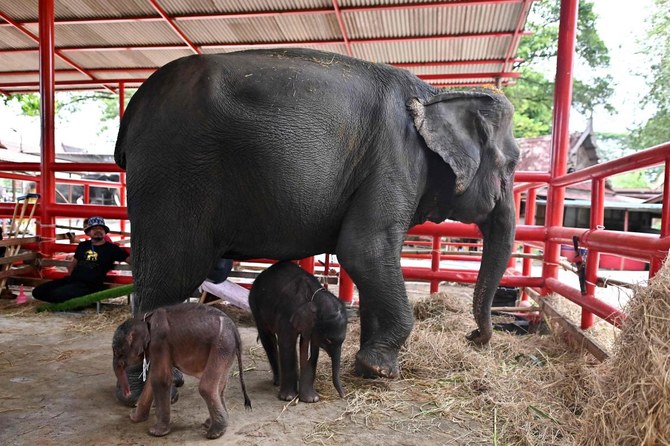
Newborn elephant twins, a female (L) and a male (C), stand next to their mother Jamjuree at the Ayutthaya Elephant Palace and Royal Kraal in Ayutthaya on June 10, 2024. (AFP)
2 / 3
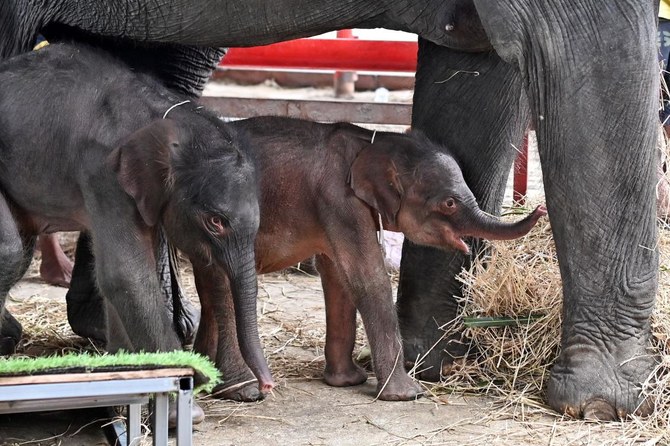
Newborn elephant twins, a female (R) and a male (L), stand next to their mother Jamjuree at the Ayutthaya Elephant Palace and Royal Kraal in Ayutthaya on June 10, 2024. (AFP)
3 / 3
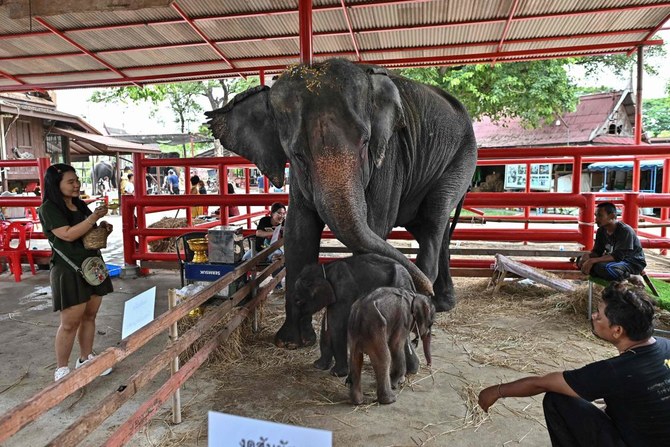
Newborn elephant twins, a female (R) and a male (C), stand in front of their mother Jamjuree at the Ayutthaya Elephant Palace and Royal Kraal in Ayutthaya on June 10, 2024. (AFP)
Short Url
Updated 11 June 2024
Follow

Rare elephant twins born in dramatic birth in Thailand

AYUTTHAYA: An elephant in Thailand has delivered a rare set of twins in a dramatic birth that left a carer injured after he tried to rescue one of the newborns.
The 36-year-old Asian elephant named Jamjuree gave birth to an 80-kilogramme (176-pound) male at the Ayutthaya Elephant Palace and Royal Kraal north of Bangkok on Friday night.
But when a second, 60-kilogramme female calf emerged 18 minutes later, the mother went into a frenzy and attacked her new arrival.
“We heard somebody shout ‘there is another baby being born!’” said veterinarian Lardthongtare Meepan.
An elephant keeper, also known as a mahout, moved in to prevent the mother from attacking her newborn, and took a blow to his ankle in return.
“The mother attacked the baby because she had never had twins before — it’s very rare,” said Michelle Reedy, the director of the Elephant Stay organization, which allows visiting tourists to ride, feed and bathe elephants at the Royal Kraal center.
“The mahouts who are the carers of the elephants jumped in there trying to get the baby away so that she didn’t kill it,” Reedy told AFP.
Jamjuree has now accepted her calves, who are so small that a special platform has been built to help them reach up to suckle.
They are also being given supplemental pumped milk by syringe, said Lardthongtare.
Twin elephants are rare, forming around only one percent of births, according to research organization Save the Elephants, and male-female twin births are even more unusual.
Mothers often do not have enough milk for both calves and the pair might not have survived in the wild, said Reedy.
“Whether the rest of the herd may have intervened — they may have, but the baby may have been trampled in the process,” she said.
Reedy said many of the 80 elephants at the center were rescued from street begging, a practice that became increasingly common after a logging ban in 1989 that left mahouts working in the industry with their elephants seeking alternative income.
The practice, which was outlawed in 2010, involved the animals performing tricks like playing with footballs or carrying baskets of fruit.
Some elephants at Royal Kraal carry tourists to the nearby ruins and temples of Ayutthaya, the historic former capital of Siam.
Many conservation groups oppose elephant riding, arguing it is stressful for the animals and often involves abusive training.
The center argues the rides allow the animals to socialize and exercise, and promote conservation of the species, which is endangered in Southeast Asia and China.
Only about 8,000-11,000 Asian elephants remain in the wild, according to the WWF.
The animals were once widespread, but deforestation, human encroachment and poaching have decimated their numbers.
The twin calves, whose father is a 29-year-old elephant named Siam, will be named seven days after their birth, in accordance with Thai custom.


Thai officials say 72 tigers at tourist parks died of canine distemper, allaying bird flu fears

Updated 24 February 2026
Follow

Thai officials say 72 tigers at tourist parks died of canine distemper, allaying bird flu fears

  • “There has not been an animal-to-human infection case,” Promphat said
  • “If we detect any sick persons, we will prepare for a nationwide monitoring measure,” said Khanasawat

BANGKOK: The deaths of 72 tigers in two animal parks for tourists in northern Thailand shouldn’t be a major concern for the public, officials said Tuesday, because they were caused by a virus not known to affect humans, rather than bird flu.
No one has shown any symptoms so far, but authorities were nonetheless monitoring the health of people who had recently come into contact with the animals.
“There has not been an animal-to-human infection case,” Public Health Minister Pattana Promphat said at a news conference at Government House in Bangkok.
The tigers in the parks in Mae Taeng and Mae Rim districts in Chiang Mai province became sick and died during a roughly 10-day period between Feb. 8-18.
On Friday, the Chiang Mai regional livestock office announced in a statement that autopsies of the animals found genetic material of canine distemper virus, or CDV, and traces of bacterial infection, but no avian influenza type A virus, also known as bird flu.
“If we detect any sick persons, we will prepare for a nationwide monitoring measure,” said Monthien Khanasawat, director-general of the Public Health Ministry’s Disease Control Department. “This will include contact tracing and treatment as necessary.”
Monthien spoke at the news conference in an apparent effort to reassure the public that the tigers’ deaths didn’t come from bird flu, which has been resurgent in parts of Asia. Thailand saw 17 deaths among 25 infected patients from poultry-caused influenza from 2004 to 2007, according to the Public Health Ministry.
CDV, infectious for both dogs and felines, can cause stronger symptoms in cats and tigers and can be spread through bodily fluids and air. Thai authorities said that tigers in confined environments, and which are already affected by stress and inbreeding conditions, could be particularly vulnerable to the viral infection.
The remains of the tigers went through necropsies before being cremated and buried. The carcasses were properly disinfected, photographed and discarded to prevent any further use, Livestock Development Department Director-General Somchuan Rattanamangklanan said at the news conference.
But Visit Arsaithamkul, a veterinarian who took part in the tiger necropsies, expressed concern that the origins of the infections remained unclear without further investigation. In a Facebook post, he said that he suspected that as the two parks were located just 30 kilometers (18 miles) apart, the cause of infection could be food the tigers were fed that came from the same source.
He declined to elaborate when contacted by The Associated Press. Both parks, run under the name of Tiger Kingdom, remain closed. The operators didn’t immediately respond when asked for comment.
Thai authorities are still alert for the threat of a bird flu outbreak. Monthien, the Public Health Ministry director, urged Thais to be careful with their consumption of poultry after a man in a neighboring country that he didn’t name was found infected with bird flu.
The first animal-to-human transmission of bird flu was discovered in Hong Kong in 1997 before a pandemic started spreading in Asia in 2003. In Thailand, tens of millions of poultry were exterminated and consumption plunged in fear of getting infected.