

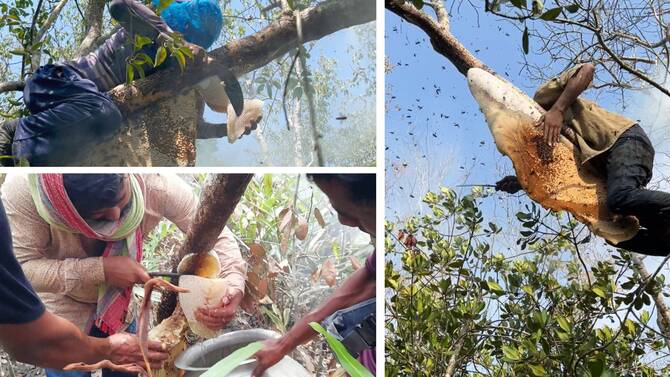
In Bangladesh’s mangrove forest, villagers brave tigers to collect rare honey

‘Mawalis’ collect honey from a honeycomb hanging in a mangrove forest of the Sundarbans near Khulna, Bangladesh, April 2025. (Lutfar Rahman)
Short Url
Updated 29 December 2025
Follow

In Bangladesh’s mangrove forest, villagers brave tigers to collect rare honey

  • Honey is gathered from wild bee colonies deep in the Sundarbans
  • Producers made a debut at the biggest food fair in Jeddah this month

DHAKA: When the harvest begins, Mizanur Rahman gathers a few hundred men and sets out into the mangrove forest along the Bay of Bengal, where for months they climb trees to collect by hand a wild natural honey whose unique properties are only starting to attract global attention.

The honey is collected from wild bee colonies deep within the Sundarbans, the world’s largest mangrove reserve spanning parts of India and southwestern Bangladesh.

“Honey collection from this forest is mostly done in the Bangladesh part,” Rahman said. “All plants, trees, and the overall environment of this forest are natural. There is no human touch.”

Sundarban honey comes from an ecosystem where trees grow and bloom naturally, without the use of fertilizers or pesticides. Its collectors, known as mawalis, begin work in March for about three and a half months.

Rahman estimates there are about 4,000 mawalis in the local community. To enter the forest, they require special passes from the forest department.

“It’s a very risky job for the people who enter the forest,” he told Arab News. “It’s the only honey in the world where collectors risk their lives in the den of the mighty Bengal tiger to gather it. Sometimes, they also face the danger of poisonous snake bites.”

During the season, his team reaches up to 1,200 members who together manage to collect about 400 tons of honey.

“One hundred small boats start sailing together, each carrying eight to 10 people,” Rahman said. “Despite the dangers, it is a matter of pride to be part of these challenging tasks.”

Collected from a humid environment, Sundarban honey is thinner than other types. Its greenish-amber shade comes from the nectar of mangrove flowers, and the taste is less sweet than most commercial honeys, with a subtle citrus-like tanginess. The scent is mild.

Being raw and unprocessed, the honey retains more enzymes, antioxidants, and pollen.

“Some people can feel acidity similar to orange juice,” Rahman said. “It has a unique taste. If someone tastes this honey once, she or he will definitely love to taste it again and again.”

Well known locally in Bangladesh and parts of eastern India, where it has been harvested and consumed for generations, Sundarban honey is only starting to gain attention in organic and specialty food markets.

Earlier this month, it debuted at AgroFood Jeddah, Saudi Arabia’s leading international exhibition for the agriculture, food, and agritech industries.

The organic honey from the Sundarbans received an encouraging reception, according to Mohammed Saleh Uddin Bhuyan, chief category officer at Ghorer Bazar, one of the companies participating in the expo.

“We have been receiving good responses from the local buyers,” he said. “Saudi Arabia is a very promising market for us.”

Bangladeshi authorities recognize the honey’s export potential but also the fact that production still needs to be standardized to enter global markets.

Mahmudul Hasan, director of Bangladesh’s Export Promotion Bureau, told Arab News that there are plans to promote the organic practices behind the honey during future food fairs in the Gulf region.

“There is huge export potential for our mangrove honey in the Gulf countries, as Arab consumers are fond of honey. They just need to be assured of the quality in the production process,” he said.

“Our mangrove honey is undoubtedly an organic product. It has unique value, but the world is not very aware of it yet.”


Cuba says attacking speedboat had nearly 13,000 rounds of ammunition

Updated 9 sec ago
Follow

Cuba says attacking speedboat had nearly 13,000 rounds of ammunition

  • Firefight took place at a range of 20 meters, Cuba says
  • Incoming crew originally ‌set out on two vessels but ditched one
HAVANA: A commando of Cuban exiles who intended to infiltrate Cuba on a speedboat was armed with nearly 13,000 rounds of ammunition, 13 rifles and 11 pistols, Cuban officials said on Friday, providing new details about Wednesday’s deadly exchange of gunfire at sea. The government in Havana has said 10 Cuban nationals coming from the United States entered Cuban waters and opened fire on a border guard vessel, leading Cuban forces to return fire killing four and wounding six others, who were taken into custody.
In an attempt to dispel doubts about its account to date, senior Cuban Interior Ministry officers displayed the captured armaments from the studio on a special television program, including bins full of at least some of the 12,846 recovered rounds. They also showed pictures of the vessels, each peppered with bullet holes from ‌the firefight they ‌said took place at a range of 20 meters (66 feet).
The confrontation took place ‌at ⁠a fraught moment ⁠in US-Cuban relations, with US President Donald Trump pressuring the island by imposing a virtual oil blockade after capturing and ousting Venezuelan President Nicolas Maduro, a crucial Cuban ally, on January 3.
Cuba has identified the assailants as Cuban exiles, some of whom had been previously placed on a list of accused terrorists, who came from the United States with the intent to sow chaos and attack military units on the Communist-ruled island.
“The intent of this group is to infiltrate, to promote public disorder. To incite the people to unite. To carry out something violent. Attack military units ⁠in order to incite social unrest and to unite the people in order to ‌steal the revolution. That has been duly proven,” said Col. Victor Alvarez ‌of the Interior Ministry.
Cuba says response ‘proportional’
US politicians have expressed skepticism over Cuba’s version of events. Secretary of State Marco ‌Rubio on Wednesday said his government would independently investigate, adding that it was not a US operation and ‌that no US government personnel were involved.
Cuban officers said the infiltrators set out from Marathon in the Florida Keys on two vessels but ditched one at some point due to technical difficulties. They united on one speedboat, which a US official said was reported stolen in Florida. Cuba said it recovered a drone, radios, knives, a portable power plant, bolt cutters and ‌other materiel. They also found emblems of the November 30th Movement and People’s Self-Defense, anti-communist groups that oppose the Cuban government.
Cuba says a patrol of five ⁠border guard members on ⁠a 9-meter boat spotted the incoming vessel shortly after 7 a.m., with some members of the incoming crew in the water, about one nautical mile off a cay on the Caribbean island’s northern coast, about 100 miles (160 km) from Marathon.
The infiltrators opened fire at a distance of 185 meters, striking the captain of the Cuban vessel in the abdomen, Cuba said. Bleeding heavily, the wounded captain remained at the helm and steered toward the enemy vessel, leading to a firefight at a distance of about 20 meters, the officers said.
Cuba called its response “proportional.”
“It is a defensive model that practically never uses firearms, and the use of firearms is proportional to the type of action being carried out against our force,” said Interior Ministry Col. Ybey Carballo.
The captured Cuban nationals were receiving medical care and face charges including armed aggression, illegal entry into national territory, crimes associated with terrorist acts, and arms trafficking, prosecutor Edward Robert Campbell told the program. He said they face prison terms of up to 10 to 15 years for the lesser offenses and 20 to 30 years — or even the death penalty — for the more serious charges.