

Saudi project clears 1,254 Houthi mines in Yemen

1 / 2
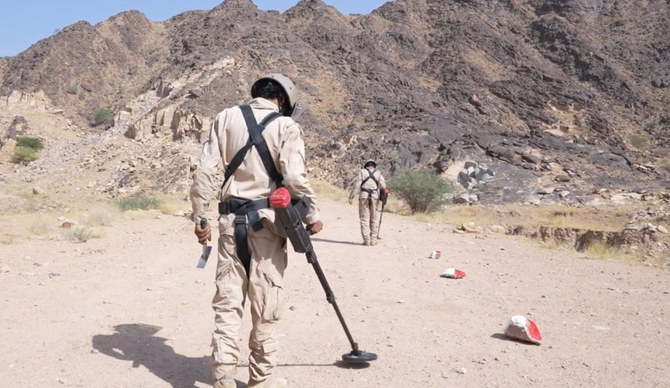
Saudi Arabia’s Project Masam cleared 1,254 mines in Yemen — which had been planted by the Houthi militia — between June 1 to 7. (SPA)
2 / 2
Saudi Arabia’s Project Masam cleared 1,254 mines in Yemen — which had been planted by the Houthi militia — between June 1 to 7. (SPA)
Short Url
Updated 09 June 2024
Follow

Saudi project clears 1,254 Houthi mines in Yemen

  • Masam teams are tasked with clearing villages, roads and schools to facilitate the safe movement of civilians and the delivery of humanitarian aid

RIYADH: Saudi Arabia’s Project Masam cleared 1,254 mines in Yemen — which had been planted by the Houthi militia — between June 1 to 7, according to a recent report.

Overseen by the Kingdom’s aid agency KSrelief, the project’s specialist teams destroyed 1,232 pieces of unexploded ordnance, 18 anti-tank mines, three improvised explosive devices, and one anti-personnel mine.

The explosives, which were planted indiscriminately by the Houthis across Yemen, posed a threat to civilians, including children, women and the elderly.

The demining operations took place in Marib, Aden, Jouf, Shabwa, Taiz, Hodeidah, Lahij, Sanaa, Al-Bayda, Al-Dhale and Saada.

A total of 446,112 mines have been cleared since the start of the initiative in 2018, according to Ousama Al-Gosaibi, the project’s managing director.

The initiative trains local demining engineers and provides them with modern equipment. It also offers support to Yemenis injured by the devices.

About 5 million people have been forced to flee their homes since the beginning of the conflict in Yemen, many of them displaced by the presence of land mines, according to the Project Masam website.

Masam teams are tasked with clearing villages, roads and schools to facilitate the safe movement of civilians and the delivery of humanitarian aid.


‘Masterpieces of Saudi Orchestra’ shine at Maraya in AlUla

The “Masterpieces of Saudi Orchestra” concert opened at Maraya Concert Hall in AlUla on Thursday. (Supplied)
Updated 23 January 2026
Follow

‘Masterpieces of Saudi Orchestra’ shine at Maraya in AlUla

  • The concert on its opening night presented a seamless artistic journey, where orchestral works met Saudi musical identity
  • It underlined the Music Commission’s aim to present Saudi artistry at a high professional level

RIYADH: The “Masterpieces of Saudi Orchestra” concert opened at Maraya Concert Hall in AlUla on Thursday under the patronage of the Kingdom’s Minister of Culture and Chairman of the board of the Music Commission Prince Bader bin Abdullah.

Organized by the Music Commission, the concert on its opening night presented a seamless artistic journey, where orchestral works met Saudi musical identity.

The Saudi National Orchestra and Choir, conducted by Maestro Hani Farhat, led audiences through carefully curated pieces reflecting heritage and modern creativity.

The repertoire combined traditional influences with orchestral scoring, offering listeners heritage-based compositions alongside recent arrangements.

Regional rhythms and layered musical textures were used to echo the Kingdom’s history, while pieces rooted in Saudi classical music tradition connected audiences with familiar cultural references in a fresh format.

The concert underlined the Music Commission’s aim to present Saudi artistry at a high professional level.

The series seeks to honor national heritage while encouraging contemporary artistic engagement, and its growing local and international presence was highlighted throughout the evening.

The program also featured a visual dimension led by the Theater and Performing Arts Commission, which staged live performances of Saudi folk arts. 

Audiences saw presentations of Samri, Dahha, Rafeihi, Yanbawi, Zair and Khabeeti, synchronized with the orchestra to create one integrated artistic experience.

These folk elements were arranged to complement the orchestral sound, reinforcing the richness and variety of Saudi cultural identity. The combination of music and movement aimed to show how traditional forms can engage with large-scale concert settings while retaining their historical character and community roots.

This performance is an extension of the series of successes achieved by the Saudi Orchestra’s masterpieces both locally and internationally, and reaffirms the Music Commission’s commitment to showcasing Saudi music in its finest form.