

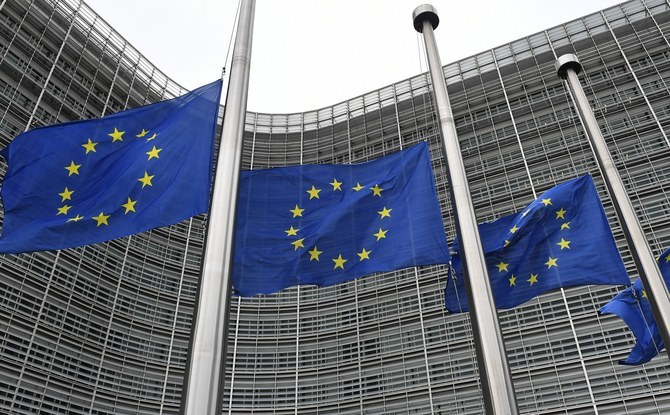
EU executive says Ukraine, Moldova ready to start EU accession talks

Ukraine and Moldova meet all the criteria needed to formally start negotiations on EU membership, the European Commission said on Friday, as Ukrainian Prime Minister Denys Shmyhal expressed hope that the talks could start later this month. AFP/File
Short Url
Updated 07 June 2024
Follow

EU executive says Ukraine, Moldova ready to start EU accession talks

  • Opening talks with the European Union would be a morale boost for Ukraine as the war with Russia enters its third year
  • The Commission assessment will now be discussed by experts in working groups

BRUSSELS/KYIV: Ukraine and Moldova meet all the criteria needed to formally start negotiations on EU membership, the European Commission said on Friday, as Ukrainian Prime Minister Denys Shmyhal expressed hope that the talks could start later this month.
“We confirm that on the Commission side we consider that all the steps have been met by the two countries,” Commission spokeswoman on enlargement Ana Pisonero said.
“The decision is now in the hands of the member states — it is for them to adopt the negotiating framework,” she said. “Once this step is done it is the prerogative of the EU Presidency to convene an intergovernmental conference to formally mark the start of the negotiations,” she added.
Opening talks with the European Union would be a morale boost for Ukraine as the war with Russia enters its third year and Moscow’s forces are advancing in the eastern Donetsk region and opening a new front in the northeastern Kharkiv region.
“Now we expect our European partners to take the next step — to start negotiations on European Union membership already this month,” Shmyhal said on the Telegram messaging app.
“Every day, the Ukrainian people fight for the right to be part of the European family in the war against the Russian aggressor.”
The Commission assessment will now be discussed by experts in working groups and then by ambassadors of EU governments next week. The 27 EU member states have to unanimously agree to start the negotiations, which take years to conclude, by adopting the so-called negotiating framework.

HUNGARY SCEPTICAL
Belgium, which holds the rotating EU presidency until the end of June, is making arrangements for intergovernmental conferences with Ukraine and Moldova to be held on June 25 in Luxembourg if there is unanimous backing.
But such backing is not guaranteed because Hungary, which maintains warm ties with Russia and has criticized Ukraine’s membership bid, has doubts about the Commission’s assessment that Ukraine is ready and wants to see some more items added to the negotiating frameworks, diplomats said.
Belgium and the Commission are keen to get agreement in June, before Hungary takes over the rotating presidency from July 1 for six months, because EU diplomats expect Budapest will put the whole process on ice until 2025.
Kyiv applied for EU membership in the weeks after Russia launched its full-scale invasion in February 2022 and it was granted candidate status four months later.
Despite the impact of the war, which has devastated the economy and forced millions to abandon their homes in frontline cities, towns and villages, the Ukrainian government has been implementing sweeping reforms recommended by the EU.
The changes have ranged from anti-corruption measures to regulations for public administration and food safety.


Millions of Indian girls out of school as efforts to keep them enrolled falter

Updated 7 sec ago
Follow

Millions of Indian girls out of school as efforts to keep them enrolled falter

  • Government data shows 6.57 million Indian children dropped out from school between 2019 and 2025
  • For girls, main reasons are child marriage, family migration and inadequate infrastructure, experts say

NEW DELHI: Priyanka Sau was sure that after completing secondary school she would enroll in a computer course in her hometown in Uttar Pradesh.

But neither the course nor her graduation could materialize as two years ago her father lost his job at a brick kiln and the family moved to Delhi in search of work. The 15-year-old now works as a cleaner in a housing complex, supplementing her parents’ income and helping support her three younger sisters.

Her marriage arrangement has been finalized, too.

“Very soon it will be formalized,” she told Arab News.

“For me, there was no option but to follow my parents to Delhi and start earning to make a living ... I miss my school and dream to enroll in a computer course to get modern skills.”

Priyanka is one of the 6.57 million Indian children who dropped out from school between 2019 and 2025, according to data presented in parliament in December by Women and Child Development Minister Savitri Thakur.

Nearly 3 million of the whole dropout group were adolescent girls, with the highest rates recorded in the most populous states. In Uttar Pradesh, girls accounted for more than half of nearly 100,000 school dropouts in the 2025–26 academic year alone.

Dr. Kriti Bharati, founder of Saarthi Trust, which works for child rights and rescues victims of child marriage, said the government data was “alarming” and required immediate intervention.

“The education department should go deep into it. They should find out where these thousands of girls who dropped out have gone ... The schoolteachers, when they come to know that some girls or kids have dropped, they should find out why they are dropping out. This is their social responsibility,” she said.

“A developed society is called developed not because it has better roads or it can send missions to the moon. It has to ensure education for its people, it has to ensure proper care for its poor citizens.”

The government data showed that social protection systems were failing to adapt to local realities, as dropout rates rise due to pressures such as domestic responsibilities, work, early marriage and poverty.

According to Dr. Bharati, the main reasons forcing girls to leave school were child marriage and labor migration, which has increased since the COVID pandemic.

“Poor people move from one place to another. After COVID, many things have changed as far as jobs are concerned. People are moving for jobs outside their villages,” she said.

“The third reason is child labor — these girls become a source of income for their family. They supplement the income.”

For Dr. Purujit Praharaj, director of India Child Protection, the main reasons enabling the increase in dropout rates, especially among girls, were systemic: inadequate infrastructure and legal guarantees.

The Right to Education Act makes free and compulsory education a fundamental right only for children aged 6 to 14, while access-wise, secondary schools in rural areas are often far, especially in India’s poorer, eastern states.

“All girls below 18 should be given free and compulsory education and proper infrastructure. If the schools are not located nearby, then hostel facilities should be provided,” Dr. Praharaj said.

“There is a safety issue and concern among the parents to send their girls to a different location to school ... Residential schools need to be built for these girls so that they can go there. If you can ensure continuous education for them, girls will not get married before 18.”