CHISINAU: Moldova launched a nationwide discussion on securing European Union membership, with senior officials and academics urging their compatriots to seize every opportunity to join the bloc or run the risk of being left behind or sinking into chaos.
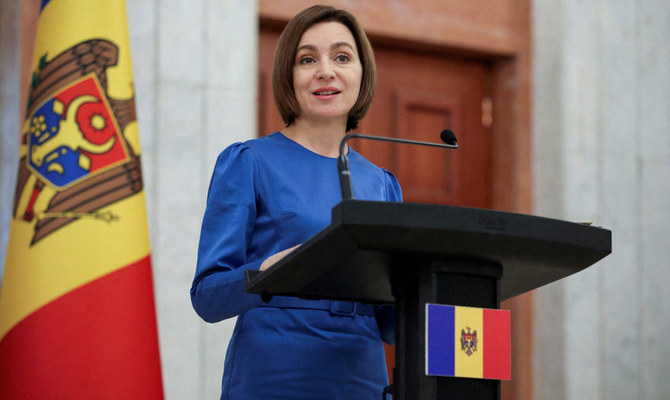
Ex-Soviet Moldova, led by pro-European President Maia Sandu and one of the continent’s poorest countries, won formal recognition from the EU in June as a candidate for the arduous process of joining the 27-nation bloc.
Buffeted by Moscow’s 19-month-old invasion of adjacent Ukraine, which has been regularly denounced by Sandu, Moldova is further beset by the presence on its eastern border of the pro-Russian separatist enclave of Transdniestria.
Foreign Minister Nicu Popescu launched the discussion on EU membership on Friday, saying that public participation “has a critical meaning in building a more prosperous future within the framework of the community of Europe.”
Academics quickly lent their support.
“If Moldova loses this European vector, it will turn into a chaotic country,” Vlad Culminschi, director of the Institute of Strategic Initiatives, told the news site point.md on Saturday.
Culminschi, a former deputy prime minister, said there was no time to lose as Sandu’s allies control parliament for now.
“Striving for European integration is not the work of one person. It transcends personal ambitions,” he said.
The Moscow-sympathetic opposition, thrown out of power by Sandu’s landslide 2020 election victory, is skeptical about EU membership.
Moldovans, their country wedged between Ukraine and EU member Romania, have proved enthusiastic. Tens of thousands attended an open-air rally in May to applaud Sandu’s drive, which will involve long negotiations on bringing legislation in line with EU standards and overhauling the justice system.
Sandu and other officials have suggested that Moldova should forge ahead with its EU membership bid and ignore separatist Transdniestria, much like Cyprus was allowed to join despite the Turkish occupation of its northern regions since the 1970s.
Transdniestria broke away from Moldova as the Soviet Union was collapsing, and its separatist forces fought a brief war with the newly independent country’s army in 1992.
A 1,500-strong contingent of Russian peacemakers remains in the region, but for 30 years there has been virtually no violence, and business and other links thrive across the border.
“This would not mean abandoning Transdniestria. It could occur in several steps,” Sandu said in televised comments this week. “We cannot remain in this situation for another 30 years, with no consolidated democracy and no high standard of living.”


![]()

Officials urge Moldova to seize opportunity for EU membership
Short Url
https://arab.news/mj8jf
Officials urge Moldova to seize opportunity for EU membership
- A 1,500-strong contingent of Russian peacemakers remains in the region, but for 30 years there has been virtually no violence, and business and other links thrive across the border


Latest updates




Recommended


© 2026 SAUDI RESEARCH & PUBLISHING COMPANY, All Rights Reserved And subject to Terms of Use Agreement.