

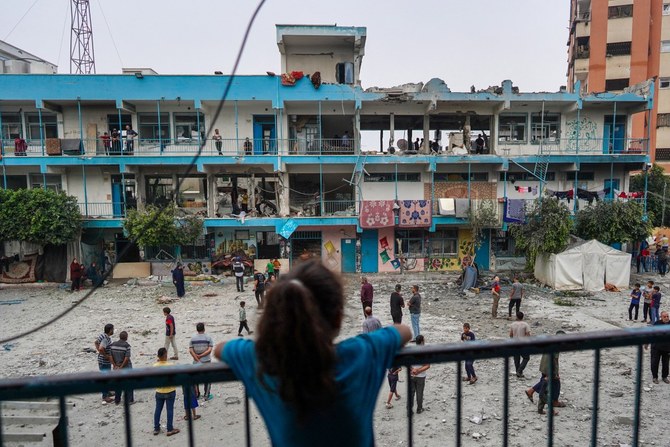
US-made bomb used in UN-run school strike in Gaza, investigation reveals

Philippe Lazzarini, the director of UNRWA, wrote on social media that around 6,000 Palestinians had been sheltering in the school complex. (AFP/File)
Short Url
Updated 07 June 2024
Follow

US-made bomb used in UN-run school strike in Gaza, investigation reveals

  • GBU-39 explosive deployed in attack is made by Boeing
  • The incident killed at least 45 people, mostly women and children

LONDON: A bomb used by the Israeli military to strike a UN-run school in Gaza, killing at least 45 people including women and children, was made in the US, a new investigation has revealed.

A video reviewed by the New York Times and corroborated by weapons experts showed that the remnants of the device dropped on the school in Nuseirat, central Gaza, was a GBU-39 — a bomb designed and manufactured by aviation and defense giant Boeing.

“This distinct nose is unique to the GBU-39 munition series, and, due to its solid construction, it can survive the blast intact,” Trevor Ball, a former US Army explosive ordnance disposal technician, said, adding that the damage caused to the building is evidence of the use of this type of precision-guided weapon.

A similar analysis by CNN appeared to confirm these findings.

The Israeli military confirmed it carried out Thursday’s airstrike, stating it targeted a Hamas compound operating inside the school. It added that “many measures were taken to minimize the danger of harming uninvolved individuals,” including aerial surveillance and “additional precise intelligence.”

Philippe Lazzarini, the director of UNRWA, wrote on social media that around 6,000 Palestinians had been sheltering in the school complex.

The school was also attacked in mid-May, during which the Israeli military claimed to have killed 15 Hamas militants.

Footage uploaded to Instagram and Telegram on Thursday shortly after the strike shows the nose tip of the GBU-39, along with objects such as cans of food and clothes covered in rubble near the site of the strike, suggesting the damage was recent.

In one of the videos, a man can be seen recovering body parts from the scene, holding up a severed finger to the camera.

This incident marks the second time in two weeks that separate investigations have confirmed the use of US-manufactured munitions in deadly Israeli attacks on displaced Palestinians.

In May, US-made weaponry appeared to have been used in a strike on a displacement camp in Gaza, during which at least 45 people died and more than 200 were injured after a fire broke out.

According to the New York Times, US officials have been encouraging the Israeli military for months to use GBU-39s, a lighter and more precise alternative to the heavier and more lethal 2,000-pound bombs previously used in the campaign.

“While they’re using smaller bombs, they’re still deliberately targeting where they know there are civilians,” Bryant added.

“The only thing they’ve done in going down from 2,000-pound bombs to 250-pound bombs is killing a few less civilians.”


Semafor targets Gulf expansion after first profitable year

Updated 09 January 2026
Follow

Semafor targets Gulf expansion after first profitable year

  • Digital news brand generates $2m in earnings on $40m of revenue in 2025, and raises $30m in new financing
  • Platform aims to be the ‘business and financial news brand of record for the Gulf,’ CEO says, and to ‘blanket the world’ within 2 years

DUBAI: Digital news platform Semafor generated $2 million in earnings in 2025 before interest, taxes, depreciation and amortization, on revenue of $40 million, marking its first year of profitability.

It also closed $30 million in new financing, which it plans to use to grow its editorial operations and live events business.

These achievements are particularly notable at a time when the global news industry is facing declining revenues and the erosion of audience trust, the company said.

Justin B. Smith, the company’s co-founder and CEO, told Arab News that Semafor’s model and approach is distinguished by several factors, which can be encapsulated by its vision of building a news product to “serve consumers that are increasingly not trusting news, but also designed with a business model that could deliver sustainable economic advantage.”

Following its first profitable year and armed with new funding, Semafor, founded in 2022, now plans an accelerated phase of global expansion with a focus on scaling editorial output and global convenings.

The company said it will broaden its publication schedule in the year ahead. Semafor Gulf and Semafor Business will become daily publications as the platform increases the frequency of its “first-read” services, which are daily briefings designed to showcase “front page” news and intended to serve as the “first read” for audiences, Smith said.

The Gulf edition of Semafor launched in September 2024, with former Dow Jones reporter Mohammed Sergie as editor. In 2025 Matthew Martin was appointed its Saudi Arabia bureau chief.

Semafor’s brand slogan is “intelligence for the new world economy” and “the Gulf is the epicenter of the new world economy,” Smith said. Currently, its Gulf operation employs eight journalists, based in the UAE and Saudi Arabia, and as it moves to a daily publishing schedule it plans to significantly bolster its editorial team, both in existing markets and new ones, such as Qatar.

Semafor is “obsessed with the business, financial and economic story” in the region and aims to become “the business and financial news brand of record for the Gulf,” Smith said.

In the US, Semafor DC, currently published daily, will move to a twice-a-day format in March. In addition, the company’s flagship annual Semafor World Economy platform in Washington will expand this year from a three-day event to five days, with extended programming. The event, in April, is expected to attract more than 400 global CEOs, more than double the number that took part in 2025.

In addition to the US and the Gulf, Semafor currently operates in Africa. It held its first event in the Gulf region last month, during Abu Dhabi Finance Week, and said it is now looking to grow its events footprint across the Gulf, and into Asia. It will launch a China edition next month, its first foray into Asia, and plans to launch in Europe in 2027, followed eventually by Latin America.

Within the next two years, Semafor aims to have “blanketed the whole world” and become a mature, global intelligence and news brand competing with the “greatest legacy business and financial news brands in the world,” Smith said.

“Our goal is to become the leading global intelligence and news company for the world, founded on independent, high-quality content and convenings,” he added.