

Saudi Arabia establishes logistics zone in Djibouti to expand economic presence in Africa

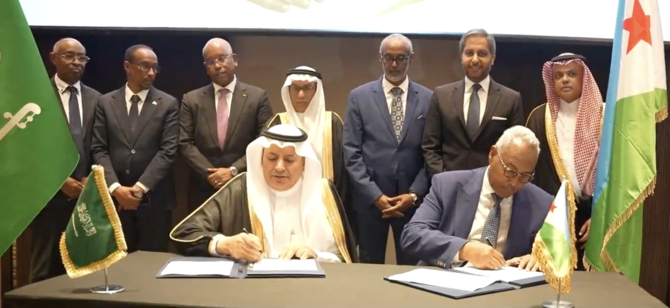
During a delegation visit of Saudi investors to the capital city of the East African country, the contract was signed by Hassan Al-Huwaizi, president of the Federation of Saudi Chambers, and Aboubaker Omar Hadi, chairman of Djibouti Ports and Free Zones Authority. Supplied
Short Url
Updated 05 June 2024
Follow

Saudi Arabia establishes logistics zone in Djibouti to expand economic presence in Africa

RIYADH: Saudi Arabia has signed a deal to establish a logistics zone in the port of Djibouti, leveraging Africa’s gateway to propel the Kingdom’s products and exports, fostering economic interplay. 

During a delegation visit of Saudi investors to the capital city of the East African country, the contract was signed by Hassan Al-Huwaizi, president of the Federation of Saudi Chambers, and Aboubaker Omar Hadi, chairman of Djibouti Ports and Free Zones Authority. 

Under the leadership of Al-Huwaizi, the delegation, including over 100 entrepreneurs and government representatives, came together to advance this transformative initiative. 

The 92-year contract for the logistics zone, spanning an expansive area of 120,000 sq. m. in its inaugural phase, underscores a pivotal milestone in Saudi-Djibouti economic relations. 

The Saudi logistics city, serving as a nexus for commerce and innovation, is positioned to strengthen the Kingdom’s economic presence across the African continent, as reported by the Saudi Press Agency. 

Djibouti’s port, strategically located as Africa’s gateway, facilitates the expansion of Saudi products and exports into new markets, promoting robust economic interplay. 

Simultaneously, the Saudi-Djibouti Business Forum, attended by over 300 stakeholders, unveiled a range of investment opportunities, highlighting Djibouti’s appeal as a free zone. 

In return, Djibouti authorities have promised equal treatment for Saudi investors, guaranteeing fair opportunities across sectors, from renewable energy to technology. 

This collaborative effort emphasizes a steadfast commitment to fostering lasting economic cooperation between the two nations. 

In February, Djibouti’s president reaffirmed his country’s dedication to promoting maritime security in the Red Sea. 

Ismail Omar Guelleh noted that the East African nation was collaborating with major powers, including Saudi Arabia, to ensure safe passage for international shipping in the Bab El-Mandeb and the Gulf of Aden. 

He emphasized that Djibouti’s strategic position made it a key player in facilitating global trade, mentioning cooperation with nations such as the US, France, the UK, and Red Sea coastal states, especially Saudi Arabia, in counterterrorism efforts and maritime security. 

Guelleh had underscored Djibouti’s longstanding ties with Saudi Arabia, dating back to 1977 when his country gained independence. 

The president added that Djibouti aimed to further enhance collaboration with Saudi Arabia, especially in maritime transport, logistics, and port services, building on significant progress in port development. 

Dya-Eddine Saïd Bamakhrama, Djibouti's ambassador to Saudi Arabia, told Arab News: “This contract, signed between the Ports and Free Zones Authority of Djibouti and the Saudi Investors Alliance, will make it possible to create the largest logistics city outside the Kingdom.

“This Free Zone will facilitate access for Saudi products and exports to a large number of African countries.”


India and US release a framework for an interim trade agreement to reduce Trump tariffs

Updated 58 min 25 sec ago
Follow

India and US release a framework for an interim trade agreement to reduce Trump tariffs

  • Under the deal, tariffs on goods from India would be lowered to 18 percent, from 25 percent, after Indian Prime Minister Narendra Modi agreed to stop buying Russian oil, Trump had said.

NEW DELHI: India and the United States released a framework for an interim trade agreement to lower tariffs on Indian goods, which Indian opposition accused of favoring Washington.
The joint statement, released Friday, came after US President Donald Trump announced his plan last week to reduce import tariffs on the South Asian country, six months after imposing steep taxes to press New Delhi to cut its reliance on cheap Russian crude.
Under the deal, tariffs on goods from India would be lowered to 18 percent, from 25 percent, after Indian Prime Minister Narendra Modi agreed to stop buying Russian oil, Trump had said.
The two countries called the agreement “reciprocal and mutually beneficial” and expressed commitment to work toward a broader trade deal that “will include additional market access commitments and support more resilient supply chains.” The framework said that more negotiations will be needed to formalize the agreement.
India would also “eliminate or reduce tariffs” on all US industrial goods and a wide range of food and agricultural products, Friday’s statement said.
The US president had said that India would start to reduce its import taxes on US goods to zero and buy $500 billion worth of American products over five years, part of the Trump administration’s bid to seek greater market access and zero tariffs on almost all American exports.
Trump also signed an executive order on Friday to revoke a separate 25 percent tariff on Indian goods he imposed last year.
Indian Prime Minister Narendra Modi thanked Trump “for his personal commitment to robust ties.”
“This framework reflects the growing depth, trust and dynamism of our partnership,” Modi said on social media, adding it will “further deepen investment and technology partnerships between us.”
India’s opposition political parties have largely criticized the deal, saying it heavily favors the US and negatively impacts sensitive sectors such as agriculture. In the past, New Delhi had opposed tariffs on sectors such as agriculture and dairy, which employ the bulk of the country’s population.
Meanwhile, Piyush Goyal, Indian Trade Minister, said the deal protects “sensitive agricultural and dairy products” including maize, wheat, rice, ethanol, tobacco, and some vegetables.
“This (agreement) will open a $30 trillion market for Indian exporters,” Goyal said in a social media post, referring to the US annual GDP. He said the increase in exports was likely to create hundreds of thousands of new job opportunities.
Goyal also said tariffs will go down to zero on a wide range of Indian goods exported to the US, including generic pharmaceuticals, gems and diamonds, and aircraft parts, further enhancing the country’s export competitiveness.
India and the European Union recently reached a free trade agreement that could affect as many as 2 billion people after nearly two decades of negotiations. That deal would enable free trade on almost all goods between the EU’s 27 members and India, covering everything from textiles to medicines, and bringing down high import taxes for European wine and cars.
India also signed a comprehensive economic partnership agreement with Oman in December and concluded talks for a free trade deal with New Zealand.