

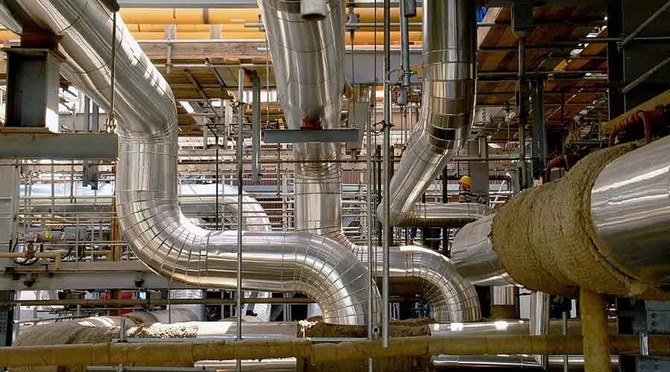
Saudi energy giant ACWA Power sells $225m stake in Rabigh IWSPP 

Rabigh IWSPP is owned and operated by Rabigh Arabian Water and Electricity Co., a joint venture between ACWA Power, Marubeni Corp., JGC Corp., and Petro Rabigh. 
Short Url
Updated 04 June 2024
Follow

Saudi energy giant ACWA Power sells $225m stake in Rabigh IWSPP 

RIYADH: Saudi-listed ACWA Power has agreed to sell 30 percent of its stake in Rabigh Independent Water Steam and Power Project to Hassana Investment Co. for SR844 million ($225 million).  

Parties in the deal included Oasis Power One Conventional Energy and Water Co. and Gosi Investment Ventures Limited, said ACWA Power in a bourse filing. 

Rabigh IWSPP is owned and operated by Rabigh Arabian Water and Electricity Co., a joint venture between ACWA Power, Marubeni Corp., JGC Corp., and Petro Rabigh. 

The project was arranged under an engineering, procurement, and construction contract by Mitsubishi Heavy Industries and consists of conventional thermal power with five 118 megawatt steam turbines, nine 470 tonnes per hour steam generators, three wet limestone flue gas desulphurization units, and 16 reverse osmosis trains capable of producing 504 cubic meters per hour. 

RAWEC is an independent water, steam, and power producer, supplying essential utilities on a captive basis to Petro Rabigh Co. 

ACWA Power stated that the sale is part of its capital recycling strategy. 

The Saudi utility giant previously held a 99 percent shareholding in the project. The company expects to gain from this divestment, which will be calculated on the closing date of the transaction. 

The statement added that RAWEC’s contribution to the group’s net income will be proportionately reduced in line with the divestment. 

On June 2, ACWA Power signed an agreement with the Tunisian government for a project that will produce up to 600,000 tonnes per year of green hydrogen in three phases for export to Europe. 

The memorandum of understanding was inked by Fatma Thabet Chiboub, Tunisia’s minister of industry, mines and energy, and Marco Arcelli, CEO of ACWA Power. 

ACWA Power is set to develop, operate, and maintain 12 gigawatts of renewable energy electricity generation units, including storage systems and transmission lines, along with water desalination plants, electrolyzers, and infrastructures to connect to the main pipeline. 

The first phase will involve installing 4 GW of renewable energy units, 2 GW of electrolyzer capacity, as well as battery storage facilities to produce 200,000 tonnes per year of green hydrogen, which will be exported through the SoutH2 Corridor, a hydrogen pipeline initiative led by European transmission system operators connecting Tunisia to Italy, Austria and Germany. 


BYD Americas CEO hails Middle East as ‘homeland for innovation’

Updated 7 sec ago
Follow

BYD Americas CEO hails Middle East as ‘homeland for innovation’

  • In an interview on the sidelines of Davos, Stella Li highlighted the region’s openness to new technologies and opportunities for growth

DAVOS: BYD Americas CEO Stella Li described the Middle East as a “homeland for innovation” during an interview with Arab News on the sidelines of the World Economic Forum.

The executive of the Chinese electric vehicle giant highlighted the region’s openness to new technologies and opportunities for growth.

“The people (are) very open. And then from the government, from everybody there, they are open to enjoy the technology,” she said.

BYD has accelerated its expansion of battery electric vehicles and plug-in hybrids across the Middle East and North Africa region, with a strong focus on Gulf Cooperation Council countries like the UAE and Saudi Arabia.

GCC EV markets, led by the UAE and Saudi Arabia, rank among the world’s fastest-growing. Saudi Arabia’s Public Investment Fund has been aggressively investing in the EV sector, backing Lucid Motors, launching its brand Ceer, and supporting charging infrastructure development.

However, EVs still account for just over 1 percent of total car sales, as high costs, limited charging infrastructure, and extreme weather remain challenges.

In summer 2025, BYD announced it was aiming to triple its Saudi footprint following Tesla’s entry, targeting 5,000 EV sales and 10 showrooms by late 2026.

“We commit a lot of investment there (in the region),” Li noted, adding that the company is building a robust dealer network and introducing cutting-edge technology.

Discussing growth plans, she envisioned Saudi Arabia and the wider Middle East as a potential “dreamland” for innovation — what she described as a regional “Silicon Valley.” 

Talking about the EV ambitions of the Saudi government, she said: “If they set up (a) target, they will make (it) happen. Then they need a technology company like us to support their … 2030 Vision.”