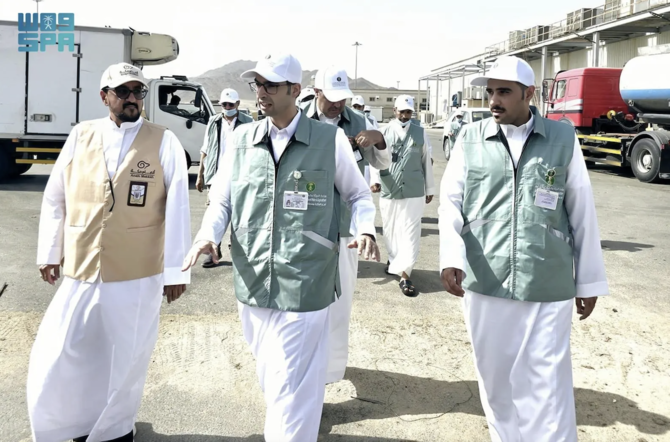
Rigorous inspections of Makkah slaughterhouses carried out ahead of Hajj

1 / 2
Saudi Arabia’s Ministry of Environment, Water, and Agriculture is conducting rigorous inspections of slaughterhouses in Makkah. (SPA)
2 / 2
Saudi Arabia’s Ministry of Environment, Water, and Agriculture is conducting rigorous inspections of slaughterhouses in Makkah. (SPA)
Short Url
Updated 02 June 2024
Follow

Rigorous inspections of Makkah slaughterhouses carried out ahead of Hajj

  • Ministry officials said that operational plans are in place, including detailed workforce deployment, slaughter scheduling, and shift organization

RIYADH: Saudi Arabia’s Ministry of Environment, Water, and Agriculture is conducting rigorous inspections of slaughterhouses in Makkah to ensure that they meet health regulations during the busy Hajj period.

Ministry officials said that comprehensive operational plans are in place, including detailed workforce deployment, slaughter scheduling, and work shift organization.

Dedicated teams will also monitor waste disposal and the proper use of equipment and machinery, Saudi Press Agency reported on Sunday.

The ministry is intensifying supervision of slaughterhouses and livestock pens, and urges adherence to all health regulations to create a safe and hygienic environment for pilgrims and prevent practices that could be hazardous to the environment.

Most Hajj pilgrims are required to sacrifice an animal in order to complete their Hajj. Only those pilgrims performing the Hajj Al-Ifrad, which does not involve performing Umrah, do not sacrifice animals.

The sacrifice is usually carried out on the 10th of Dhul Hijjah but can be carried out until sunset on the 12th.


Fragrance artisans weave heritage into Jazan Festival experience

Updated 02 January 2026
Follow

Fragrance artisans weave heritage into Jazan Festival experience

Riyadh: Perfumes are emerging as living connections to ancestral memory at the Jazan Festival 2026, which opened on Friday, the Saudi Press Agency reported.

A narrative rooted in botanical origins is unfolding as veteran craftswomen showcase decades of accumulated wisdom, transforming the contents of native plants into small vessels that distill the human bond with terrain.

Aromas wafting through the space suggest imagery of regional ecosystems — fragrant vegetation cultivated across highland and lowland zones, harvested during optimal periods, then subjected to extended drying and distillation processes before materializing as perfumes and essences embodying geographical character, the Saudi Press Agency reported.

Arranged fragrance containers resemble nature’s output, composed by skilled practitioners versed in harvest timing, plant dormancy requirements and scent extraction methods, yielding products preserving organic integrity and territorial identity.

Craftswoman Fatima bint Mohammed Al-Faifi has dedicated two decades to perfume production, characterizing regional practice as social custom interwoven throughout daily existence — deployed in guest reception, featured at celebrations, accompanying community gathering — elevating scent to cultural signature, the Saudi Press Agency reported.

Festival attendees are discovering aromatic botanicals, absorbing production methodology explanations and discerning nuanced olfactory distinctions, demonstrating how craftsmanship blends persistence with expertise, tradition with innovation.

Perfume artisan involvement aligns with Jazan Festival’s initiative repositioning traditional crafts as dynamic, evolving culture while spotlighting women’s contributions safeguarding regional inheritance and expressing this through modern methods, the Saudi Press Agency reported.