

Hajj preparations in full swing

1 / 3
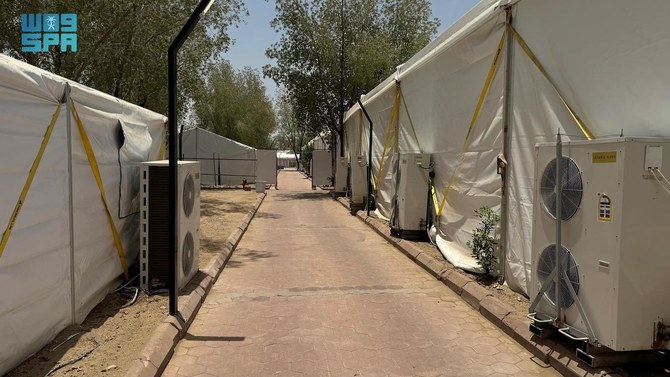
Camps are fully equipped to cater to pilgrims’ needs, ensuring comfortable and peaceful rituals. (SPA)
2 / 3
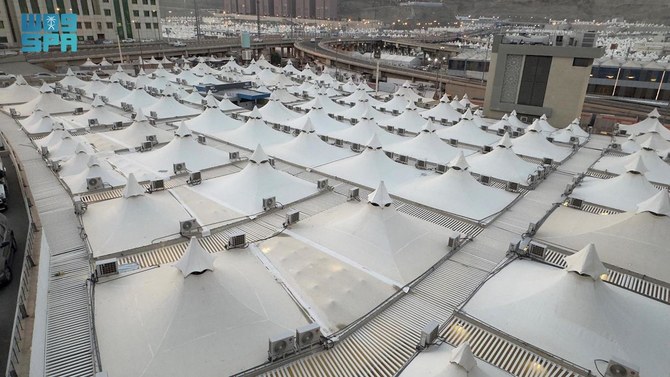
Camps are fully equipped to cater to pilgrims’ needs, ensuring comfortable and peaceful rituals. (SPA)
3 / 3
Makkah Municipality has made extensive preparations, including supervising roads, lighting, sidewalks and public facilities for safe and optimal use. (SPA)
Short Url
Updated 02 June 2024
Follow

Hajj preparations in full swing

  • Makkah Municipality has made extensive preparations, including supervising roads, lighting, sidewalks and public facilities for safe and optimal use

RIYADH: Efforts are underway to prepare holy sites for this year’s Hajj season. Camps are fully equipped to cater to pilgrims’ needs, ensuring comfortable and peaceful rituals.

Public and private sectors are collaborating with comprehensive operational plans to enhance services for pilgrims, as directed by the leadership, the Saudi Press Agency reported.

Makkah Municipality has made extensive preparations, including supervising roads, lighting, sidewalks and public facilities for safe and optimal use.

Engineers and technical teams conducted thorough tests on road routes to ensure quality. The municipality also maintained 4,767 light poles and towers at the holy sites.

A total of 123 bridges in Makkah and 20 in other holy sites have undergone maintenance, while 58 tunnels (48 for vehicles and 10 for pedestrians) spanning 34 km have been completed.

To enhance services, strategically positioned service centers at all holy sites have been equipped with additional resources and staff.

Tawaf companies have prepared field centers and established modern camps that meet international standards. These are insulated, fire-resistant and equipped with cooling systems in each tent for pilgrims’ comfort. Safety measures, support services and high-quality meals are also provided.

Efforts are underway to ensure efficient public transport at the holy sites. Tawaf companies are testing roads and bus routes to adhere to transportation plans and schedules set by The General Syndicate of Cars in Makkah.

The Roads General Authority, along with other relevant agencies, is expanding its cooling asphalt experiment at the holy sites. This aims to lower temperatures in residential areas, reduce energy consumption and create a more comfortable environment in waiting and gathering areas.

The Makkah branch of the Ministry of Environment, Water and Agriculture is inspecting slaughterhouses to ensure compliance with health regulations for the upcoming Hajj season.

Comprehensive operational plans, including workforce deployment, slaughter scheduling and waste disposal monitoring are in place and being implemented. Dedicated teams will oversee equipment use and waste disposal.

The ministry is intensifying supervision of slaughterhouses and livestock pens, emphasizing adherence to health regulations to ensure a safe environment for pilgrims and prevent hazardous practices for the environment.

Under the supervision of the Ministry of Health, the Makkah Health Cluster has confirmed its readiness for Hajj. Operational plans for 18 hospitals and 126 health centers in Makkah and the holy sites have been completed to provide high-quality medical services.

Ajyad Emergency Hospital is open round the clock at the Grand Mosque and there are three other emergency centers. Al-Haram Hospital is also operational in the northern courtyards of the Grand Mosque.

All necessary training and resources have been provided to ensure the continuity of outpatient clinic services across facilities, with 3,944 beds allocated, including 654 for intensive care.

The Makkah Health Cluster also highlighted the readiness of 155 operational ambulances for the Hajj season, along with additional support for Nimra Hospital and ambulance teams distributed across various sites and hospitals.


Swedish king awards American Saudi scientist, Omar Yaghi, Nobel Prize in Chemistry 2025

Nobel Prize in Chemistry 2025 laureate US-Saudi chemist Omar M. Yaghi poses with award during the award ceremony in Stockholm.
Updated 10 December 2025
Follow

Swedish king awards American Saudi scientist, Omar Yaghi, Nobel Prize in Chemistry 2025

  • Yaghi will share $1.2m prize with British Australian and Japanese scientists Richard Robson and Susumu Kitagawa
  • He is the 1st Saudi national to be awarded the Nobel Prize and 2nd Arab-born to win in the chemistry category since 1999

STOCKHOLM: King Carl XVI Gustaf of Sweden on Wednesday awarded American Saudi scientist Omar Yaghi the Nobel Prize in Chemistry for his breakthrough development of metal-organic frameworks, a sponge-like structure that could store CO2 or harvest water from the air, alongside the British Australian and Japanese scientists Richard Robson and Susumu Kitagawa.

Yaghi, Robson and Kitagawa have each contributed over the past 50 years to developing scalable, reliable MOF models that can be deployed in industry to address climate-related issues and deliver clean air and water. They will share the $1.2 million prize.

Yaghi, 60, who grew up in a refugee camp in Jordan to a Palestinian family expelled from their property by Zionist militias in 1948, is the second Arab-born laureate to be awarded the Nobel Prize in Chemistry by the Royal Swedish Academy of Sciences.

The Nobel Foundation said that MOFs, which are structures with large internal spaces, “can be used to harvest water from desert air, capture carbon dioxide, store toxic gases or catalyze chemical reactions.”

In 2015, Yaghi received the King Faisal International Prize for Chemistry, and in 2021, King Salman granted him Saudi citizenship for his scientific achievements. He holds the James and Neeltje Tretter Chair in Chemistry at UC Berkeley and is the founding director of the Berkeley Global Science Institute. In addition, Yaghi has branched into entrepreneurial activity since 2018, founding Atoco, which works on water harvesting and carbon capture, and co-founding H2MOF for hydrogen storage and WaHa Inc. for water harvesting with projects in the Middle East.

His focus on harvesting water from the air in arid conditions stems from his upbringing in Jordan, where water reached homes every 14 days. He began field tests in the Arizona desert in the 1990s to capture water from the air using the MOF-303 model he had developed.

Yaghi is the first Saudi national to be awarded the Nobel Prize and the second Arab-born to win in the chemistry category since the Egyptian American chemist and scientist Ahmed Zewail was honored in 1999.

Zewail’s model of the “femtochemistry apparatus” is on display at the Nobel Prize Museum. He used the apparatus to demonstrate the principle behind his method of studying chemical reactions using laser technology, capturing it in a femtosecond, which is to a second what a second is to 32 million years.

He is one of dozens of laureates who donated objects to the museum since its foundation in 2001 to mark the 100th anniversary of the Nobel Prize, which began in 1901, five years after the death of the Swedish chemist Alfred Nobel. Since 2001, it has become tradition that each December the winners of that year bring an item to be displayed that reflects their work, personal life or inspiration, Karl Johan, a curator at the museum, told Arab News.

“Zewail wanted to donate an object that could visualize his work and his experiment. He constructed (the interactive apparatus) specifically for the museum. As one of the first objects to be displayed after 2001, it got lots of attention,” Johan said.

The award ceremony in the Swedish capital is the latest event to wrap up Nobel Week, which, since Friday, has featured Nobel laureates in the fields of literature, chemistry, physics, medicine and economic sciences engaging in public events. The Nobel Peace Prize was awarded in the Norwegian capital of Oslo on Wednesday, where the daughter of the Venezuelan opposition leader, Maria Corina Machado, accepted it in her mother’s name after authorities prevented her from leaving early to attend the ceremony.