

PM Sharif pins hopes on Trump-led peace board to help end Gaza war

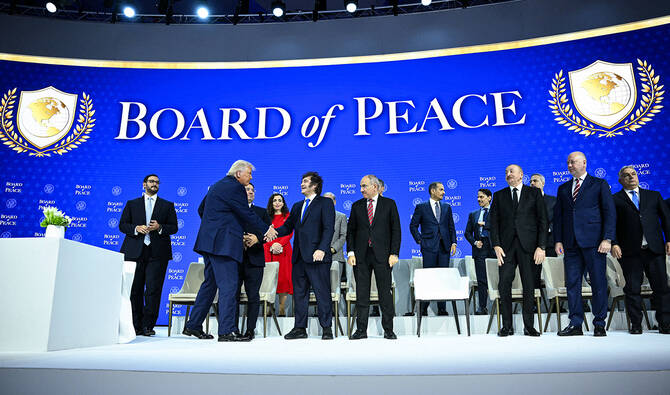
US President Donald Trump (2L) shakes hands with Argentina's President Javier Milei at the "Board of Peace" meeting during the World Economic Forum (WEF) annual meeting in Davos on January 22, 2026. (AFP/ file)
Short Url
Updated 04 February 2026
Follow

PM Sharif pins hopes on Trump-led peace board to help end Gaza war

  • Pakistan says new body should push ceasefire, reconstruction and two-state solution
  • Sharif thanks Kazakh president for joining peace initiative during Islamabad visit

ISLAMABAD: Prime Minister Shehbaz Sharif expressed optimism on Wednesday US President Donald Trump’s newly formed Board of Peace (BoP) would help end the conflict in Gaza and advance the implementation of a two-state solution, as he addressed a ceremony at his official residence in the capital.

The Board of Peace brings together participating states and international stakeholders seeking to support dialogue, stability and peace-related initiatives linked to the war in the Palestinian enclave.

Sharif signed the body’s charter last month alongside other world leaders on the sidelines of the World Economic Forum’s annual meeting in Davos, a move his government later described as a diplomatic success amid opposition criticism for not taking parliament into confidence.

Speaking at a ceremony to sign more than 30 memoranda of understanding with Kazakhstan, also a Board of Peace member, Sharif thanked President Kassym-Jomart Tokayev for accepting his invitation to visit Pakistan for bilateral talks.

“I would ... like to congratulate you on accepting this invitation, being a member of the Board of Peace under President Trump’s leadership,” Sharif said.

“Let us hope and pray to Allah Almighty that through our joint efforts, we will be successful in bringing long-lasting peace in Gaza, its reconstruction, and, of course, make the two-state solution a reality as soon as possible,” he added.

Pakistan told the United Nations in January that it expected the new international body to take concrete steps toward a permanent ceasefire, the reconstruction of Gaza and a lasting and just peace grounded in the Palestinian right to statehood.

It maintained that its decision to join the Board of Peace was driven by the need to address the unresolved Palestinian question, which it has described as the core source of instability in the region.

Pakistan has consistently called for the establishment of a geographically contiguous Palestinian state based on pre-1967 borders, with East Jerusalem as its capital.


Pakistan reports current account surplus in Jan. owing to improved trade, remittances

Updated 17 February 2026
Follow

Pakistan reports current account surplus in Jan. owing to improved trade, remittances

  • Pakistan’s exports crossed the $3 billion mark in Jan. as the country received $3.5 billion in remittances
  • Last month, IMF urged Pakistan to accelerate pace of structural reforms to strengthen economic growth

ISLAMABAD: Pakistan recorded a current account surplus of more than $120 million in January, the country’s finance adviser said on Tuesday, attributing it to improved trade balance and remittance inflows.

Pakistan’s exports rebounded in January 2026 after five months of weak performance, rising 3.73 percent year on year and surging 34.96 percent month on month, according to data released by the country’s statistics bureau.

Exports crossed the $3 billion mark for the first time in January to reach $3.061 billion, compared to $2.27 billion in Dec. 2025. The country received $3.5 billion in foreign remittances in Jan. 2026.

Khurram Schehzad, an adviser to the finance minister, said Pakistan reported a current account surplus of $121 million in Jan., compared to a current account deficit of $393 million in the same month last year.

“Improved trade balance in January 2026, strong remittance inflows, and sustained momentum in services exports (IT/Tech) continue to reinforce the country’s external account position,” he said on X.

Pakistan has undergone a difficult period of stabilization, marked by inflation, currency depreciation and financing gaps, and international rating agencies have acknowledged improvements after Islamabad began implementing reforms such as privatizing loss-making, state-owned enterprises (SOEs) and ending subsidies as part of a $7 billion International Monetary Fund (IMF) loan program.

Late last month, the IMF urged Pakistan to accelerate the pace of these structural reforms to strengthen economic growth.

Responding to questions from Arab News at a virtual media roundtable on emerging markets’ resilience, IMF’s director of the Middle East and Central Asia Jihad Azour said Islamabad’s implementation of the IMF requirements had been “strong” despite devastating floods that killed more than 1,000 people and devastated farmland, forcing the government to revise its 4.2 percent growth target to 3.9 percent.

“What is important going forward in order to strengthen growth and to maintain the level of macroeconomic stability is to accelerate the structural reforms,” he said at the meeting.

Azour underlined Pakistan’s plans to privatize some of the SOEs and improve financial management of important public entities, particularly power companies, as an important way for the country to boost its capacity to cater to the economy for additional exports.

“This comes in addition to the effort that the authorities have made in order to reform their tariffs, which will allow the private sector of Pakistan to become more competitive,” the IMF official said.