

Over 62,140 Pakistani pilgrims arrive in Saudi Arabia for this year’s Hajj

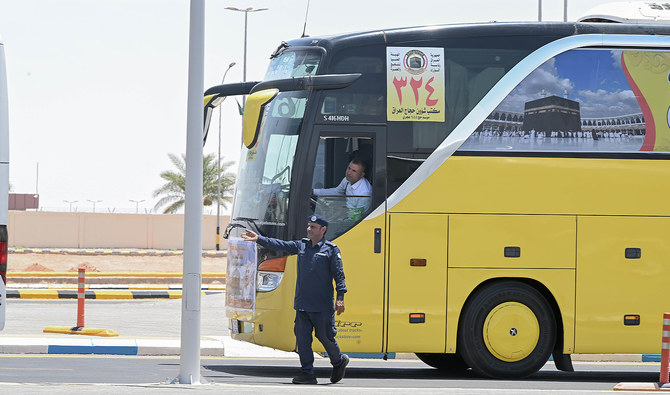
A bus awaits for Hajj pilgrims in Makkah, Saudi Arabia on June 2, 2024. (SPA)
Short Url
Updated 02 June 2024
Follow

Over 62,140 Pakistani pilgrims arrive in Saudi Arabia for this year’s Hajj

  • Pakistan welcomes 46,648 pilgrims under government scheme, 15,500 under private scheme
  • This year 179,210 Pakistani pilgrims are expected to perform annual Islamic pilgrimage 

ISLAMABAD: The Pakistan Hajj Mission (PHM) has so far welcomed 62,148 pilgrims in the cities of Makkah and Madinah under both government and private schemes since May 9, an official of the country’s religion ministry said this week. 

Hajj is one of the five pillars of Islam and requires every adult Muslim to undertake the journey to the holy Islamic sites in Makkah at least once in their lifetime if they are financially and physically able.
Pakistan has a Hajj quota of 179,210 pilgrims this year, of which around 70,000 people will perform the pilgrimage under the government scheme, while the rest will use private tour operators.

This year’s pilgrimage is expected to run from June 14 till June 19.

“So far, 46,648 pilgrims have arrived via 185 flights under the government scheme, while 15,500 have arrived under the private scheme,” Muhammad Umar Butt, a spokesperson for Pakistan’s Ministry of Religious Affairs (MoRA) said on Saturday. 

An additional 22,090 Pakistani pilgrims are expected to arrive in Makkah over the next nine days, Butt said. This year, the PHM will host over 70,105 pilgrims under the government scheme and more than 80,000 under the private scheme. 

He said the PHM is making use of two toll-free helplines and four WhatsApp numbers to address pilgrims’ complaints.

“Additionally, the spokesman said two central hospitals and a dozen dispensaries in the Haram are providing medical facilities to pilgrims, with 322 doctors and medical staff on duty,” the state-run Associated Press of Pakistan (APP) said. 

A total of 511 Hajj Moavineen or facilitators, including Pakistani civilians and uniformed personnel, are working to provide pilgrims with travel, accommodation, and food facilities.


IMF hails Pakistan privatization drive, calls PIA sale a ‘milestone’

Updated 10 January 2026
Follow

IMF hails Pakistan privatization drive, calls PIA sale a ‘milestone’

  • Fund backs sale of national airline as key step in divesting loss-making state firms
  • IMF has long urged Islamabad to reduce fiscal burden posed by state-owned entities

KARACHI: The International Monetary Fund (IMF) on Saturday welcomed Pakistan’s privatization efforts, describing the sale of the country’s national airline to a private consortium last month as a milestone that could help advance the divestment of loss-making state-owned enterprises (SOEs).

The comments follow the government’s sale of a 75 percent stake in Pakistan International Airlines (PIA) to a consortium led by the Arif Habib Group for Rs 135 billion ($486 million) after several rounds of bidding in a competitive process, marking Islamabad’s second attempt to privatize the carrier after a failed effort a year earlier.

Between the two privatization attempts, PIA resumed flight operations to several international destinations after aviation authorities in the European Union and Britain lifted restrictions nearly five years after the airline was grounded following a deadly Airbus A320 crash in Karachi in 2020 that killed 97 people.

“We welcome the authorities’ privatization efforts and the completion of the PIA privatization process, which was a commitment under the EFF,” Mahir Binici, the IMF’s resident representative in Pakistan, said in response to an Arab News query, referring to the $7 billion Extended Fund Facility.

“This privatization represents a milestone within the authorities’ reform agenda, aimed at decreasing governmental involvement in commercial sectors and attracting investments to promote economic growth in Pakistan,” he added.

The IMF has long urged Islamabad to reduce the fiscal burden posed by loss-making state firms, which have weighed public finances for years and required repeated government bailouts. Beyond PIA, the government has signaled plans to restructure or sell stakes in additional SOEs as part of broader reforms under the IMF program.

Privatization also remains politically sensitive in Pakistan, with critics warning of job losses and concerns over national assets, while supporters argue private sector management could improve efficiency and service delivery in chronically underperforming entities.

Pakistan’s Cabinet Committee on State-Owned Enterprises said on Friday that SOEs recorded a net loss of Rs 122.9 billion ($442 million) in the 2024–25 fiscal year, compared with a net loss of Rs 30.6 billion ($110 million) in the previous year.