

Russia and Ukraine exchange POWs for the first time in months. Bodies of fallen are also swapped

1 / 2
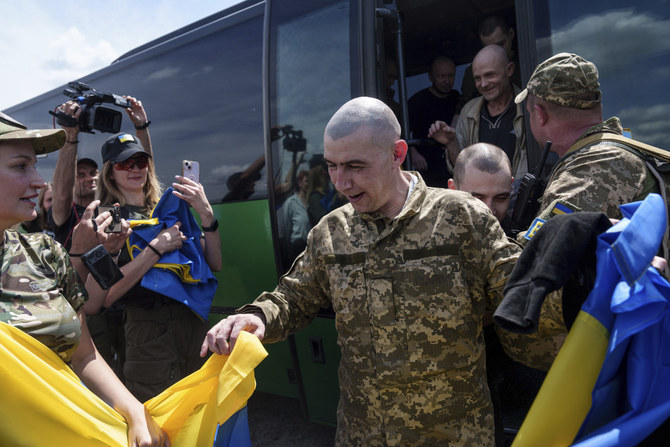
A Ukrainian serviceman reacts after returning from captivity during POWs exchange in Sumy region, Ukraine, on May 31, 2024. (AP)
2 / 2
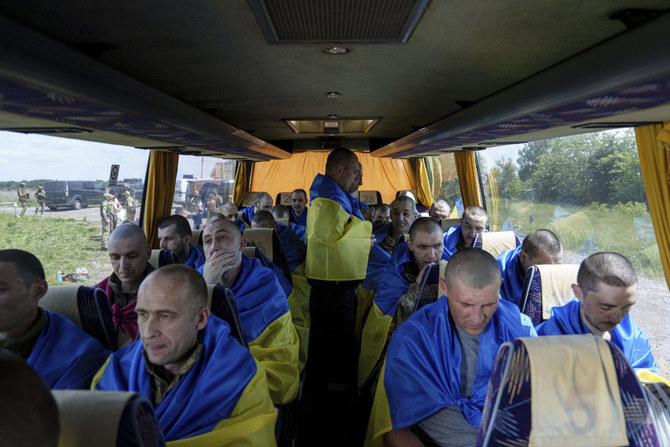
Ukrainian servicemen sit in a bus after returning from captivity during a POWs exchange in Sumy region, Ukraine, on May 31, 2024. (AP)
Short Url
Updated 01 June 2024
Follow

Russia and Ukraine exchange POWs for the first time in months. Bodies of fallen are also swapped

  • The exchange of the 150 POWs in all was the fourth swap this year and the 52nd since Russia invaded Ukraine in February 2022
  • Ukraine has gotten back a total of 3,210 members of the Ukrainian military and civilians since the outbreak of the war

SUMY REGION, Ukraine: Ukraine and Russia exchanged prisoners of war on Friday, each sending back 75 POWs in the first such swap in the past three months, officials said. A few hours earlier and at the same location, the two sides also handed over bodies of their fallen soldiers.
The Ukrainian POWs, including four civilians, were returned on several buses that drove into the northern Sumy region. As they disembarked, they shouted joyfully and called their families to tell them they were home. Some knelt and kissed the ground while many wrapped themselves in yellow-blue flags and hugged one another, breaking into tears. Many appeared emaciated and poorly dressed.
The exchange of the 150 POWs in all was the fourth swap this year and the 52nd since Russia invaded Ukraine in February 2022. The United Arab Emirates said it helped negotiate this latest exchange.
The two sides have traded blame for what they say is a slowdown in the swaps.
Ukraine has in the past urged Russia to swap “all for all” and rallies calling for the release of POWs take place across Ukraine weekly. A Ukrainian official at the headquarters coordinating the exchanges, Vitalii Matviienko said that “Ukraine is always ready.”
Tatyana Moskalkova, Russia’s human rights ombudsperson, said earlier this week that Kyiv was making “new artificial demands,” without elaborating.
Among those who were returned home to Ukraine on Friday was Roman Onyschuk, an IT worker who joined Ukrainian forces as a volunteer at the start of the Russian invasion. He was captured in March 2022 in the Kharkiv region.
“I just want to hear my wife’s voice, my son’s voice. I missed his three birthdays,” he said. In the more than 800 days he spent in captivity, he never communicated with his family and he doesn’t know what city they are in now, he said.
“It’s a little bit overwhelming,” Onyschuk added.
With the exchanges, including Friday’s, Ukraine has gotten back a total of 3,210 members of the Ukrainian military and civilians since the outbreak of the war, according to Ukraine’s Coordination Headquarters for Treatment of POWs.
Neither Ukraine nor Russia disclose how many POWs there are in all.
Dmytro Kantypenko was captured on Snake Island in the Black Sea in the first days of the war. He was among those freed Friday and said he called his mother to tell her he was back in Ukraine.
“I’ll be home soon,” he said, wiping away his tears. He learned that his wife had fled to Lithuania with their son.
The Russians woke him up in the middle of the night without any explanation, he said, giving him a short time to change his clothes before they were on their way. Kantypenko said they were tortured with electroshock shortly before the exchange, and his fellow POWs standing beside him confirmed that.
According to UN reports, the majority of Ukrainian POWs are subject to routine medical neglect, severe and systematic mistreatment, and even torture while in detention. There have also been isolated reports of abuse of Russian soldiers, mostly during capture or transit to internment sites.
At least one-third of Ukrainians who returned home suffered “injuries, severe illnesses, and disabilities,” according to the Coordination Headquarters for the Treatment of POWs. Among those returned Friday were 19 Ukrainian fighters from Snake island, 14 people captured at Chernobyl Nuclear Power Plant, and 10 fighters from the city of Mariupol that was captured by Russia.


A Ukrainian serviceman hugs his comrade after returning from captivity during POWs exchange in Sumy region, Ukraine, on May 31, 2024. (AP)

Five women were among the returned Ukrainians, including Nataliia Manuilova, who was a cook in the Azov regiment and spent more than two years in captivity. The Russians took her from her home in Mariupol, pulling a bag over her head and tying her hands, she recounted.
“I hate them. They took away two years of my beautiful life,” she said, hugging her son on Friday. “I can’t believe he’s grown up like this.”
The POWs traveled through small villages before reaching Sumy, from where they were taken to hospitals for two weeks of rehabilitation. The buses moved past green fields with newly dug defense lines preparing for Russian attacks in the area following Moscow’s offensive in the neighboring Kharkiv region.
Ukrainians with blue and yellow flags took to the streets and loudly welcomed the POWs home.
Earlier in the day and at the same location, Ukraine and Russia also swapped bodies of their fallen soldiers — Ukraine returned 212 bodies and Russia 45.
Bohdan Okhrimenko, another official at the Ukrainian POWs offices, explained the sharp difference in numbers. “This time, the negotiators agreed to bring back more of our heroes,” he said.
The warring sides only meet when they swap their dead and POWs, which require considerable preparation and diplomacy.
Vitalii Matviienko, another Ukrainian official from the POW headquarters, said there were days when the exchanges didn’t happen because the Russian side would change their mind at the last minute.
Since the outbreak of the war, Ukraine got back nearly 3,000 bodies, mostly of servicemen, according to Ukraine’s missing persons office. About 1,300 of them have been identified.
Sometimes it takes weeks before the bodies are identified and returned to their families for burial.
“They haven’t returned home alive, but their memory allows us to continue fighting,” said Okhrimenko. “And it gives their families a possibility for proper burial”.


Epstein files reveal links to cash, women, power in Africa

Updated 26 February 2026
Follow

Epstein files reveal links to cash, women, power in Africa

  • Documents attest to Epstein’sclose ties with Karim Wade, son of former Senegalese president Abdoulaye Wade
  • They also reveal his ties to Nina Keita, niece of Ivorian president Alassane Ouattara

PARIS: Jeffrey Epstein built close ties with powerful figures in Senegal and Ivory Coast, files released by the US government last month show, detailing the late sex offender’s influence network across Africa.
Emails, scheduled meetings, investment projects, and loans reviewed by AFP attest to the disgraced New York financier’s close relationship with Karim Wade, son of former Senegalese president Abdoulaye Wade.
They also reveal his ties to Nina Keita, niece of Ivorian president Alassane Ouattara.
Wade and Epstein met in 2010 through Emirati businessman Sultan Ahmed bin Sulayem, who recently resigned as CEO of port giant DP World after mounting pressure over his close friendship with Epstein.
The pair quickly struck up a rapport.
“Thanks for coming. I think there are many things to consider... I feel confident that we will have fun,” Epstein wrote to Wade on November 15, 2010 after their first meeting in Paris.
“Have a safe trip back to your paradise Island,” Wade replied.
While Wade’s exchanges show no link to Epstein-related sex trafficking crimes, they do reveal conversations on potential business ventures in various sectors, such as finance and energy.
Nicknamed the “Minister of Heaven and Earth” for the multiple portfolios he held including international cooperation, energy, and air transport, Wade was a powerful figure in Senegal until April 2012, when his father’s bid for a third term sparked deadly riots.
Epstein saw him as “one of the most important players in africa” and invited him to meet close contacts such as Ehud Barak, then Israel’s defense minister.
He also put him in touch with Chinese businessman Desmond Shum to discuss “offshore banking.”
The US Department of Justice documents show Shum and Wade met in Beijing on May 9, 2011.
That same month, Wade planned an African tour through Senegal, Mali, and Gabon for Epstein.

‘You will not suffer’ 

Epstein and Wade’s relationship became even more apparent after the latter’s fortunes reversed when his father left office in 2012.
That autumn, Epstein proposed that his “friend” — under the Dakar authorities’ scrutiny over his assets — use his house in Florida.
“You and your family are welcome to use my house in palm beach, staff is there, pool etc. you will not suffer,” Epstein wrote.
“Txs a lot Brother for the advise,” Wade replied a few weeks later to another email, in which Epstein urged him to “stay mentally strong.”
Numerous files suggest Epstein became financially involved on Karim Wade’s behalf after his arrest in 2013 and his 2015 sentencing to six years in prison for corruption.
Karim Wade’s lawyer, Mohamed Seydou Diagne, sent two invoices in May 2014 and July 2015 of $500,000 to one of Epstein’s companies.
Contacted by AFP on Monday, Diagne said he “did not consider it useful to comment.”
Other archives suggest that Epstein covered at least $50,000 in fees for the US lobbying firm Nelson Mullins, hired by Wade’s entourage to secure his release.
Epstein regularly exchanged emails with Robert Crowe, a partner at the firm who kept him informed of their efforts in the US and Senegal.
In a June 16, 2016 email thread where Epstein and Crowe discussed whether then Senegalese president Macky Sall would pardon Wade, Crowe writes: “He has told my friends high up at State that he was going to do it. They have been putting pressure on him!“
Karim Wade was released from prison eight days later, on June 24, and went into exile in Qatar, which he credited for efforts toward his release.
Jeffrey Epstein was told by Sultan Ahmed bin Sulayem and Nina Keita.

‘A very interesting person!’

The DOJ documents show Nina Keita was close to both Epstein and Karim Wade and that she acted as a regular intermediary while Wade was in prison.
Keita also helped put Epstein in contact with her uncle, president of Ivory Coast since May 2011, and his team.
“He thought you were a very interesting person! ... they were all very happy to have you here,” she wrote on January 20, 2012, after the financier’s visit to Abidjan.
She had booked him the “ministerial suite” of the luxury Hotel Ivoire for that trip.
Ahead of the visit, Epstein had said he hoped to see “very pretty girls there, as well as interesting places.”
“You will!” Keita replied.
Emails show Keita, a former model, at least once sent photos and the phone number of a young woman to Epstein.
He then met this woman at the Ritz hotel in Paris on August 31, 2011.
“ask sadia to send pictures of her sister. i prefer under 25,” Epstein wrote to Keita after the meeting.
Now the deputy general director of Ivorian petroleum stocks company GESTOCI, Keita also appears in a February 2019 will in which Epstein requested that debts owed to him by a number of people be canceled upon his death.
AFP received no response to its requests for comment from both Keita and the Ivorian presidency, or from Karim Wade, who was contacted through his entourage.
The mere mention of a person’s name in the Epstein files does not in itself imply wrongdoing.