

French artist produces rich portrayals of Saudi history, culture

Short Url
Updated 01 June 2024
Follow

French artist produces rich portrayals of Saudi history, culture

  • Joel Alessandra sheds light on his artistic adventures in the Kingdom

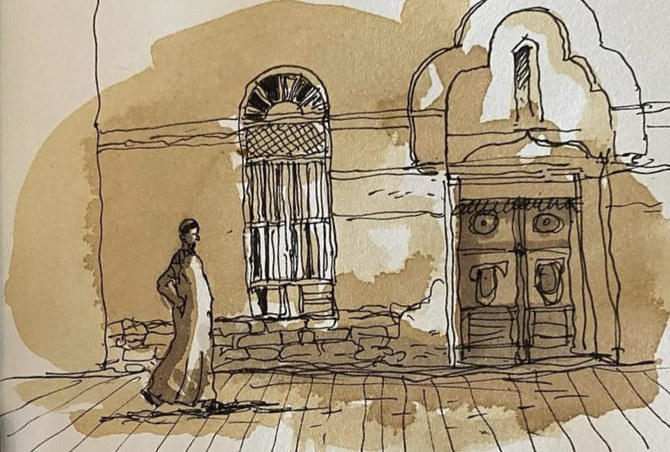
JEDDAH: Joel Alessandra, the renowned French comic book artist, travelled through Saudi Arabia recently so that he could portray the nation’s rich culture and heritage.

Known for his innovative use of coffee and watercolors in his drawings, Alessandra’s visit was facilitated by the French Embassy and the Alliance Francaise Saudi Arabia.

Having visited Riyadh, Alkhobar and AlUla, Alessandra found himself captivated by the charm of Al-Balad, Jeddah’s old town.

“This part of the city of Jeddah is the one that inspired me the most. We feel the atmosphere of a time when pilgrims stopped here, we perceive this fervent activity, there is an atmosphere of a centuries-old tradition that is still palpable,” Alessandra told Arab News.

The ancient architecture was a rich source of inspiration for his sketches, including the patina-covered walls and the intricate doorways. Alessandra’s drawings during his days in Jeddah aimed to capture the essence of Al-Balad's vibrant past and present.

He also held a live performance in Jeddah, where he recreated scenes from Al-Balad, offering spectators a glimpse into his artistic process.

“The subject was an improvised walk in Al-Balad, based on my sketches from the afternoon, I reproduced them in watercolor on the screen. Scenes of life in the street, buildings from past centuries, mosque minarets from the neighborhoods you pass through,” he said.

For Alessandra, travel serves as a constant wellspring of inspiration. Drawing from his experiences across Africa, he said “it is the atmosphere and the people of a country that shape my way of drawing, my real inspiration is taken on the ground.”

Reflecting on his recent visit to the Kingdom, Alessandra said he was amazed by Saudi Arabia’s burgeoning cultural scene and the enthusiasm for artistic expression among its youth.

While Alessandra’s sketches convey a deep appreciation for Saudi Arabia’s cultural heritage, he shies away from conveying explicit messages.

“I just want to convey the emotion felt in front of all the incredible and immensely rich cultural, architectural, and historical heritage. I am lucky to know how to draw and show this emotion through my sketchbooks and my books ... I hope that my readers will also be sensitive to it,” he said.

He said AlUla left him in awe.

“It would be difficult to forget the fascination AlUla had on me. The Nabataean tombs, just imagining a vibrant life there, in the middle of the desert, at this ancient time is simply incredible.

“Also imagining that the Roman Empire pushed its armies so far from Italy is inconceivable.

“But also the old town with its shaded and covered streets. It is a paradise to inspire designers,” he said.



Joel Alessandra

Last year, he ventured out to sketch in the streets of AlUla with female students from the local art school.

“This moment is engraved in my memory as these students were attentive and wanted to produce and learn how to draw their environment. I’m not sure I’ve ever encountered such a desire among young people in other countries.”

His use of coffee as a medium adds depth and richness to his artwork, capturing the nuances of skin tones and desert landscapes.

During his stay in Jeddah, he conducted workshops focusing on the Francophonie, bringing together students from various schools to collaborate on a work of fiction through text and drawings.

Engaging French school students in a collaborative storybook project, Alessandra explored a fictionalized journey of Muslim traveler Ibn Battuta in modern-day Arabia. Through writing and drawing, students reimagined Ibn Battuta’s adventures, blending elements of history and fantasy.

“The quest for a key to access the door of time and allow Ibn Battuta to return to his century, it was very amusing to see how the young people translated this graphically,” Alessandra said.

On his growth as an artist, Alessandra said that constant practice was key, and to aspiring artists, he added: “Draw, draw, and draw some more.”

“Always have a drawing pad in your pocket and train your hand and mind every chance you get. While waiting for the bus, at the cafe, during TV commercials, take advantage of every free moment to scribble in this notebook, there are no issues, just a few lines for practice,” Alessandra added.


Shaping future society: How intellectual forums contribute to cultural development

Updated 7 sec ago
Follow

Shaping future society: How intellectual forums contribute to cultural development

RIYADH: Modern nations do not transform on technological progress alone, but evolve through various factors such as values, religion, culture and assumptions that guide how societies interpret development.

Philosophy is one aspect of understanding civilization. Although it is often seen as abstract or far from reality, it plays an essential role in shaping a nation’s understanding of modernization.

It impacts how people see progress and discuss cultural identity, along with measuring the ethical implications of joining the global mindset.

Yet, by examining the philosophical thoughts that shape national narratives, people gain a deeper understanding of why societies adopt certain ideologies for development, resist others, and struggle to balance tradition with innovation.

Saudi Arabia, for example, defines its place on the global stage and navigates the complex tensions between heritage, aspiration and global responsibility through its own philosophy.

The Philosophy Forum, organized in Riyadh this week for the fifth year, witnessed the attendance of both local and international thinkers. During the conference, some Arab philosophers shared their beliefs in the idea that there is no absolute truth; while other philosophers differed, considering the Arab view on truth, culture and relativism.

“We must distinguish between the existence of relativity in science — the world is changing because it is relative — and our belief in absolute truths within our culture. For example, the only truly absolute thing in the world is death, which is mentioned in the Holy Qur’an,” Essam Gameil, professor of logic and critical thinking at Cairo University, told Arab News on the sidelines of the forum.

He added: “Our morals are unchanging; ethical principles are fixed. For example, respecting others is a fundamental principle; how can it be altered?

“Some concepts can be changed within the framework of science, but not in the humanities, not in religion, not in ethics. There are constants.

“It is the moral principles and rules that drive me forward,” Gameil said, adding that philosophy was created to solve issues that occurred in society during the time of Aristotle and Plato.

“It appeared to solve social problems … it was created to address lying, deception and more. Socrates was a moral philosopher and nothing else,” he said.

Gameil described Saudi Arabia as an example of “an extraordinary leap” in the Arab world in terms of development and philosophy.

He said that the Kingdom’s interest in philosophy and its organization of a major conference in the field stems from a crucial concept discovered by the Saudi leadership, which is that humanity has two aspects: A spiritual aspect and a material aspect, represented by the body.

“Studies typically focus on the body — artificial intelligence, engineering, and so on — but have often neglected the spiritual dimension. Philosophy is a human science; the more you emphasize it, the more certain concepts become firmly established and ingrained,” said Gameil.

Eman Al-Mulhem, a researcher in the philosophy of science at King Faisal University in Al-Ahsa, believes that the Kingdom’s situation presents three very promising paths: The philosophy and ethics of artificial intelligence, science and technology studies, and a re-reading of the Arab philosophical heritage using contemporary methodologies.

“This field is no longer a luxury, but a necessity. The question is no longer: What can a machine do? Rather, it has become: How do we preserve our humanity in a world where we share the power of decision-making with machines?” she said, highlighting the philosophy and ethics of AI.

She added: “We have a rich heritage, but we need modern tools to understand and reconstruct it, not just explain it. These fields are not only promising, but they are also capable of reshaping the role of philosophy in the Arab world.”

Al-Mulhem also works to connect Arab philosophical heritage to questions of contemporary science. She believes that philosophy is not detached from reality, but rather helps to reevaluate our relationship with science, humanity and the world.

On the question of whether Arab philosophical heritage is still suffering from global misconceptions, she said: “(It) still suffers some global misconceptions, such as being reduced to a mere extension of Greek philosophy or a stagnant tradition.”

However, the Riyadh International Philosophy Conference, which hosts philosophical minds from around the world, is helping to correct this image, she added.

“They present Arab heritage in a dynamic context, through the voices of its own scholars. At this conference, the world encounters Arab thoughts that engage in dialogue, produce ideas and critique — not as a static heritage, but as an integral part of contemporary global philosophy,” said Al-Mulhem.

“Philosophy is not far removed from humanity; it is closer than we imagine. Every question we ask, every attempt to understand the world, is a philosophical step,” she said.

“I believe that the Arab region today has a great opportunity to reclaim its role in producing knowledge, not just consuming it. And the Arab researcher is capable — given the right environment — of making a lasting impact that transcends geographical boundaries,” she added.