Iraq hangs 8 convicted of ‘terrorism’: security, health sources

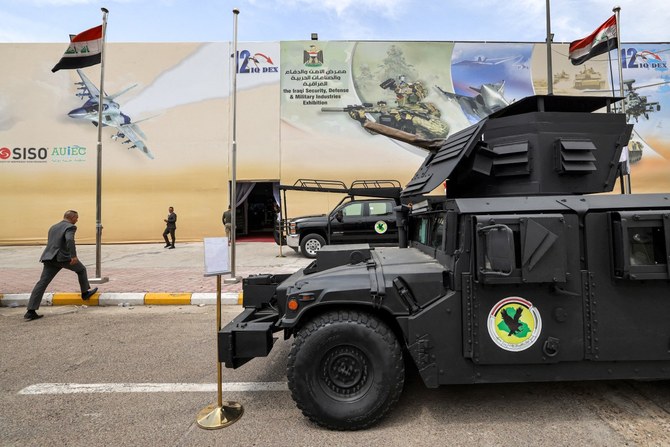
A man walks past an armed humvee vehicle of the Iraqi counter-terrorism service (CTS) (AFP)
Short Url
Updated 31 May 2024
Follow

Iraq hangs 8 convicted of ‘terrorism’: security, health sources

  • Eight Iraqis were convicted of terrorism and of being members of the Daesh group were executed by hanging
  • Under Iraqi law all terrorism and murder offenses are punishable by death

Nasiriyah: Iraqi authorities have executed eight people convicted of “terrorism” over links to the Daesh group, a security source in the country’s southern Dhi Qar province said Friday.
The source told AFP that eight Iraqis “convicted of terrorism and of being members of the Daesh group were executed by hanging” Thursday at Al-Hut prison in the city of Nasiriyah “under the supervision of a justice ministry team.”
A local medical source confirmed that the health department had received the bodies of eight executed people.
Under Iraqi law, terrorism and murder offenses are punishable by death, and execution decrees must be signed by the president.
The eight Iraqis were hanged “under Article 4 of the anti-terrorism law,” the security source said, requesting anonymity due to the sensitivity of the issue.
On May 6, Iraqi authorities executed by hanging 11 people convicted of “terrorism,” security and health sources told AFP. It was the second such group put to death since late April.
The execution on April 22 of 11 people sparked concern among rights groups, with Amnesty International condemning an “alarming lack of transparency.”
Al-Hut is a notorious prison in Nasiriyah whose Arabic name means “the whale,” because Iraqis believe that those jailed there never walk out alive.
Iraqi courts have handed down hundreds of death and life sentences in recent years for people convicted of membership in a “terrorist group,” an offense that carries the death penalty regardless of whether the defendant had been an active fighter.


Tunisian police clash with youths in Kairouan after man’s death

Rights groups accuse Saied of using the judiciary and police to stifle criticism, something that Saied denies. (AFP file photo)
Updated 15 December 2025
Follow

Tunisian police clash with youths in Kairouan after man’s death

  • Tunisia President Kais Saied shut down parliament and began ruling by decree in 2021 in what he called a move to root out rampant corruption and mismanagement, but which the opposition called a coup

TUNIS: Clashes erupted for a second night on Saturday between police and youths in the central Tunisian city of Kairouan after a man died following a police chase, according to his family, fueling authorities’ fears that protests could spread across the country. As Tunisia prepares to mark the January anniversary of the 2011 revolution, which sparked the Arab Spring uprising, tensions have risen amid protests, and a powerful UGTT union call for a nationwide strike next month. Thousands have been protesting for weeks in the southern city of Gabes, demanding the closure of a chemical plant on environmental grounds.
Witnesses said demonstrators in Kairouan threw stones, petrol bombs and flares, and blocked streets by burning tires, prompting police to disperse crowds with tear gas.
The family said the man, riding a motorcycle without a license, was chased by police, beaten, and taken to a hospital. He later fled and died on Friday from a head injury.
The government was not immediately available to comment. Relatives of the deceased said they will not remain silent and will spark major protests if those responsible are not held accountable.
In a bid to defuse tensions, Kairouan’s governor visited the family on Saturday evening and pledged to open an investigation to determine the circumstances of the death and establish accountability, witnesses said.
Tunisia President Kais Saied shut down parliament and began ruling by decree in 2021 in what he called a move to root out rampant corruption and mismanagement, but which the opposition called a coup.
Rights groups accuse Saied of using the judiciary and police to stifle criticism, something that Saied denies.