Jordanian minister calls for greater water cooperation with Iraq

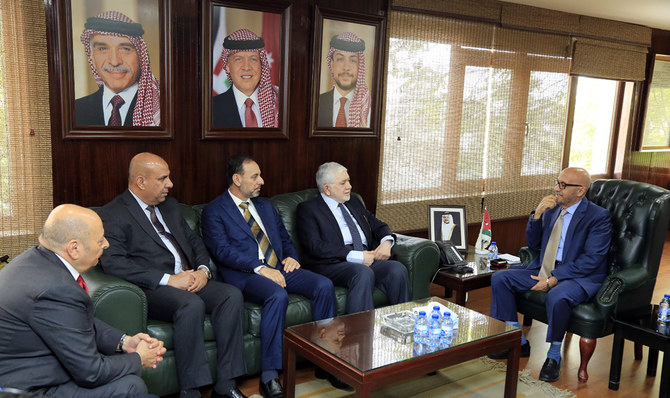
Jordan’s minister of water and irrigation Raed Abu Saud meets with an Iraqi delegation. (Petra)
Short Url
Updated 28 May 2024
Follow

Jordanian minister calls for greater water cooperation with Iraq

  • Abu Saud stressed pivotal role of the private sector in operating and maintaining water and sanitation facilities

AMMAN: Jordan’s minister of water and irrigation has called for increased regional cooperation in a bid to address water challenges through innovative and sustainable solutions.

On Tuesday, Raed Abu Saud met with a delegation from the Iraqi Ministry of Water Resources who are visiting Jordan to bolster collaboration in managing water resources, Jordan News Agency reported.

The visit aims to facilitate an exchange of expertise, drawing from Jordan’s experience in water conservation, reducing waste, improving irrigation efficiency, utilizing treated water, and providing training as part of a joint program between the two countries.

During the visit, the Iraqi delegation toured the command and control center at the Jordanian ministry’s headquarters. They were also scheduled to visit various water sites to observe the management of irrigation water systems and the modern technologies employed.

Abu Saud highlighted the need for collective efforts to combat the effects of climate change, implement advanced water harvesting techniques, and enhance capacity building through specialized technical courses.

He pointed out the significant decline in Jordan’s water resources, which he attributed to erratic rainfall and climate change, and outlined the ministry’s initiatives in developing water and sanitation services, notably through Build-Operate-Transfer projects and other sustainable initiatives.

Abu Saud also stressed the pivotal role of the private sector in operating and maintaining water and sanitation facilities, underscoring the importance of strengthening partnerships with private entities.

He highlighted the water authority’s training center as a regional hub for training technical personnel in modern water management practices and thanked the Iraqi ministry’s efforts in fostering cooperation with Jordan’s water sector.


Israeli strikes killed eight people in south Lebanon: state media

Updated 4 sec ago
Follow

Israeli strikes killed eight people in south Lebanon: state media

  • Israeli strikes killed eight people in Lebanon on Thursday as Israel renewed its evacuation call for vast areas of the country’s south, long a stronghold of Hezbollah

BEIRUT: Israeli strikes killed eight people in Lebanon on Thursday as Israel renewed its evacuation call for vast areas of the country’s south, long a stronghold of Hezbollah.
The Iran-backed militant group, which dragged Lebanon into the regional war on Monday when it launched an attack on Israel, said it had launched missiles at positions in the Galilee area.
The National News Agency (NNA) reported that the mayor of a village in the Nabatieh region of south Lebanon and his wife were killed in one strike, while in a nearby village another strike killed two children and their parents.
The Lebanese health ministry said two people were killed by a strike on a car near the city of Zahle in the east of the country.
There were new strikes on the southern suburbs of the capital, Hezbollah’s main bastion, early on Thursday, NNA reported, with AFPTV footage showing smoke coming from the area.
It also said a pre-dawn Israeli drone strike hit an apartment in Beddawi, a Palestinian refugee camp near Tripoli in the north of Lebanon, killing senior Hamas official Wassim Atallah Al-Ali and his wife.
Also on Thursday, Israel renewed its warning to residents of hundreds of square kilometers (miles) of southern Lebanon to evacuate because of military action.
Arabic-language spokesman for the Israeli military Avichay Adraee posted on X: “Urgent warning to residents of southern Lebanon: you must immediately continue evacuating to the north of the Litani river.”
The warning included the cities of Tyre and Bint Jbeil.
On Tuesday, Israel’s military said it was creating a buffer zone inside Lebanon to protect Israeli residents.
The following day, it said troops from three divisions, including infantry, armored and engineering units were operating inside Lebanon.