SINJAR, Iraq: When Bassem Eido steps outside his modest village house in Iraq’s Sinjar district, he is reminded of the horrors that befell the majority-Yazidi region during Daesh group’s onslaught a decade ago.
The area near the Syrian border still bears the scars of the fighting that raged there in 2014 — bullet-riddled family homes with pancaked roofs and warning signs of the lethal threat of land mines and war munitions.
It was here that the militants committed some of their worst atrocities, including mass executions and sexual slavery, before a fightback driven by Kurdish forces dislodged them from the town of Sinjar by the following year.
A decade on, the self-declared Daesh caliphate across Syria and Iraq is a dark and distant memory, but the pain is raw in Eido’s largely abandoned village of Solagh, 400 kilometers (250 miles) northwest of Baghdad.
“Out of 80 families, only 10 have come back,” Eido told AFP in the desolate village which was once famed for its flourishing grape vines. “The rest say there are ... no homes to shelter them. Why would they return?“
A walk through Solagh reveals collapsed homes overgrown with wild scrub and the rusting skeletons of destroyed plumbing systems scattered amid the dust and debris.
“How can my heart be at peace?” said Eido, a 20-year-old Yazidi. “There is nothing and no one that will help us forget what happened.”
After liberation, Eido honored his father’s wish to spend his final days at their home and agreed to move back in with him. Their house was ravaged by fire but still standing and could be rebuilt with help from an aid group.
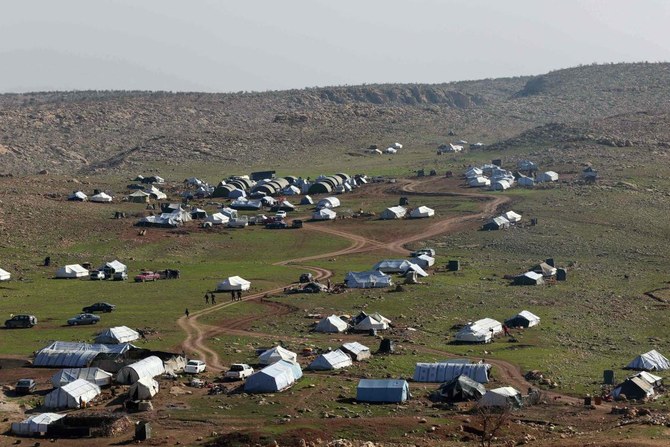
Most people cannot afford to rebuild, said Eido, and some camp in tents in the ruins of their homes. However, if large-scale reconstruction started, he predicted, “everyone would come back.”
Such efforts have been slowed by political infighting, red tape and other structural problems in this remote region of Iraq, a country still recovering from decades of dictatorship, war and instability.
Many who fled the Daesh moved to vast displacement camps, but the federal government this year announced a July 30 deadline to close them.
Baghdad promised financial aid to returning families and has vowed to ramp up reconstruction efforts. The migration ministry said recently that hundreds had returned to their homes.
However, more than 183,000 people from Sinjar remain displaced, the International Organization for Migration said in a recent report.
While most areas have seen “half or fewer” of their residents come back, it said, “13 locations have not recorded returns since 2014.”
Local official Nayef Sido said that villages “are still razed to the ground and the majority of the people haven’t received compensation.”
Some returnees are leaving again because, with no jobs, they cannot make ends meet, he added.
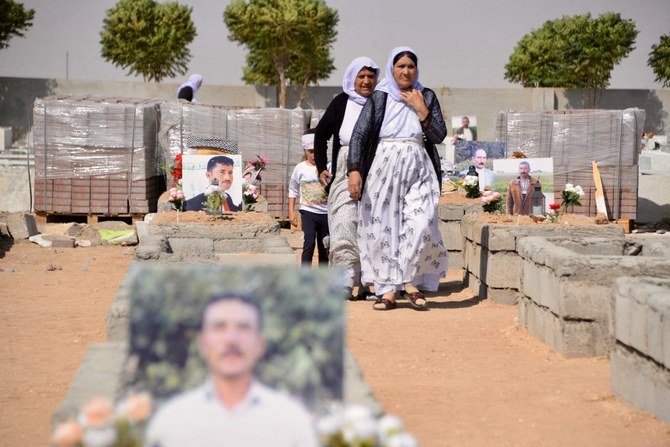
All of this only adds to the plight of the Yazidis, an ethnic and religious minority that suffered the brunt of Daesh atrocities, with thousands killed and enslaved.
In the village of Kojo, Hadla Kassem, a 40-year-old mother of three, said she lost at least 40 members of her family, including her mother, father and brother.
Three years ago, she sought government compensation for her family’s destroyed home, with the support of the Norwegian Refugee Council (NRC), but to no avail.
While she is still hoping for a monthly stipend for the loss of her relatives, she is trapped in a maze of bureaucracy like many others.
Authorities “haven’t opened all the (mass) graves, and the martyrs’ files haven’t been solved, and those in camps haven’t returned,” Kassem said.
“We are devastated... We need a solution.”
In order to entice people to return, said the NRC’s legal officer in Sinjar, Feermena Kheder, “safe and habitable housing is a must, but we also need functional public infrastructure like roads, schools and government buildings.”
“Only with these foundations can we hope to rebuild our lives.”
For now, many residents must travel hours for medical care that is not available at the city’s only hospital.
A local school has been turned into a base for an armed group, while an old cinema has become a military post.
Sinjar has long been at the center of a paralysing struggle for control between the federal government and the autonomous Kurdistan administration based in Irbil.
In 2020, the two sides reached an agreement that included a reconstruction fund and measures to facilitate the return of displaced people. But they have so far failed to implement it.
Adding to the complexities is the tangled web of armed forces operating there today.
It includes the Iraqi military, a Yazidi group affiliated with Turkiye’s foe the Kurdistan Workers’ Party (PKK), and the Hashed Al-Shaabi, a coalition of pro-Iran ex-paramilitaries now integrated into the regular army.
“All parties want more control, even blocking appointments and hindering” reconstruction efforts, said a security official who requested anonymity.
In 2022, clashes between the army and local fighters forced thousands to flee again.
Human Rights Watch researcher Sarah Sanbar warned that “both Baghdad and Irbil claim authority over Sinjar, but neither is taking responsibility for it.”
“Rather than focus on closing the camps, the government should invest in securing and rebuilding Sinjar to be a place people actually want to return to.”


![]()
![]()
![]()

Decade after Daesh horrors, Iraq’s Sinjar remains in ruins

Short Url
https://arab.news/99pcb
Decade after Daesh horrors, Iraq’s Sinjar remains in ruins
- The area near the Syrian border still bears the scars of the fighting that raged there in 2014
- A decade on, the self-declared Daesh caliphate across Syria and Iraq is a dark and distant memory


Latest updates


Recommended


© 2026 SAUDI RESEARCH & PUBLISHING COMPANY, All Rights Reserved And subject to Terms of Use Agreement.