

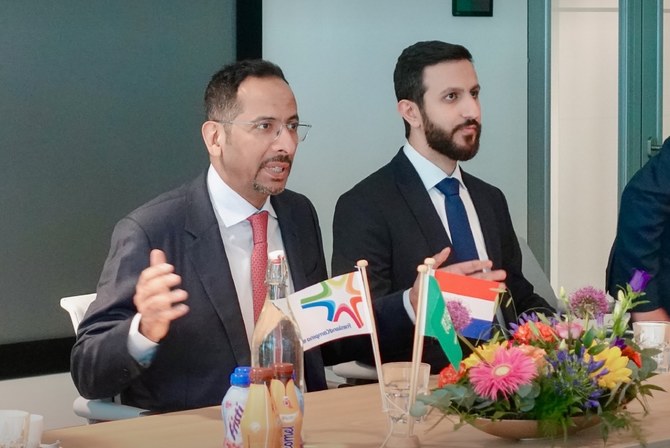

RIYADH: Saudi-Dutch ties in the industrial and mining sector are set to strengthen, as the Kingdom’s industry minister visited some of the leading manufacturing firms in the Netherlands.
Bandar Alkhorayef visited the Philips Medical Devices factory in Eindhoven, where he met with Edwin Paalvast, the executive board member and head of international markets at Philips. They discussed enhancing cooperation in the medical devices field and localizing this vital industry within Saudi Arabia.
The Saudi minister’s visit to the Netherlands aimed to bolster cooperation and develop partnerships in various industrial activities between the two countries.
Alkhorayef also visited FrieslandCampina, a leader in dairy products and their derivatives. In discussions with Marchel Gorselink, the general manager of research and development at FrieslandCampina, they explored the potential for establishing a research and development center in the Kingdom to enhance local production quality and food processing.
Additionally, the minister met with David Haines, CEO of Upfield, to discuss cooperation in consumer products and plant-based food production. They shared expertise to contribute to food security goals and environmental sustainability.
This visit aligns with Saudi Arabia’s ongoing efforts to enhance the role of its industrial and mining sectors in the national economy and promote growth pathways between the two countries in promising industries. It also seeks to attract quality investments and increase the penetration of Saudi non-oil exports into Dutch and European markets.
During his meetings with Dutch ministers, including the Minister of Foreign Trade and Development, Liesje Schreinemacher, and the Minister of Economic Affairs and Climate Policy, Micky Adriaansens, Alkhorayef focused on strengthening bilateral trade relations and exploring cooperation opportunities in industry, mining, trade, and investment.
They also discussed developing strategic partnerships in various sectors, including manufacturing, advanced technology, and renewable energy.
The visit highlights Saudi Arabia’s unique opportunities and capabilities in the industrial and mining sectors, along with its environmental conservation efforts and climate change initiatives, such as the Saudi Green and Middle East Green Initiatives.
Additionally, Alkhorayef held discussions with officials at the Dutch Port of Rotterdam on ways to enhance cooperation in logistics, the Saudi Press Agency reported.
During these sessions, they explored the Kingdom’s role as a supplier of vital minerals in the global supply chain and discussed investment cooperation with Dutch companies in metal processing and recycling.
Earlier in May, Saudi Arabia’s General Authority for Survey and Geospatial Information served as a strategic partner in the Geospatial World Forum, a global event featuring over 300 speakers specializing in geospatial information.
During the opening session, Mohammed Al-Sayel, president of the authority, emphasized the importance of geospatial information for decision-making in the rapidly growing Saudi economy.


