

Nearly 3 out of 10 Afghan children face emergency levels of hunger in 2024— NGO 

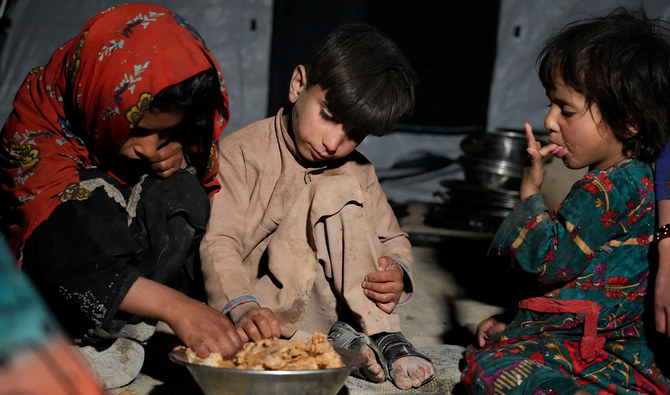
Afghan children eat in a makeshift shelter after an earthquake in Gayan district in Paktika province, Afghanistan, on June 25, 2022. (AP)
Short Url
Updated 29 May 2024
Follow

Nearly 3 out of 10 Afghan children face emergency levels of hunger in 2024— NGO 

  • Estimated 2.9 million Afghan children under five years of age to suffer acute malnutrition in 2024, says Save The Children 
  • Afghanistan reels from immediate impacts of flood, long-term effects of drought and return of refugees from Pakistan

ISLAMABAD: About 6.5 million children in Afghanistan were forecast to experience crisis levels of hunger in 2024, a nongovernmental organization said.

Nearly three out of 10 Afghan children will face crisis or emergency levels of hunger this year as the country feels the immediate impacts of floods, the long-term effects of drought, and the return of Afghans from neighboring Pakistan and Iran, according to a report released late Tuesday by Save The Children.

New figures from global hunger monitoring body Integrated Food Security Phase Classification forecast that 28 percent of Afghanistan’s population, about 12.4 million people, will face acute food insecurity before October. Of those, nearly 2.4 million are predicted to experience emergency levels of hunger, which is one level above famine, according to Save the Children.

The figures show a slight improvement from the last report, released in October 2023, but underline the continuing need for assistance, with poverty affecting half of the population.

Torrential rain and flash floods hit northern Afghanistan in May, killing more than 400 people. Thousands of homes were destroyed or damaged and farmland was turned into mud.

Save the Children is operating a “clinic on wheels” in Baghlan province, which was hit the worst by floods, as part of its emergency response program. The organization added that an estimated 2.9 million children under the age of 5 are projected to suffer from acute malnutrition in 2024.

Arshad Malik, country director for Save the Children in Afghanistan, said that the NGO has treated more than 7,000 children for severe or acute malnutrition so far this year.

“Those numbers are a sign of the massive need for continuing support for families as they experience shock after shock,” Malik said. 

Children are feeling the devastating impacts of three years of drought, high levels of unemployment, and the return of more than 1.4 million Afghans from Pakistan and Iran, he added.

“We need long-term, community-based solutions to help families rebuild their lives,” Malik said.

More than 557,000 Afghans have returned from Pakistan since September 2023, after Pakistan began cracking down on foreigners it alleges are in the country illegally, including 1.7 million Afghans. It insists the campaign isn’t directed against Afghans specifically, but they make up most of the foreigners in the South Asian country.

In April, Save the Children said that a quarter-million Afghan children need education, food and homes after being forcibly returned from Pakistan.

Malik added that only 16 percent of funding for the 2024 humanitarian response plan has been met so far, but nearly half the population needs assistance.

“This is not the time for the world to look away,” he said.

Meanwhile, the European Union is allocating an additional 10 million euros (nearly $10.9 million) to the UN food agency for school feeding activities in Afghanistan. These latest funds from the EU follow an earlier contribution of 20.9 million euros ($22.7 million) toward the World Food Program’s school meal program in Afghanistan for 2022 and 2023.

The funding comes at a timely moment and averts WFP having to downsize its school meal program this year because of a lack of funding, the WFP said in a statement.

“Hunger can be a barrier to education. The additional EU funding to our long-standing partner WFP ensures that more children in Afghanistan receive nutritious food,” said Raffaella Iodice, chargé d’affaires of the EU’s delegation to Afghanistan.

The WFP’s statement said that the agency will be able to use the funding to distribute fortified biscuits or locally produced nutritious school snacks to pupils in more than 10,000 schools in the eight provinces of Farah, Ghor, Jawzjan, Nangarhar, Nuristan, Paktika, Uruzgan and Zabul.

Last year, WFP supported 1.5 million school-age children through this program.


Ukraine’s Zelensky meets Pope Leo, prepares revised plan on Russia war

Updated 6 sec ago
Follow

Ukraine’s Zelensky meets Pope Leo, prepares revised plan on Russia war

  • UKrainian leader said that Washington’s 28-point plan had been reduced to 20 points after US-Ukraine talks at the weekend
CASTEL GANDOLFO, Italy: Ukrainian President Volodymyr Zelensky met with Pope Leo XIV in Italy on Tuesday as he prepared to send the United States revised proposals to end Russia’s invasion.
Zelensky on Monday held talks with European leaders in London and Brussels as US President Donald Trump keeps up pressure on Kyiv for a settlement.
Trump has accused Zelensky of not even reading his administration’s initial proposals, which were judged by Ukraine’s allies to be overly favorable to Russia.
Zelensky said that Washington’s 28-point plan had been reduced to 20 points after US-Ukraine talks at the weekend.
Ukrainian and European officials “are going to work on these 20 points,” Zelensky told an online press conference on Monday.
“We do not like everything that our partners came back with. Although this issue is not so much with the Americans as with the Russians.
“But we will definitely work on it, and as I said, tomorrow evening (Tuesday) we will do everything to send our view on this to the US.”
Washington’s plan involved Ukraine surrendering land that Russia has not captured in return for security promises that fall short of Kyiv’s aspirations to join NATO.
Zelensky pointed to the land issue and international security guarantees as two of the main sticking points.
“Do we envision ceding territories? We have no legal right to do so, under Ukrainian law, our constitution and international law. And we don’t have any moral right either,” Zelensky said.
“The key is to know what our partners will be ready to do in the event of new aggression by Russia. At the moment, we have not received any answer to this question,” Zelensky said.
‘Robust security guarantees’
Zelensky met with Pope Leo at his country residence in Castel Gandolfo near Rome, and is to meet Italian Prime Minister Giorgia Meloni later Tuesday.
Meloni has been a staunch supporter of Kyiv since Russia’s February 2022 invasion, although one of her coalition allies, Matteo Salvini’s League party, is more skeptical.
Rome has sent weapons to Ukraine but only for use inside the country. Meloni has also ruled out sending troops in a possible monitoring force proposed by Britain and France.
The Italian government last week postponed a decision on renewing military aid to Ukraine, with the current authorization due to end on December 31. Salvini has reportedly questioned if it was necessary given the new talks.
However, Meloni at the time insisted that “as long as there’s a war, we’ll do what we can, as we’ve always done to help Ukraine defend itself.”
On Monday, Zelensky met in London with the leaders of Britain, France and Germany before heading to Brussels for talks with the heads of the EU and of NATO.
“Ukraine’s sovereignty must be respected. Ukraine’s security must be guaranteed, in the long term, as a first line of defense for our Union,” European Commission President Ursula von der Leyen said after Monday’s meeting.
French President Emmanuel Macron wrote on X after the London meeting that “we are preparing robust security guarantees and measures for Ukraine’s reconstruction.”
Macron said the “main issue” was finding “convergence” between the European-Ukrainian position and that of the United States.
Trump has blown hot and cold on Ukraine since returning to office in January, initially chastising Zelensky for not being grateful for US support.
But he was also frustrated that efforts to persuade Russian President Vladimir Putin to end the war had failed to produce results and he recently slapped sanctions on Russian oil firms.