

Jerusalem’s Latin Patriarch visits Gaza for Christmas
The senior churchman “arrived in Gaza today for a pastoral visit to the Holy Family Parish, on the eve of the Christmas celebrations,” his office said
During his visit, Pizzaballa will review developments in humanitarian response on the ground in Gaza
Updated 19 December 2025
AFP
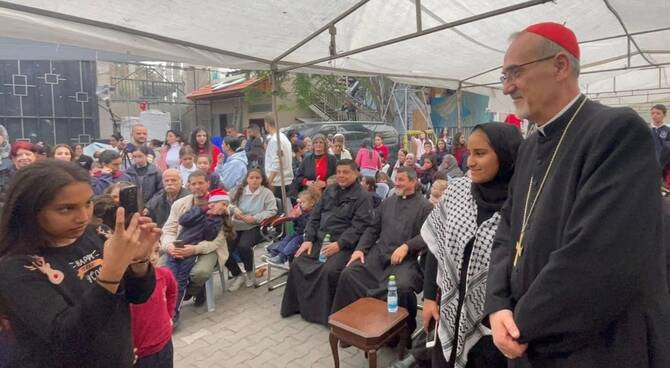
JERUSALEM: Jerusalem’s Latin Patriarch, Cardinal Pierbattista Pizzaballa, arrived in Gaza Friday for Christmas Mass at the Holy Family Parish in Gaza City, which hosts the Palestinian territory’s only Roman Catholic church.
The senior churchman “arrived in Gaza today for a pastoral visit to the Holy Family Parish, on the eve of the Christmas celebrations,” his office said in a statement.
صور من استقبال رعية العائلة المقدسة في غزة لغبطة البطريرك الكاردينال بيتسابالا، بطريرك القدس للاتين، والمطران وليم شوملي، النائب البطريركي العام، ووفد من الكهنة احيث استهلت الزيارة اليوم الجمعة ١٩ كانون الاول ٢٠٢٥ .
It said the visit “reaffirms the enduring bond of the Holy Family Parish in Gaza with the wider Diocese of the Latin Patriarchate of Jerusalem.”
During his visit, Pizzaballa will review developments in humanitarian response on the ground in the Gaza Strip as well as rehabilitation efforts.
He will also lead an anticipated Christmas Mass at the Holy Family Parish on Sunday, the statement said.
Cardinal Pierbattista Pizzaballa, the Latin Patriarch of Jerusalem, visits the Holy Family Catholic Parish in Gaza City ahead of Christmas and will lead the Christmas Mass there.
During his last visit to Gaza in July, Pizzaballa brought in 500 tons of food for residents suffering from shortages caused by Israeli restrictions on goods entering the devastated territory.
Pizzaballa and his Greek Orthodox counterpart, Theophilos III, were visiting after Israeli fire hit the Holy Family Church, killing three people.
A famine declared in Gaza in August is now over thanks to improved access for humanitarian aid, the United Nations said on Friday, also warning that the food situation there remained “critical.”
About 1,000 of 2.2 million Gaza inhabitants are Christians, most of them Orthodox.
The Latin Patriarchate says 135 Catholics live in Gaza. They sought shelter inside the compound of the Holy Family Church in the first days of the war between Israel and Hamas.
Some members of the Greek Orthodox church joined them in the compound owned by the Roman Catholic church.
How wars in the Middle East turned motherhood into daily survival battles
Behind UN statistics on malnutrition and war injuries are mothers navigating an impossible reality
With power out and hospitals in ruins, mothers in war zones must go to extreme lengths to do once-simple chores
Updated 4 sec ago
ANAN TELLO
LONDON: As wars rage, mothers bear a disproportionate share of the suffering, navigating grief, hunger and fear while trying to shield their children from violence that has fractured families and communities.
From the Gaza Strip to Syria’s coastal regions, conflicts differ in origins and combatants but share a common human cost: the toll on women raising children amid bombardment, displacement and the collapse of basic services.
“When we speak of conflict, we must remember that violence does not stop at the battlefield,” said Ayesha Ahmed, an associate professor at City St George’s, University of London. “It reaches into homes where food runs out and into tents where babies sleep without warmth or nourishment.”
“The grief of mothers is not collateral damage,” she told Arab News. “It is the epicenter of war’s enduring echo.”
A woman reacts as mourners attend the funeral of Palestinians who were killed, according to medics, in Israeli fire, at Al-Shifa hospital, in Gaza City, June 12, 2025. (REUTERS/Mahmoud Issa)
That echo is particularly loud in Palestine’s Gaza Strip, where thousands of families have been repeatedly displaced, at least 9,000 children suffer acute malnutrition, and more than 42,000 people have been left disabled by war-related injuries, according to UN figures.
Behind each number is a mother coping with loss.
Early in the ongoing war, footage circulated worldwide of a Palestinian mother cradling her toddler’s lifeless body, rocking him gently as he lay wrapped in a bloodstained shroud.
In the December 2023 video, she tells her own mother through sobs: “By God, Yamma (Mom), I really suffered to have him … I took 580 heparin shots,” referring to blood-thinning injections sometimes used in fertility treatments.
Even for those who survive airstrikes in Gaza, the dangers persist. Disease, exposure and hunger continue to claim lives amid shortages of clean water, food, and medical supplies.
The crisis has not spared expecting and new mothers.
Months of a tight Israeli blockade have pushed food insecurity to levels that threaten maternal and newborn health, even as limited humanitarian assistance has trickled back since a ceasefire took effect on Oct. 10.
Acute hunger among pregnant and breastfeeding women is a lesser-known but critical threat with a “devastating domino effect” for thousands of newborns, Tess Ingram, a communications manager at the UN Children’s Fund, said from Gaza on Dec. 9.
Low-birthweight infants, Ingram noted, are about 20 times more likely to die than babies of normal weight.
Even for those who are not pregnant, survival is a daily struggle.
Maysa Yousef, an artist and mother of four in central Gaza, said the current war has introduced challenges unlike any she experienced during previous conflicts.
“Never before had we lived without electricity for two years or more,” she told Arab News. “Since Oct. 7, 2023, we haven’t seen electricity at all. We have a washing machine, a refrigerator, and other appliances, but none of it can be used.”
Without power, routine tasks require hours of labor.
“We must invent ways to carry out all household tasks and responsibilities,” she said. “To charge a mobile phone, you need solar power, or you have to find someone who can charge it for you — along with a light so your children can do their homework after dark.”
She added: “You have to wash your children’s clothes by hand. You have to figure out how to preserve the food you manage with great difficulty to find after searching for hours — a single meal, a loaf of bread, anything.
“If you can’t find bread, you must make it yourself: knead dough by hand and bake it over an improvised fire. We had to break room doors in our house and burn our clothes and even my art supplies just to bake a single loaf of bread.
“It’s a constant struggle to have to come up with solutions, thinking 24 hours a day. It’s mentally draining because you must always be alert, and time is never on your side.”
Yousef said she wakes before dawn and works until late afternoon without a break, juggling household chores with caring for her children and running art workshops.
Yet this grueling routine is overshadowed by the trauma many women have endured since Israel launched its offensive on Oct. 7, 2023, in retaliation for a deadly Hamas-led Palestinian militant attack.
As Israeli forces advanced into neighborhoods, some residents were forcibly removed, Yousef said. Some women, she added, were detained during evacuations and forced to leave their children — including infants — behind.
“There were women taken while they were with their children, some holding babies just a few months old,” Yousef said. “They were told, ‘Put the baby down on the pavement and come,’ and then they were taken prisoner.”
“Imagine a mother’s psychological state,” she added, “when her baby is only months old, or when she has four or five children, yet is forced to leave them on the street while the army takes her to an unknown prison.”
During a ground offensive in Rafah in April 2024, families were given about an hour to evacuate, she said. Survivors later told her that people fled barefoot, leaving belongings behind.
“One mother said, ‘While I was running with my children, soldiers started firing randomly at us, as if for sport,’” Yousef recalled. Some of her children were shot and fell. Unable to carry them, she continued to run.
“She said, ‘If we don’t leave, we will all die, or we don’t know what they might do to us.’ She left her injured child behind and kept running.”
Similar images of maternal grief are also common in Syria, where 14 years of war and renewed sectarian violence have left thousands of families mourning lost children.
In March, a video filmed by assailants showed an elderly mother standing over the bodies of her two sons and grandson in a coastal village, reportedly killed during sectarian attacks.
The woman, identified locally as Umm Ayman, faced armed men who insulted her and accused her community of betrayal. One mockingly told her to take her sons. He also said: “You (Alawites) are traitors.”
“Fashart (nonsense),” she replied. “We did not betray,” before praying for God to avenge her sons.
Rights groups said Umm Ayman guarded the bodies, which lay behind her house, for four days until she was able to bury them.
According to media reports, Umm Ayman is from Qabu Al-Awamiya, between Latakia and Jableh. Her sons, Kinan and Suhail, were poor farmers; Suhail was also a teacher and translator. Kinan, a former soldier, had reported to a reconciliation center after the fall of Bashar Assad’s regime on Dec. 8 and regained civilian status.
Their deaths came amid revenge killings along Syria’s coast and nearby central regions following clashes between government forces and supporters of the ousted regime. The violence marked one of the deadliest episodes since Assad’s fall in December.
The UN said that approximately 1,400 people, most of them civilians, were reportedly killed in the March massacres. In August, it warned that Syria’s Alawite minority, which makes up about 10 percent of the population, continues to face targeted attacks.
In another incident on Dec. 8, a mother in Latakia watched footage circulating online that showed her son’s killing.
According to media reports, armed men were driving around the Al-Yahudiya quarter that evening and firing celebratory shots, marking the anniversary of Assad’s downfall.
As the young man, Murad Mohammed Mehrez, was walking home from his job at a cafe, the armed men stopped him and asked about his sect. When he answered that he was Alawite, they immediately opened fire on his chest.
People in the area took him to the hospital, but he did not survive.
At his funeral, mourners recorded his mother saying, “Close the door behind you, Murad … enough blood,” urging an end to the bloodshed and praying that her son would be the last victim of sectarian violence.
Despite the losses, mothers across conflict zones continue to provide stability for their children, said Ahmed, the London-based academic who studies war trauma.
“Motherhood in war is a sanctuary,” she said. “These women become healers without hospitals, teachers without schools ... Their lullabies to their children are whispered acts of resistance.”
While conflicts across Gaza, Syria, Sudan and Yemen are often discussed in geopolitical terms, Ahmed said their human impact is strikingly similar.
“When you listen to mothers from different war zones, the details change, but the fear and grief do not,” she said. “They are trying to keep their children alive in circumstances no parent should face.”