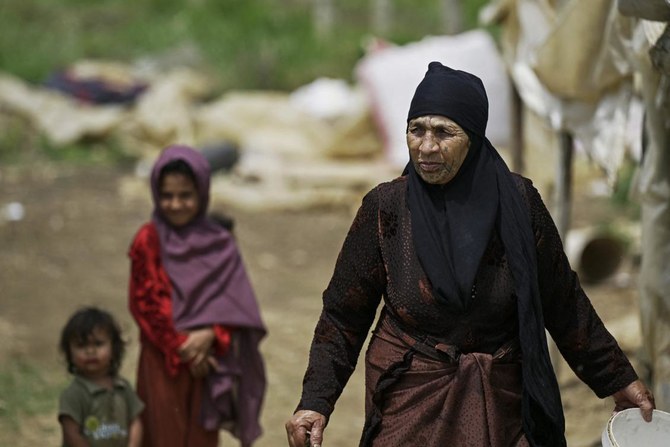
BEKAA VALLEY: The soldiers came before daybreak, singling out the Syrian men without residence permits from the tattered camp in Lebanon’s Bekaa Valley. As toddlers wailed around them, Mona, a Syrian refugee in Lebanon for a decade, watched Lebanese troops shuffle her brother onto a truck headed for the Syrian border.
Thirteen years since Syria’s conflict broke out, Lebanon remains home to the largest refugee population per capita in the world: roughly 1.5 million Syrians — half of whom are refugees formally registered with the United Nations refugee agency UNHCR — in a country of approximately 4 million Lebanese.
They are among some five million Syrian refugees who spilled out of Syria into neighboring countries, while millions more are displaced within Syria. Donor countries in Brussels this week pledged fewer funds in Syria aid than last year.
With Lebanon struggling to cope with an economic meltdown that has crushed livelihoods and most public services, its chronically underfunded security forces and typically divided politicians now agree on one thing: Syrians must be sent home.
Employers have been urged to stop hiring Syrians for menial jobs. Municipalities have issued new curfews and have even evicted Syrian tenants, two humanitarian sources told Reuters. At least one township in northern Lebanon has shuttered an informal camp, sending Syrians scattering, the sources said.
Lebanese security forces issued a new directive this month shrinking the number of categories through which Syrians can apply for residency — frightening many who would no longer qualify for legal status and now face possible deportation.
Lebanon has organized voluntary returns for Syrians, through which 300 traveled home in May. But more than 400 have also been summarily deported by the Lebanese army, two humanitarian sources told Reuters, caught in camp raids or at checkpoints set up to identify Syrians without legal residency.
They are automatically driven across the border, refugees and humanitarian workers say, fueling concerns about rights violations, forced military conscription or arbitrary detention.
Mona, who asked to change her name in fear of Lebanese authorities, said her brother was told to register with Syria’s army reserves upon his entry. Fearing a similar fate, the rest of the camp’s men no longer venture out.
“None of the men can pick up their kids from school, or go to the market to get things for the house. They can’t go to any government institutions, or hospital, or court,” Mona said.
She must now care for her brother’s children, who were not deported, through an informal job she has at a nearby factory. She works at night to evade checkpoints along her commute.
’Wrong $ not sustainable’
Lebanon has deported refugees in the past, and political parties have long insisted parts of Syria are safe enough for large-scale refugee returns.
But in April, the killing of a local Lebanese party official blamed on Syrians touched off a concentrated campaign of anti-refugee sentiment.
Hate speech flourished online, with more than 50 percent of the online conversation about refugees in Lebanon focused on deporting them and another 20 percent referring to Syrians as an “existential threat,” said Lebanese research firm InflueAnswers.
The tensions have extended to international institutions. Lebanon’s foreign minister has pressured UNHCR’s representative to rescind a request to halt the new restrictions and lawmakers slammed a one billion euro aid package from the European Union as a “bribe” to keep hosting refugees.
“This money that the EU is sending to the Syrians, let them send it to Syria,” said Roy Hadchiti, a media representative for the Free Patriotic Movement, speaking at an anti-refugee rally organized by the conservative Christian party.
He, like a growing number of Lebanese, complained that Syrian refugees received more aid than desperate Lebanese. “Go see them in the camps — they have solar panels, while Lebanese can’t even afford a private generator subscription,” he said.
The UN still considers Syria unsafe for large-scale returns and said rising anti-refugee rhetoric is alarming.
“I am very concerned because it can result in... forced returns, which are both wrong and not sustainable,” UNHCR head Filippo Grandi told Reuters.
“I understand the frustrations in host countries — but please don’t fuel it further.”
Zeina, a Syrian refugee who also asked her name be changed, said her husband’s deportation last month left her with no work or legal status in an increasingly hostile Lebanese town.
Returning has its own dangers: her children were born in Lebanon and do not have Syrian ID cards, and her home in Homs province remains in ruins since a 2012 government strike that forced her to flee.
“Even now, when I think of those days, and I think of my parents or anyone else going back, they can’t. The house is flattened. What kind of return is that?” she said.


![]()
![]()

Syrians in Lebanon fear unprecedented restrictions, deportations

Short Url
https://arab.news/cs2mk
Syrians in Lebanon fear unprecedented restrictions, deportations
- Lebanon remains home to the largest refugee population per capita in the world: roughly 1.5 million Syrians
- Five million Syrian refugees who spilled out of Syria into neighboring countries, while millions more are displaced within Syria


Latest updates


© 2026 SAUDI RESEARCH & PUBLISHING COMPANY, All Rights Reserved And subject to Terms of Use Agreement.