Philippine authorities say 7 dead after storm

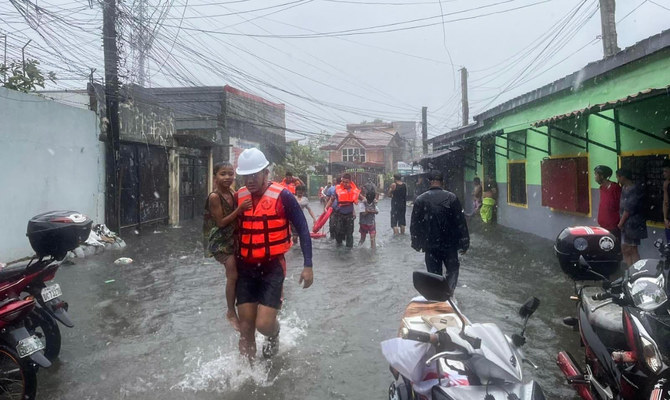
Children are evacuated from a flooded area by coast guard personnel in Lucena, Quezon Province, amid heavy rain brought by tropical storm Ewiniar. (AFP)
Short Url
Updated 28 May 2024
Follow

Philippine authorities say 7 dead after storm

  • The Southeast Asian nation sees an average of 20 storms annually, often resulting in heavy rains, strong winds, and deadly landslides

MANILA: Philippine authorities said at least seven people had been killed by tropical storm Ewiniar, which hit the country on the weekend, and President Ferdinand Marcos Jr said on Tuesday that search and rescue efforts would continue.
Ewiniar brought strong winds and heavy rain in provinces south of the capital, shutting down airports and seaports and disrupting power supply.
The storm was heading toward east coast of Japan on Tuesday, with sustained winds of up to 130 kilometers per hour (80 mph) and gustiness of up to 160 kph (100 mph).
A 14-year-old girl was confirmed dead in southern Misamis Oriental province after a tree fell on a parked vehicle she was boarding. Another student was injured, the national disaster agency said in a report.
In Quezon province, east of the capital, six people were reported dead, police major Elizabeth Capistrano told DWPM radio station. Among the deceased were two men, aged 56 and 22, who drowned, and a 39-year-old man who was hit by a falling tree.
Marcos, speaking ahead of a state visit to Brunei, said the storm affected nearly 27,000 people, and disrupted operations of three airports and nine seaports over the weekend.
Ewiniar was the first tropical storm to hit the Philippines this year. The Southeast Asian nation sees an average of 20 storms annually, often resulting in heavy rains, strong winds, and deadly landslides.


Japan to test mine rare-earth mud from deep seabed

Updated 5 sec ago
Follow

Japan to test mine rare-earth mud from deep seabed

TOKYO: Japan will conduct test mining of rare-earth-rich mud from the deep seabed off Minamitori Island, some 1,900 ​kilometers (1,180 miles) southeast of Tokyo, from January 11 to February 14, the head of the government-backed project said on Tuesday.
The operation will mark the world’s first attempt to continuously lift rare-earth mud from a depth of around 6,000 meters on to a vessel.
Tokyo, like its Western allies, is seeking to secure stable supplies of critical minerals as China, the ‌dominant supplier ‌of rare earths, tightens export controls.
“One of ‌our ⁠missions ​is ‌to build a supply chain for domestically produced rare earths to ensure stable supply of minerals essential to industry,” Shoichi Ishii, program director of the Cabinet Office’s national platform for innovative ocean developments, told reporters.
The Japanese government is pressing ahead with a national project as part of broader efforts to strengthen maritime and economic ⁠security.
The January test will focus on connecting the deep-sea mining system and confirming ‌its ability to lift 350 metric ‍tons of rare-earth mud per day. ‍Environmental impacts will be monitored both on board and on ‍the seabed throughout the operation.
No production target has been set, but if successful, a full-scale mining trial will be conducted in February 2027.
The government-funded project has spent about 40 billion yen ($256 million) ​since 2018, Ishii said, though estimated reserves have not been disclosed.
Ishii also said that while their research ⁠vessel was conducting rare-earth surveys within Japan’s exclusive economic zone (EEZ) around Minamitori Island from May 27 to June 25, a Chinese naval fleet entered the waters on June 7.
“We feel a strong sense of crisis that such intimidating actions were taken, despite our activities being limited to seabed resource surveys within our EEZ,” he said.
China’s foreign ministry said the activities of its military vessels are in line with international law and international conventions, and called on Japan to “refrain from hyping up threats and provoking ‌confrontation,” in a reply to Reuters’ request for comment.