BRUSSELS: The EU on Wednesday releases its plan to try to end the 27-nation bloc’s dependence on China for rare earths, as Beijing’s stranglehold threatens key industries.
China, the world’s top producer of rare earths, in October announced new controls on the export of the elements, which are used to make magnets crucial to the auto, electronics and defense industries.
The move rattled markets and snarled supply chains until China later said it would suspend the curbs for one year.
Already since April, Beijing has required licenses for certain exports of the materials, hitting global manufacturing sectors.
EU industry chief Stephane Sejourne has called on the bloc to “step up” against what he said was essentially a “racket” being run by Beijing.
The new plan will look to push for the EU to speed up the joint purchasing of critical raw materials including rare earths, accelerate production and recycling in Europe, work with reliable partners and conclude new partnerships.
The EU’s executive will also propose next week the creation of a European Center for Critical Raw Materials that will be the bloc’s supply hub, modelled on Japan’s state-run Japan Oil, Gas and Metals National Corporation.
The EU finds itself squeezed between China’s restrictions and the United States under Donald Trump, which is negotiating bilateral agreements on all fronts to secure its own supplies.
A study published Monday by the EU Chamber of Commerce in China said 60 percent of its members expected disruptions to their supply chains because of government-imposed restrictions, and 13 percent fear they may have to interrupt or slow down their production.
“The situation is really urgent from our perspective,” said Florian Anderhuber, the deputy director general of Euromines lobby group.
“Speed is now of the essence.”
Euromines is calling to accelerate permits for new mines in Europe and to slash the red tape required.
It also wants financing guarantees and initiatives to reduce the price difference between China and Europe, which has acted as a break on producers on the continent.
In addition, the European Commission on Wednesday will update its strategy for ensuring the EU’s “economic security.”
The first strategy was produced in 2023 as the bloc grappled with the harsh lessons from the Covid pandemic and Ukraine war that showed up the fragility of its supply lines.
In the face of new diplomatic and geopolitical tensions, most strikingly a US administration willing to act aggressively on trade against its close allies, Brussels needs a refresh.
The new strategy will look to revise how Europe can use its most potent trade tools such as controls on foreign investment and export restrictions, to flex its own muscles.

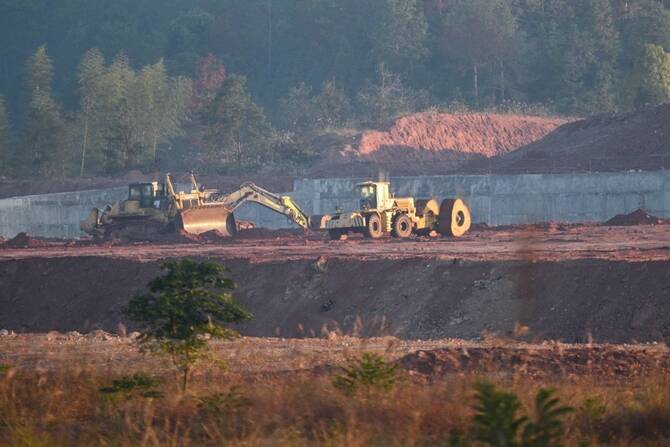
EU pushes to end its dependence on China for rare earths
https://arab.news/8aa2p
EU pushes to end its dependence on China for rare earths
US allows oil majors to broadly operate in Venezuela, new energy investments
- Treasury Department issues general license allowing Chevron, BP, Eni, Shell and Repsol to operate oil and gas operations in Venezuela
- Move is the most significant relaxation of sanctions on Venezuela since US forces captured and removed President Nicolas Maduro
WASHINGTON: The US eased sanctions on Venezuela’s energy sector on Friday, issuing two general licenses that allow global energy companies to operate oil and gas projects in the OPEC member and for other companies to negotiate contracts to bring in fresh investments. The move was the most significant relaxation of sanctions on Venezuela since US forces captured and removed President Nicolas Maduro last month.
The Treasury Department’s Office of Foreign Assets Control issued a general license allowing Chevron, BP, Eni, Shell and Repsol to operate oil and gas operations in Venezuela. Those companies still have offices in the country and stakes in projects, and are among the main partners of state-run company PDVSA.
The authorization for the oil majors’ operations requires payments for royalties and Venezuelan taxes to go through the US-controlled Foreign Government Deposit Fund.
The other license allows companies around the world to enter contracts with PDVSA for new investments in Venezuelan oil and gas. The contracts are contingent on separate permits from OFAC.
The authorization does not allow transactions with companies in Russia, Iran, or China or entities owned or controlled by joint ventures with people in those countries.
The licenses “invite American and other aligned companies to play a constructive role in supporting economic recovery and responsible investment, ” the US State Department said in a release. Additional authorizations may be issued “as necessary,” it said.
A spokesperson for Chevron, the only US oil firm currently operating in Venezuela, said the company welcomed the new licenses.
“The new General Licenses, coupled with recent changes in Venezuela’s Hydrocarbons Law, are important steps toward enabling the further development of Venezuela’s resources for its people and for advancing regional energy security,” the spokesperson said in a statement.
Eni said it is assessing the opportunities in Venezuela that the authorization opens up.
Oil law reform
The US licenses follow a sweeping reform of Venezuela’s main oil law approved last month, which grants autonomy for foreign oil and gas producers to operate, export and cash sale proceeds under existing joint ventures with PDVSA or through a new production-sharing contract model.
The US has had sanctions on Venezuela since 2019 when President Donald Trump imposed them during his first administration. Trump is now seeking $100 billion in investments by energy companies in Venezuela’s oil and gas sector. US Energy Secretary Chris Wright said on Thursday, during his second day of a trip to Venezuela, that oil sales from the country since Maduro’s capture have hit $1 billion and would hit another $5 billion in months.
Wright said the US will control the proceeds from the sales until Venezuela stands up a “representative government.” Since last month, the Treasury issued several other general licenses to facilitate oil exports, storage, imports and sales from Venezuela. It also authorized the provision of US goods, technology, software or services for the exploration, development or production of oil and gas in Venezuela.
The Venezuelan government expropriated assets of Exxon Mobil and ConocoPhillips in 2007 under then-President Hugo Chavez. The Trump administration is trying to get those companies to invest in Venezuela as well. At a meeting at the White House with Trump last month, Exxon Mobil CEO Darren Woods said Venezuela was “uninvestable” at the moment.
Wright said on Thursday that Exxon, which no longer has an office in Venezuela, is in talks with the government there and gathering data about the oil sector. Exxon did not immediately comment.


