

Pakistan PM praises European countries for recognizing Palestinian state, hopes for same attention for Kashmir

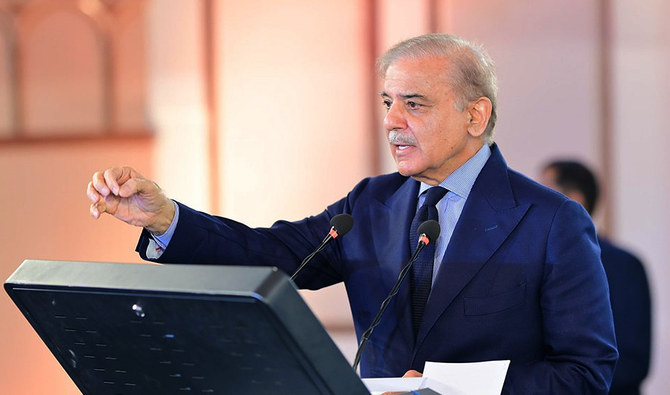
In this handout photograph, taken and released by Government of Pakistan on May 16, 2024, Pakistan Prime Minister speaks during an event at the Prime Minister House in Islamabad. (Photo courtesy: PMO)
Short Url
Updated 27 May 2024
Follow

Pakistan PM praises European countries for recognizing Palestinian state, hopes for same attention for Kashmir

  • Prime ministers of Ireland, Spain and Norway have said they will formally recognize Palestine as a state on May 28
  • Himalayan region of Kashmir, administered in parts by India and Pakistan, has been a flashpoint between them since 1947

ISLAMABAD: Pakistan’s Prime Minister Shehbaz Sharif on Monday praised Spain, Norway and Ireland for their decision to recognize the state of Palestine, hoping that the international community will “pay the same amount of attention” to the plight of the people of Kashmir. 

The prime ministers of Ireland, Spain and Norway announced on Wednesday they would formally recognize Palestine as a state on May 28, following recent recognitions by Barbados, Jamaica, Trinidad and Tobago and the Bahamas. The additions have brought the total number of countries recognizing the Palestinian state to nearly 150.

In a telephonic conversation with Norwegian PM Jonas Gahr Store on Sunday night, PM Sharif appreciated Norway’s “principled stance,” adding that it would send a message of hope and solidarity to the people of Kashmir suffering continuous bombardment at Israel’s hands. 

“I expressed my hope that this bold, principled decision by Norway, Spain, and Ireland will encourage other countries to recognize the State of Palestine,” Sharif wrote on social media platform X from his official account that shares updates in Arabic. 

“We hope the international community will pay the same amount of attention to the suffering and tragedy of Kashmiris who have been suffering from oppression and brutal occupation for 76 years.”

The Himalayan region of Kashmir has been a flashpoint between India and Pakistan since 1947 when the two countries gained independence from British colonial India. The nuclear-armed South Asian neighbors have fought two out of three wars over Kashmir. 
Both countries claim the territory in full but administer parts of it. The western portion of the larger Kashmir region is administered by Pakistan as a nominally self-governing entity.
On Aug. 5 2019, Indian Prime Minister Narendra Modi withdrew Indian-administered Kashmir’s autonomy in a move that was seen by analysts as a strategy to tighten his grip over the territory. The decision provoked outrage in Pakistan and triggered the downgrading of diplomatic ties and suspension of bilateral trade between the two countries. 
Israel’s war on Gaza has sparked international condemnation from rights activists and organizations and countries around the world. Israel’s constant bombardment has killed nearly 36,000 Palestinians, according to Gaza’s Health Ministry, which does not distinguish between civilians and fighters in its count. 
Around 80 percent of Gaza’s 2.3 million people have fled their homes while severe hunger is widespread and UN officials say parts of the territory are experiencing famine.

Israel says Hamas triggered the war with its Oct. 7 attacks on Israel, in which Palestinian militants killed some 1,200 people and seized some 250 hostages. Hamas still holds some 100 hostages after many were released during a ceasefire last year.


Pakistan urges concessional finance for developing nations to boost clean energy security

Updated 6 sec ago
Follow

Pakistan urges concessional finance for developing nations to boost clean energy security

  • Pakistan has emerged as one of world’s fastest growing solar markets, with 12GWs of off-grid and 6GWs of net-metered capacity in 2025
  • PM’s aide says Islamabad remains committed to Paris Agreement, looks for continued support in building a resilient and low-carbon future

ISLAMABAD: Pakistan has urged international partners to scale up concessional financing for developing countries, the country’s Press Information Department (PID) said on Sunday, citing an aide to Prime Minister Shehbaz Sharif.

The call was made by Sharif’s coordinator on climate change, Romina Khurshid Alam, while delivering Pakistan’s national statement at the 16th International Renewable Energy Agency (IRENA) Assembly in Abu Dhabi.

Pakistan has emerged as one of the world’s fastest growing solar markets, with 12 gigawatts (GWs) of off-grid and over 6GWs of net-metered solar capacity by the end of 2025. Last fiscal year, renewables accounted for a historic 53 percent of total electricity generation, according to Alam.

The prime minister’s aide stressed that affordable funding for developing nations is critical to accelerating their transition to clean energy and strengthening energy security amid rising climate and economic challenges.

“Alam reaffirmed Pakistan’s target of achieving 60 percent renewables in the power mix by 2030,” the PID said in a statement.

“In her call to action, she urged IRENA and Member States to increase concessional finance for developing nations, treat technologies such as energy storage and green hydrogen as global public goods, and strengthen regional cooperation for shared energy security.”

IRENA is a global intergovernmental agency for energy transformation that serves as the principal platform for international cooperation, supports countries in their energy transition, and provides state of the art data and analyzes on technology, innovation, policy, finance and investment. Its membership comprises 170 countries and the European Union (EU).

The 16th session of the IRENA Assembly is taking place on Jan. 10-12 in Abu Dhabi and focuses on the theme of “Powering Humanity: Renewable Energy for Shared Prosperity.” The session has gathered global leaders and energy decision-makers to discuss strategies and underline necessary actions for the acceleration of renewable energy across countries, regions, and the world, driving economic inclusion, equity, and human well-being.

Alam shared that Pakistan is taking action against energy poverty through initiatives like the Punjab Solar Panel Scheme 2026, which provides free or subsidized systems to low-income households.

She highlighted how distributed solar kits have restored power and livelihoods in flood-affected communities and offer a replicable model for climate-resilient recovery.

“Pakistan remains fully committed to the Paris Agreement and looks to IRENA for continued technical and financial support in building a resilient, inclusive, and low-carbon future,” Alam said.

Adopted in 2015 to combat climate change, the Paris Agreement binds nations to hold “the increase in the global average temperature to well below 2°C above pre-industrial levels” and pursue efforts “to limit the temperature increase to 1.5°C above pre-industrial levels.”