

Meta takes down Israeli settlers’ accounts following attacks on aid convoys

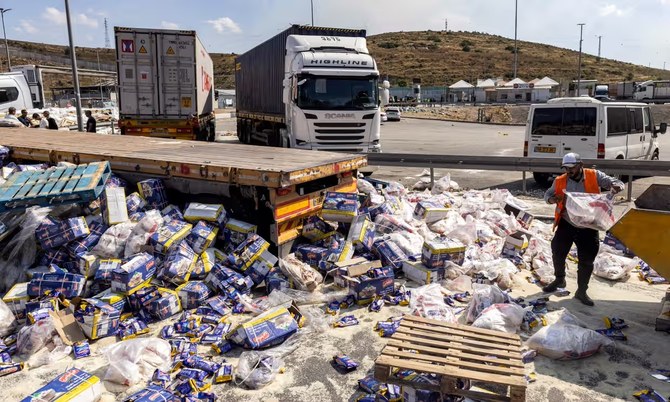
Meta has faced pressure to tackle media accounts on both sides of the Israeli-Palestinian conflict since Oct. 7, and has been accused of inciting violence or disseminating misinformation. (AFP/File)
Short Url
Updated 24 May 2024
Follow

Meta takes down Israeli settlers’ accounts following attacks on aid convoys

  • Platform said Tzav 9’s operations violated harm policy
  • Arab News learns that group behind several raids on trucks directed to Gaza resumed operations under different username

LONDON: Meta has deactivated the accounts of a group of Israeli settlers after a series of attacks on aid convoys bound for Gaza.

The right-wing Israeli group Tzav 9 (Order 9) has been responsible for organizing attacks on trucks carrying food, medicines, and other essential supplies to the Gaza Strip.

According to a report by Middle East Eye, the group, which used both Facebook and Instagram to coordinate raids on convoys, was suspended for violating Meta’s Coordinating Harm policy.

This prohibits users from using the platform to “facilitate, organize, promote, or admit” criminal activities.

Meta confirmed on Thursday that Tzav 9’s operations fell under this policy.

The group has claimed responsibility for several attacks, including blocking a convoy from Jordan to Gaza at a checkpoint in the Hebron Hills region last week.

During these attacks, members affiliated to the group threw goods on the ground and set fire to two trucks.

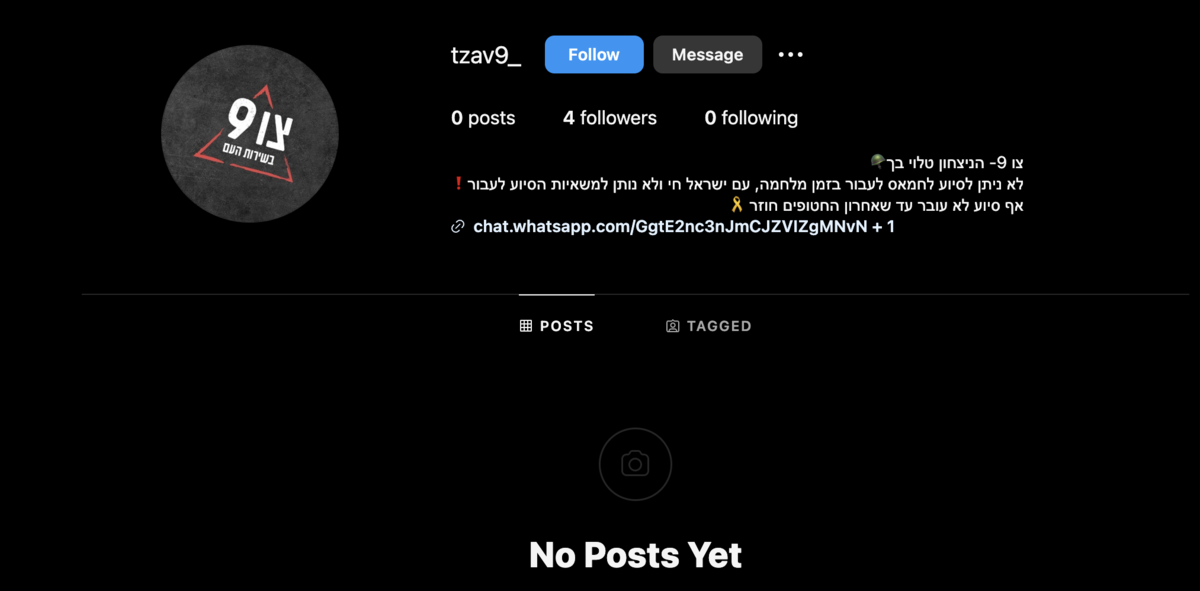
Arab News has learned that, at the time of writing, Tzav 9 appears to have resumed activity on Instagram under a similar username.

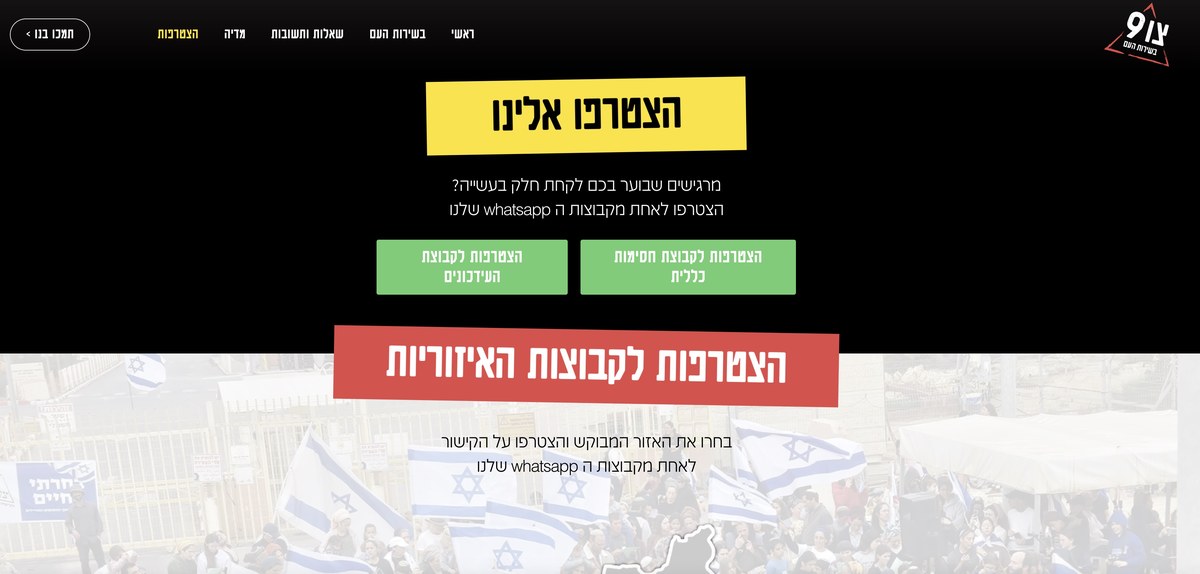
Links in the account’s bio redirect to what appears to be the group’s website and WhatsApp channel.

Arab News has reached out to Meta for comments.

Meanwhile, Tzav 9’s accounts on X and TikTok are still active.
Several reports indicate that the group has been attacking humanitarian convoys since January in a bid to demand the release of hostages held by Hamas.

Tzav 9 states on its website that, besides blocking aid convoys, the group’s goal is to “prevent the legitimization of UNRWA (the UN Relief and Works Agency for Palestine Refugees in the Near East) in the country, in accordance with the nature and actions of the terrorist organization.”

This reference relates to allegations made by Israeli authorities in January, accusing 12 UNRWA employees of involvement in attacks on Israel on Oct. 7, 2023, later expanding this claim to 19 employees and 400 personnel.

These allegations, which led several nations to cut funding to UNRWA at a critical time, have largely been dismissed after Israel failed to provide supporting evidence.
Meta has faced pressure to tackle media accounts on both sides of the Israeli-Palestinian conflict since Oct. 7, and has been accused of inciting violence or disseminating misinformation.

The tech giant introduced temporary measures to limit “potentially unwelcome or unwanted comments” on posts about the conflict between Israel and Hamas.

This tool, which changed the default setting for who can comment on new public Facebook posts, ultimately failed to meet its objectives.

Human Rights Watch accused Meta in December of “broken promises” after finding the company guilty of “systemic censorship of Palestinian content” and failing to “meet its human rights due diligence responsibilities.”

The nongovernmental organization attributed these issues to “flawed Meta policies and their inconsistent and erroneous implementation, over-reliance on automated tools to moderate content, and undue government influence over content removals.”


Israel arrests 2 Turkish CNN journalists over live broadcast outside IDF HQ

Updated 03 March 2026
Follow

Israel arrests 2 Turkish CNN journalists over live broadcast outside IDF HQ

  • Police said reporter Emrah Cakmak and cameraman Halil Kahraman were detained on suspicion of filming a sensitive security facility
  • Since the Gaza war began, restrictions have expanded significantly, including tighter limits on filming soldiers on duty and sensitive or strategic sites

LONDON: Israeli police have arrested two Turkish CNN journalists who were broadcasting live outside the Israel Defense Forces’ headquarters in Tel Aviv.

Police said the pair were detained on suspicion of filming a sensitive security facility, according to the Israel Police Spokesperson’s Unit.

Reporter Emrah Cakmak and cameraman Halil Kahraman, from the network’s Turkish-language channel, had been reporting near the IDF’s Kirya military headquarters on Tuesday after Iran launched another missile barrage at Tel Aviv and other parts of central Israel.

During the live broadcast, two men believed to be soldiers approached the crew and seized the reporter’s phone, according to initial reports and a video circulating online that could not be independently verified.

Police said officers were dispatched after receiving reports of two people carrying cameras and allegedly broadcasting in real time for a foreign outlet.

Israel’s long-standing military censorship system, overseen by the IDF Military Censor, has long barred journalists and civilians from publishing material deemed harmful to national security.

Since the Gaza war began, restrictions have expanded significantly, including tighter limits on filming soldiers on duty and sensitive or strategic sites.

After a series of similar incidents involving foreign media — most of them Palestinian citizens of Israel working for Arab-language and international media, along with foreign journalists — during the 12-Day War, Israeli police halted live international broadcasts from missile impact sites, citing concerns that exact locations were being revealed.

The Government Press Office later imposed a blanket ban on live coverage from crash and impact areas.

Communications Minister Shlomo Karhi and National Security Minister Itamar Ben-Gvir subsequently ordered that all foreign journalists obtain prior written approval from the military censor before broadcasting — live or recorded — from combat zones or missile strike locations.

Police said that when officers asked the CNN Turk crew to identify themselves, they presented expired press cards and were taken in for questioning.

Burhanettin Duran, head of Turkiye’s Directorate of Communications, condemned the arrests as an attack on the press and said Ankara is working to secure the journalists’ release.