

Israeli settler gang in attack on Jordanian aid convoy for Gaza

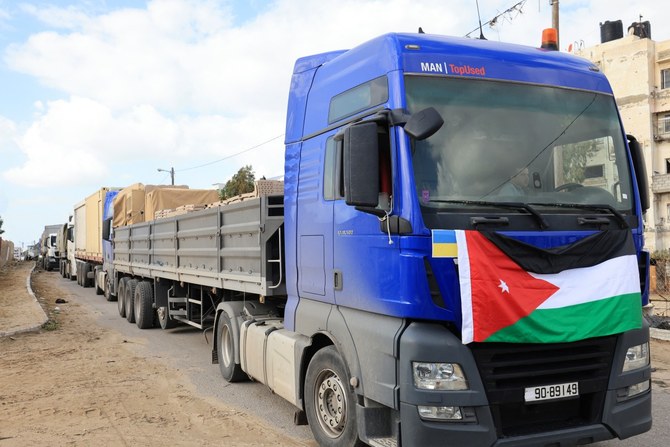
This file photo shows an aid convoy transporting a Jordanian field hospital arrives in Khan Yunis in the southern Gaza Strip on November 20, 2023, after crossing through the Rafah border crossing with Egypt. (AFP)
Short Url
Updated 02 May 2024
Follow

Israeli settler gang in attack on Jordanian aid convoy for Gaza

  • “Two Jordanian aid convoys carrying food, flour and other humanitarian aid to the Gaza Strip were attacked by settlers,” the ministry said
  • Both convoys continued on their way and managed to reach their destination in Israeli-besieged Gaza

JEDDAH: A gang of Israeli settlers in the occupied West Bank attacked two humanitarian aid convoys on Wednesday traveling from Jordan to Gaza, the Jordanian government said.

Israel earlier reopened the sole crossing on the northern edge of the Gaza Strip on Wednesday, allowing aid trucks to pass through the Erez checkpoint following US demands to do more to address the growing humanitarian crisis.

One convoy of 31 trucks was on its way to the Erez crossing into north Gaza and the other, with 48 trucks, was headed for the Kerem Shalom crossing into southern Gaza. They were carrying food, flour and other aid.

“Two Jordanian aid convoys carrying food, flour and other humanitarian aid to the Gaza Strip were attacked by settlers,” the ministry said, without giving details of what happened.

Both convoys managed to continue on their journey and reach their destination in war-devastated Gaza, the ministry added in a statement. Such a route to the Gaza Strip would have taken them through the Israeli-occupied West Bank and Israel.

Honenu, an Israeli legal aid agency, said police had arrested four settlers who blocked the aid trucks as the convoys passed near the West Bank settlement of Ma’ale Adumim, and the trucks continued to their destinations.

The Jordanian government condemned the attack and said it held Israeli authorities fully responsible for ensuring the protection of aid convoys and international agencies.

Jordan has been air-dropping aid and sending convoys westward overland to Palestinians in Gaza throughout the war between Israel and Gaza’s ruling Palestinian Islamist group Hamas that erupted on Oct. 7.

Reopening the Erez crossing has been one of the main pleas of international aid agencies for months, to alleviate hunger which is believed to be most severe among the hundreds of thousands of civilians in the enclave’s northern sector.

In Israel on Wednesday, US Secretary of State Antony Blinken urged Israeli Prime Minister Benjamin Netanyahu to enable the delivery of more aid into Gaza. Israel is the final stop on the top US diplomat’s Middle East tour, his seventh visit to the region.

Blinken toured a compound at the Kerem Shalom crossing where aid trucks bound for Gaza are held for inspection, and visited Ashdod port in the south, which has recently started receiving aid for Gaza.

Earlier, in more than two hours of talks with Netanyahu, Blinken noted “the improvement in the delivery of humanitarian aid to Gaza since the call between President Biden and Prime Minister Netanyahu on April 4 and reiterated the importance of accelerating and sustaining that improvement,” the State Department said.

Blinken said Israel needed do more on aid, by establishing a deconfliction mechanism with humanitarian agencies and making sure there were enough drivers and trucks in Gaza to deliver aid where it was needed.

He said a clear list of humanitarian items was also needed to make sure aid shipments were not arbitrarily denied entry into Gaza by Israel’s inspections, a process that aid groups have complained has been a major bottleneck.

While the focus of Blinken’s visit was on getting more aid to Palestinians in Gaza, Washington has also warned Israel not to go ahead with a planned assault on the southern city of Rafah.

Netanyahu said on Tuesday that Israel would carry out an operation against Hamas in Rafah regardless of whether a ceasefire and hostage release deal were reached.

UN aid chief Martin Griffiths said Israeli improvements to aid access in Gaza “cannot be used to prepare for or justify a full-blown military assault on Rafah.”

(With Agencies)


Egypt’s historic mosques drenched in spirituality during Ramadan

Updated 5 sec ago
Follow

Egypt’s historic mosques drenched in spirituality during Ramadan

  • Arab News visits some of Cairo’s most historic mosques, including Al-Azhar, Sultan Hassan, and Amr ibn Al-As
  • ‘I have experienced an exceptional atmosphere in Egypt during Ramadan,’ says Mazen, a student at Al-Azhar University who is from Java in Indonesia

CAIRO: Cairo is home to more than 400 Islamic landmarks that represent a rich diversity of heritage and architectural styles, and the already spiritual atmosphere in the Egyptian capital receives a boost during Ramadan.

During the first week of the holy month, Arab News visited some of the city’s most historic mosques, including Al-Azhar, Sultan Hassan, and Amr ibn Al-As.

Al-Azhar Mosque hosts iftar, the evening meal that breaks the daily fast during Ramadan, at which it welcomes students from more than 100 countries as well as faculty members from Al-Azhar University. Thousands sit in organized circles throughout the mosque as they enjoy their meals.

“This is the third year I have attended this iftar since joining Al-Azhar University to study at the Faculty of Usul Al-Din (Islamic Theology),” Mazen, a student from Java in Indonesia, told Arab News. “I have experienced an exceptional atmosphere in Egypt during Ramadan.”

Gamal Abdel Rahim, a professor of Islamic antiquities, told Arab News that iftar tables first appeared in Egyptian mosques during the era of Ahmad ibn Tulun, founder of the Tulunid dynasty (835 to 884 A.D.). They became more widespread during the Mamluk and Fatimid periods at places of worship such as Amr ibn Al-As Mosque, one of the oldest in the country. The tradition continues.

“Ramadan preparations in Egypt’s historic mosques usually begin in the months of Rajab and Shaban, during which the mosque carpets are replaced,” Abdel Rahim said. “In olden times, mishkat (lamps) were filled with fresh olive oil during Ramadan.”

In the days of the Tulunid dynasty, he added, Ahmad ibn Tulun regulated working hours during Ramadan so that mosque workers could return home to their families after Asr prayer.

One of the most distinctive features of the holy month in Egypt is the firing of the Ramadan cannon, he said, a tradition that began in 1454 A.D. during the era of Sultan Khushqadam Al-Ahmadi.

“This ritual continues, linking modern practices to centuries of Islamic heritage,” he added.

At the Sultan Hussein Mosque, where original features of its construction in 1356 A.D. have been preserved, a large number of Muslims perform Taraweeh (late-night) prayers during Ramadan enveloped in a deeply spiritual and serene atmosphere that reflects the historical and religious significance of the mosque.

The mosque is also distinguished by its school, which is dedicated to teaching the four main schools of Sunni jurisprudence (Madhab). It features uniquely designed lamps that reflect the exquisite craftsmanship of its era and add to a spiritual ambiance that has attracted worshippers and scholars for centuries.

At Amr ibn Al-As Mosque, worshippers who gather for Isha and Taraweeh prayers are immersed in an atmosphere of devotion. The mosque is particularly notable for the magnificent dome at the center of its courtyard, which is a hallmark of its historic and architectural significance.

In areas around Egypt’s historic mosques, traditional lanterns and Ramadan decorations adorn the streets as Egyptians gather in these historic districts at night during the holy month to celebrate and socialize into the early hours, creating a lively and festive atmosphere that blends tradition and spirituality with communal joy.