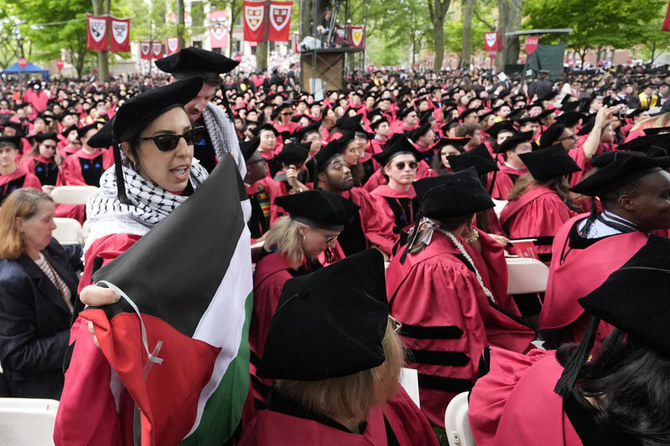
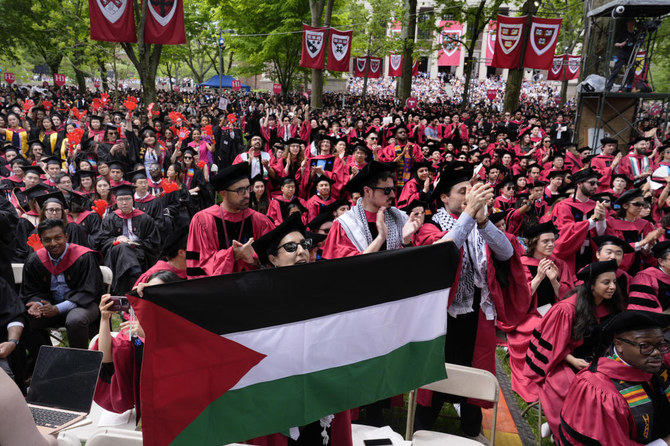
CAMBRIDGE: A group of graduates walked out of the Harvard commencement chanting “Free, Free Palestine” after weeks of protests on campus.
School officials announced Wednesday, the day before Thursday’s graduation, that 13 Harvard students who participated in a protest encampment would not be able to receive degrees alongside their classmates.
Some students chanted “Let them walk, let them walk walk,” during Thursday’s commencement, referring to allowing those 13 students to get their degrees along with fellow graduates.
Harvard University held its commencement address Thursday following a weekslong pro-Palestinian encampment that shut down Harvard Yard to all but those with university ties and roiled tensions on the campus.
Those tensions were ticked up a notch on Wednesday when school officials announced that 13 Harvard students who participated in the encampment won’t be able to receive degrees alongside their classmates. Some students chanted “Let them walk, Let them walk,” during commencement.
Student speaker Shruthi Kumar said “this semester our freedom of speech and our expressions of solidarity became punishable,” she said to cheers and applause.
She said she had to take a moment to recognize “the 13 undergraduates in the class of 2024 who will not graduate today,” Kumar said to prolonged cheers and clapping. “I am deeply disappointed by the intolerance for freedom of speech and the right to civil disobedience on campus.”
Over 1,500 students had petitioned, and nearly 500 staff and faculty had spoken up, all over the sanctions, she said.
“This is about civil rights and upholding democratic principals,” she said. “The students had spoken. The faculty had spoken. Harvard do you hear us?”
Those in the encampment had called for a ceasefire in Gaza and for Harvard to divest from companies that support the war.
Also on Thursday, the leaders of Northwestern University and Rutgers University are expected to testify at a House Committee on Education and the Workforce hearing about concessions they gave to pro-Palestinian protesters to end demonstrations on their campus. The chancellor of the University of California, Los Angeles, also was scheduled to appear at the latest in a series of hearings looking into how colleges have responded to the protests and allegations of antisemitism
The decision by the school’s top governing board follows a recommendation Monday by faculty members to allow the 13 to receive their degrees despite their participation in the encampment.
Harvard’s governing board, the Harvard Corporation, however said that each of 13 have been found to have violated the university’s policies by their conduct during the encampment protest.
“In coming to this determination, we note that the express provisions of the Harvard College Student Handbook state that students who are not in good standing are not eligible for degrees,” the corporation said in a written statement.
The statement left open the possibility of an appeals process saying the corporation understands “that the inability to graduate is consequential for students and their families” and supports the Faculty of Arts and Sciences’ intention to provide an expedited review of requests for appeal.
“We care deeply about every member of our community — students, faculty, staff, researchers, and alumni — and we have chosen a path forward that accords with our responsibilities and reaffirms a process for our students to receive prompt and fair review,” the statement added.
Supporters of the students said the decision not to allow them to receive degrees at commencement violated a May 14 agreement between interim President Alan Garber and the Harvard Out of Occupied Palestine coalition that would have allowed the students to graduate.
Protesters against the war between Israel and Hamas voluntarily dismantled their tents after they said university officials agreed to discuss their questions about the endowment, bringing a peaceful end to the kinds of demonstrations that were broken up by police on other campuses.
The group issued a statement late Wednesday saying the decision jeopardizes the post-graduation lives of the 13 students.
“By rejecting a democratic faculty vote, the Corporation has proved itself to be a wholly illegitimate body, and Garber an illegitimate president, accountable to no one at the university,” the group said.
“Today’s actions have plunged the university even further into a crisis of legitimacy and governance, which will have major repercussions for Harvard in the coming months and years,” the group said,
There was a noticeable presence of police officers around the campus Thursday mixing with soon-to-be-graduates, their family members and sidewalk flower sellers.
A small plane circled above trailing an Israeli and US flag. A truck was parked outside the campus with an electronic billboard with the names and images of some of the pro-Palestinian protesters under the banner “Harvard’s Leading Antisemites.”
At Drexel University in Philadelphia, protesters packed up their belongings and left a pro-Palestinian encampment Thursday after the school announced a decision to have police clear the encampment. A wave of pro-Palestinian tent encampments on campuses has led to over 3,000 arrests nationwide.


Group of graduates walk out of Harvard commencement chanting ‘Free, free Palestine’

https://arab.news/5yxwn
Group of graduates walk out of Harvard commencement chanting ‘Free, free Palestine’

- Student speaker Shruthi Kumar said “this semester our freedom of speech and our expressions of solidarity became punishable,” she said to cheers and applause
- “I am deeply disappointed by the intolerance for freedom of speech and the right to civil disobedience on campus”


Sudanese man jailed in UK for murdering asylum hotel worker
- Deng Chol Majek followed Rhiannon Whyte, 27, to a railway station in October 2024
- He stabbed her 23 times to the head, chest and arm with a screwdriver
LONDON: A Sudanese asylum seeker was jailed on Friday for a minimum of 29 years for murdering a woman who worked at the hotel in central England where he and other migrants were being housed.
Anti-immigration activists have seized on other criminal cases involving asylum seekers, predominantly young men, in hotels to argue that they are a danger to nearby communities.
Last summer, a number of protests at asylum hotels across England – sparked by the arrest of an Ethiopian asylum seeker for sexually assaulting a teenage girl and a woman – turned violent.
The Labour government, nervous of the rise of the anti-immigration Reform UK party in opinion polls, has promised to clamp down on illegal immigration and, by 2029, to stop placing asylum seekers in hotels while their cases are processed.
Deng Chol Majek followed Rhiannon Whyte, 27, to a railway station in October 2024 after she finished her shift.
He stabbed her 23 times to the head, chest and arm with a screwdriver. She died in hospital three days later.
Majek was convicted in October and sentenced on Friday to life imprisonment with a minimum of 29 years at Coventry Crown Court, where some anti-immigration protesters gathered outside for the hearing.
Judge Michael Soole said the murder was “particularly vicious” and told Majek there had been a “chilling composure in every aspect of your behavior.”


