

Pakistan court reserves verdict on pleas against ruling Imran Khan, wife violated marriage law

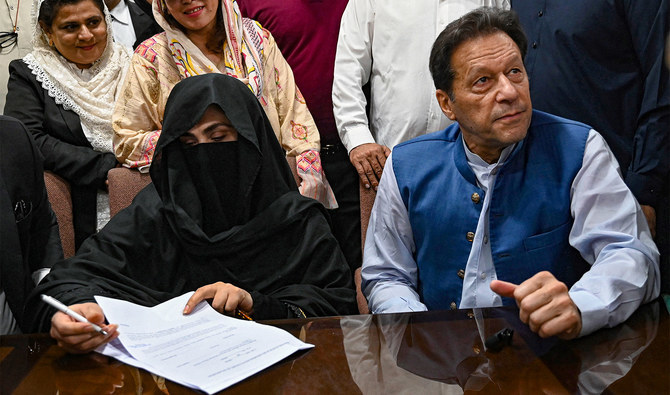
Pakistan's former Prime Minister, Imran Khan (R) along with his wife Bushra Bibi (L) looks on as he signs surety bonds for bail in various cases, at a registrar office in the High court, in Lahore on July 17, 2023. (AFP/File)
Short Url
Updated 23 May 2024
Follow

Pakistan court reserves verdict on pleas against ruling Imran Khan, wife violated marriage law

  • Khan, wife Bushra sentenced to seven years in prison in February by court that ruled their 2018 marriage illegal 
  • Bushra is currently serving out two prison sentences at Rawalpindi’s Adiala Jail where Khan is also incarcerated

ISLAMABAD: A district and sessions court in Islamabad on Thursday reserved its verdict on appeals challenging seven-year jail sentences each for former Pakistani Prime Minister Imran Khan and his wife Bushra Khan for violating the country’s marriage law. 

Khan and his wife were sentenced to seven years in prison and fined in February by a court that ruled their 2018 marriage broke the law. Bushra was accused of not completing the waiting period mandated by Islam, called “Iddat,” after divorcing her previous husband and marrying Khan.

The Khans signed their marriage contract, or “Nikkah,” in January 2018 in a secret ceremony seven months before the former cricket superstar became prime minister for the first time. There was controversy over whether they had wed before the Iddat period was complete. After initial denials of the marriage, Khan’s Pakistan Tehreek-e-Insaf confirmed it weeks later.

The Khans both deny wrongdoing.

“The court will announce the judgment on May 29 (Wednesday),” Pakistan’s Express Tribune newspaper reported. Other Pakistani media also widely reported that the judgment would be announced next week. 

Bushra is currently serving out two prison sentences at Adiala Jail where Khan is also incarcerated. In January, both were sentenced to 14 years in prison in a case that relates to accusations they undervalued gifts from a state repository and gained profits from selling them while Khan was prime minister from 2018-22. 

CASES

Khan was first jailed after being handed a three-year prison sentence in August 2023 by the Election Commission for not declaring assets earned from selling gifts worth more than 140 million rupees ($501,000) in state possession and received during his premiership. In January, Khan and Bushra were handed 14-year jail terms following a separate investigation by the country’s top anti-graft body, or NAB, into the same charges involving state gifts. 

An anti-graft court in Islamabad also handed Khan a 10-year jail term in January for revealing state secrets, a week before national elections on Feb. 8. The ruling on his marriage to Bushra and a seven-year sentence each for both also came ahead of the polls.

Khan has also been indicted under Pakistan’s anti-terrorism law in connection with violence against the military that erupted following his brief arrest related to a land graft case on May 9. A section of Pakistan’s 1997 anti-terrorism act prescribes the death penalty as maximum punishment. Khan has denied the charges under the anti-terrorism law, saying he was in detention when the violence took place. 

Khan’s convictions, which mean he is banned from holding public office, ruled the 71-year-old out of the February general elections. Arguably Pakistan’s most popular politician, Khan says all cases against him are motivated to keep him out of politics.

SPIRITUAL LEADER

Bushra’s ex-husband, Khawar Maneka, to whom she was married for about 30 years, brought a criminal complaint against the Khans. 

Khan has often called Bushra his spiritual leader. She is known for her devotion to Sufism, a mystical form of Islam.

Born Bushra Riaz Watto, she changed her name to Khan after her marriage. Her husband and followers commonly refer to her as Bushra Bibi or Bushra Begum, titles that denote respect in Urdu.

Khan’s two previous marriages — to Jemima Goldsmith, daughter of tycoon James Goldsmith, and television journalist Reham Nayyar Khan — ended in divorce.


Islamabad dismisses claims about paying up to 8 percent interest on foreign loans as ‘misleading’

Updated 22 February 2026
Follow

Islamabad dismisses claims about paying up to 8 percent interest on foreign loans as ‘misleading’

  • Pakistan has long relied on external loans to help bridge persistent gaps in public finances and foreign exchange reserves
  • Pakistan’s total external debt, liabilities stand at $138 billion at an overall average cost of around 4 percent, ministry says

KARACHI: Pakistan’s finance ministry on Sunday dismissed as “misleading” claims that the country is paying up to 8 percent interest on external loans, saying the overall average cost of external public debt is approximately 4 percent.

Pakistan has long relied on external loans to help bridge persistent gaps in public finances and foreign exchange reserves, driven largely by a narrow tax base, chronic trade deficits, rising debt-servicing costs and repeated balance-of-payments pressures.

Over the decades, successive governments have turned to multilateral and bilateral lenders, including the International Monetary Fund, the World Bank and the Asian Development Bank, to support budgetary needs and shore up foreign exchange reserves.

The finance ministry on Sunday issued a clarification in response to a “recent press commentary” regarding the country’s external debt position and associated interest payments, and said the figures required contextual explanation to ensure accurate understanding of Pakistan’s external debt profile.

“Pakistan’s total external debt and liabilities currently stand at $138 billion. This figure, however, encompasses a broad range of obligations, including public and publicly guaranteed debt, debt of Public Sector Enterprises (both guaranteed and non-guaranteed), bank borrowings, private-sector external debt, and intercompany liabilities to direct investors. It is therefore important to distinguish this aggregate figure from External Public (Government) Debt, which amounts to approximately $92 billion,” it said.

“Of the total External Public Debt, nearly 75 percent comprises concessional and long-term financing obtained from multilateral institutions (excluding the IMF) and bilateral development partners. Only about 7 percent of this debt consists of commercial loans, while another 7 percent relates to long-term Eurobonds. In light of this composition, the claim that Pakistan is paying interest on external loans ‘up to 8 percent’ is misleading.

The overall average cost of External Public Debt is approximately 4 percent, reflecting the predominantly concessional nature of the borrowing portfolio.”

With respect to interest payments, public external debt interest outflows increased from $1.99 billion in Fiscal Year (FY) 2022 to $3.59 billion in FY2025, representing an increase of 80.4 percent, not 84 percent as reported. In absolute terms, interest payments rose by $1.60 billion over this period, not $1.67 billion, it said.

According to the State Bank of Pakistan’s records, Pakistan’s total debt servicing payments to specific creditors during the period under reference were as follows: the IMF received $1.50 billion, of which $580 million constituted interest; Naya Pakistan Certificates payments totaled $1.56 billion, including $94 million in interest; the Asian Development Bank received $1.54 billion, including $615 million in interest; the World Bank received $1.25 billion, including $419 million in interest; and external commercial loans amounted to nearly $3 billion, of which $327 million represented interest payments.

“While interest payments have increased in absolute terms, this rise cannot be attributed solely to an expansion in the debt stock,” the ministry said. “Although the overall debt stock has increased slightly since FY2022, the additional inflows have primarily originated from concessional multilateral sources and the IMF’s Extended Fund Facility (EFF) under the ongoing IMF-supported program.”

Pakistan secured a $7 billion IMF bailout in Sept. 2024 as part of Prime Minister Shehbaz Sharif’s efforts to stabilize the South Asian economy that narrowly averted a default in 2023. The government has since been making efforts to boost trade and bring in foreign investment to consolidate recovery.

“It is also important to note that the increase in interest payments reflects prevailing global interest rate dynamics. In response to the inflation surge of 2021–22, the US Federal Reserve raised the federal funds rate from 0.75-1.00 percent in May 2022 to 5.25–5.50 percent by July 2023. Although rates have since moderated to around 3.75 percent, they remain significantly higher than 2022 levels,” the finance ministry said.

“The government remains committed to prudent debt management, transparency, and the continued strengthening of Pakistan’s macroeconomic stability,” it added.