

Top Saudi officials hold discussions with global aviation giants

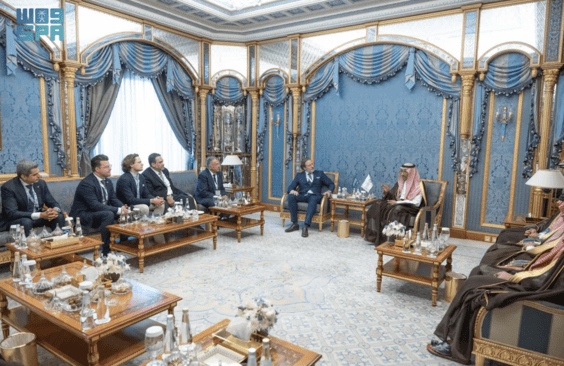
Bandar bin Ibrahim Alkhorayef speaking with the heads of global aviation companies. SPA
Short Url
Updated 21 May 2024
Follow

Top Saudi officials hold discussions with global aviation giants

RIYADH: Supply chain challenges, investment attraction, and modern technology were all discussed by Saudi Arabia’s industry minister and the heads of global aviation companies at the Future Aviation Forum 2024.

Bandar bin Ibrahim Alkhorayef held discussions with the president of the Commercial Aircraft Corp. of China, the president and CEO of Embraer Commercial, and the president of Boeing, at the Riyadh event, the Saudi Press Agency reported. 

Alkhorayef focused on bolstering cooperation across various segments of the aviation industry in the talks and the discussions highlighted the Kingdom’s opportunities, addressed global supply chain challenges, and explored avenues for investment attraction, technological advancement, and knowledge exchange. 

Meanwhile, the minister toured the pavilions of several global aviation companies, including Airbus, Boeing, and Riyadh Air, participating in the event organized by the General Authority of Civil Aviation at the King Abdulaziz International Conference Center. 

Furthermore, he received updates on the latest technologies and recent advancements in the aviation industry and its related sectors. 

On May 20, Saudia Group signed a $19 billion order deal for 105 planes, marking the largest aircraft deal with Airbus in the Kingdom’s history. 

The agreement was made public in the presence of Minister of Transport and Logistic Services Saleh bin Nasser Al-Jasser and Benoît de Saint-Exupery, executive vice president of sales at Airbus. Saint-Exupery stated that the new aircraft will play a “vital role” in contributing to Saudi Arabia’s ambitious Vision 2030 plan. 

The forum, held under the patronage of King Salman from May 20 to 22, showcases investment opportunities exceeding $100 billion. It aims to achieve the goals of Saudi Vision 2030, transforming the Kingdom into a leading logistics hub in the Middle East and meeting the objectives of the national aviation strategy. 

The event features participation from over 30 ministers, 77 leaders of civil aviation authorities, global airline executives, and 5,000 industry experts and leaders from more than 120 countries. 


Oman money supply rises 6.4% to $68.6bn in November 

Updated 4 sec ago
Follow

Oman money supply rises 6.4% to $68.6bn in November 

JEDDAH: Oman’s money supply climbed 6.4 percent to 26.4 billion Omani rials ($68.6 billion) in November, signaling solid liquidity conditions and continued growth in bank deposits, official data showed.  

The increase in broad money — a measure that includes cash in circulation and bank deposits — was driven by a 12.2 percent rise in cash and demand deposits, alongside a 4.1 percent increase in savings and time deposits, the Oman News Agency reported. 

The latest reading follows steady gains earlier in 2025, with money supply up 6.1 percent in the three months through August. This was supported by a 6.9 percent rise in narrow money and a 5.8 percent increase in quasi-money. The trend reflects sustained liquidity conditions and stronger deposit growth across the banking system. 

The expansion in monetary aggregates points to continued liquidity and policy support for private-sector lending, as Oman advances fiscal and economic reforms under its Vision 2040 strategy. 

“During the same period, currency in circulation increased 1.9  percent, while demand deposits rose 14.1 percent,” the ONA report stated. 

At conventional commercial banks, the weighted average deposit rate in Omani rials declined to 2.50 percent in November from 2.73 percent a year earlier, while the weighted average lending rate eased to 5.45 percent from 5.67 percent over the same period. 

The overnight interbank lending rate averaged 3.92 percent in November, down from 4.56 percent a year earlier, reflecting a decline in the weighted average repo rate to 4.5 percent from 5.30 percent, influenced by US Federal Reserve policy shifts. 

Meanwhile, total assets of Islamic banks and windows reached about 9.3 billion Omani rials by the end of November, accounting for 19.4 percent of the Gulf state’s total banking sector assets.  

“This marks a 12.3 percent increase compared with the same period in 2024,” ONA reported, citing data from the Central Bank of Oman. 

Total financing by Islamic banking units rose 10.3 percent to around 7.5 billion rials, while deposits increased 10.9 percent to approximately 7.3 billion rials by the end of November. 

The November data follows the International Monetary Fund’s 2025 Article IV consultation report, released earlier this month, which highlighted the continued resilience of Oman’s economy amid global uncertainty. 

The IMF cited steady growth in non-hydrocarbon sectors, low inflation, and broadly sound fiscal and external positions, underscoring the effectiveness of Oman’s coordinated economic and financial policies.