

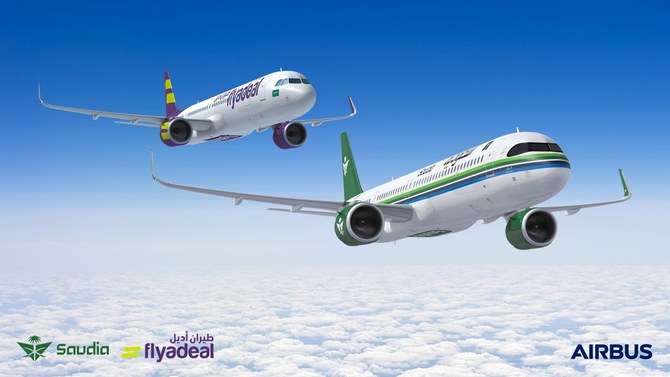

RIYADH: Saudia Group has signed an order for an additional 105 A320neo family planes, marking the largest aircraft deal with Airbus in the Kingdom’s history.
The $19 billion deal, announced at the Future Aviation Forum in Riyadh by Ibrahim Al-Omar, the director general of the group, includes A320neo and A321neo models. These aircraft will be distributed between Saudia and flyadeal, the group's low-cost carrier.
Saudia will acquire 54 A321neo aircraft, while flyadeal will receive 12 A320neo and 39 A321neo aircraft. The group is set to receive the first aircraft in the first quarter of 2026.
The agreement was announced in the presence of Minister of Transport and Logistic Services Saleh bin Nasser AI-Jasser, Director General of Saudia Group Ibrahim Al-Omar, and Benoît de Saint-Exupéry, executive vice president sales of Airbus.
Al-Omar said: “Saudia has ambitious operational objectives to meet growing demand. We are increasing flights and seat capacity across our existing 100+ destinations on four continents, with plans for further expansion.
“The progress of Saudi Vision 2030 is attracting more visits, tourists, entrepreneurs, and pilgrims each year. This motivated our decision to secure this significant deal, which will create jobs, increase local content, and contribute to the national economy.”
Al-Omar also stated that over the next five years, 88 new aircraft will be added to the fleet, adding: “If we refer to the renovation of the guest cabin, we promise everyone a new experience in the business and hospitality classes based on privacy and the innovation of new products as this project will include new aircrafts in addition to the current fleet.”
He went on: “We have set a specific date for the first plane equipped with new seats at the end of 2025,” Al-Omar added.
De Saint-Exupéry said the new aircraft will play a “vital role” in contributing to Saudi Arabia’ ambitious Vision 2030 plan.
He added: “It will enable Saudia Group’s strategy to advance the Kingdom’s aviation capabilities while enabling both airlines to benefit from the A320neo Family’s exceptional efficiency, superior economics, highest level of passenger comfort as well as lower fuel-burn and emissions.”
Starting in the fourth quarter of 2024, Saudi Airlines will begin offering fast and high-quality internet services on its flights.
Additionally, the airline will equip its aircraft with high-resolution screens that are Bluetooth-enabled and compatible with most smart devices. This upgrade will be implemented on both new and existing aircraft.
“This agreement is one of the enablers of achieving the objectives of the National Transport and Logistics Strategy. It will contribute to enhancing the operational performance of Saudia, increasing flights and seat capacity, and launching new destinations,” Al-Jasser said.
He added: “Furthermore, it aims to connect the world to the Kingdom in line with the significant transformation witnessed by the aviation sector under Saudi Vision 2030, while also reaffirming our commitment to providing the best services that enhance the travel experience."
The new aircraft directly support Saudia Group's objectives to connect the world with the Kingdom, aligning with several key pillars of Saudi Vision 2030.
These include the transportation and logistics objective to increase guests’ capacity to 330 million and expand destinations to 250 by 2030, and the tourism objective to attract 150 million visits by 2030.
This is in addition to the Hajj and Umrah objective to contribute to the increase of Umrah pilgrim capacity to 30 million by 2030.
Furthermore, the A320 family aircraft are fuel efficient as it emits 20 percent less fuel burn and carbon emissions compare to previous generation aircraft.
The boost to Saudia’s fleet comes alongside the growth of the Kingdom’s second flag carrier, the Public Investment Fund-back Riyadh Air.
The aviation company, announced by Crown Prince Mohammed bin Salman in March 2023, ordered 39 Boeing 787-9 jets last year, with options for 33 more.
Riyadh Air is set to make its maiden flight in 2025, and establish routes to 100 countries by the end of the decade.
Saudi Arabia’s ambitions for its aviation sector have been set out in a new roadmap, detailing how the Kingdom plans to grow it into a $2 billion industry.
This includes focus on the business jet segment, including charter, private, and corporate aircrafts, and will support Saudi Arabia’s development as a global high-value enterprise and tourist destination.
The roadmap comes after Saudi Arabia revised its 2030 tourism target upwards from 100 million to 150 million visitors in October 2023.


