DR Congo military says it thwarted ‘coup attempt’, arresting 40 attackers and killing leader

1 / 3
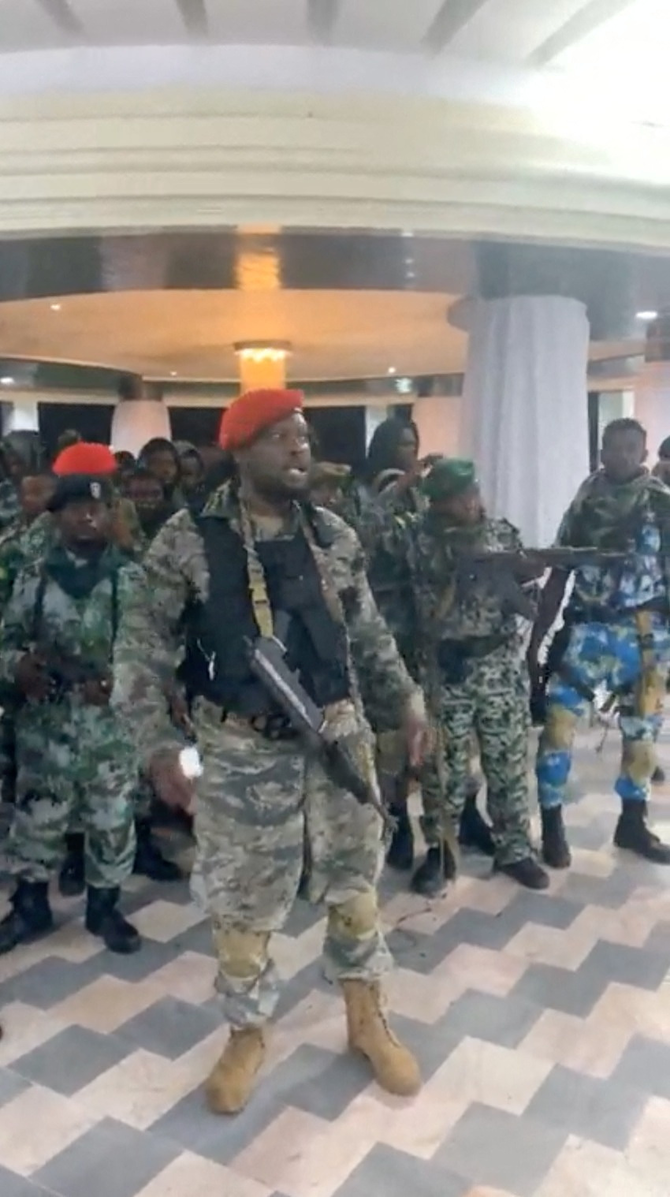
A man in military fatigues speaks as others stand next to him inside the Palace of the Nation during an attempted coup in Kinshasa, Democratic Republic of Congo, on May 19, 2024 in this screen grab from a social media video. (Christian Malanga/Handout via REUTERS)
2 / 3
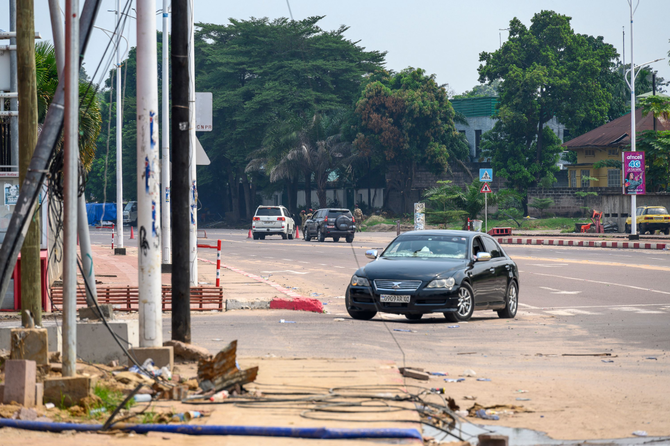
Security forces secure the streets of Kinshasa on May 19, 2024, after Congo's army said it has "foiled a coup" and arrested the perpetrators, including several foreigners. (AP Photo)
3 / 3
The Congolese Republican Guard diverts traffic from the scene of an attempted Coup in Kinshasa on May 19, 2024. (AFP)
Short Url
Updated 20 May 2024
Follow

DR Congo military says it thwarted ‘coup attempt’, arresting 40 attackers and killing leader

  • Army spokesman said some of the arrested attackers were foreigners and four — including their leader — were killed
  • The coup plotters reportedly carried flags of Zaire, the DRC's name under dictator Mobutu Sese Seko, who was overthrown in 1997

KINSHASA: The DR Congo military on Sunday said it had thwarted an “attempted coup” near the offices of President Felix Tshisekedi in Kinshasa involving “foreigners and Congolese.”

It happened in the early hours of the morning outside the residence of Economy Minister Vital Kamerhe, in the Gombe area in the north of the capital, near the Palais de la Nation that houses the president’s offices, a spokesman said.
“An attempted coup d’etat has been stopped by the defense and security forces,” said General Sylvain Ekenge in a message broadcast on national television.
Shots were also heard near the Palais de la Nation at the time of the coup attempt, according to a number of sources.
Later on Sunday, army spokesman General Sylvain Ekenge said several Americans and a British man were part of the group involved in the operation.
The coup bid was led by Christian Malanga, a Congolese man who was a “naturalized American” and had been “definitively neutralized” — killed — by the security forces, Ekenge said in a broadcast on Sunday evening.
The group was made up of “several nationalities,” Ekenge said, adding that around 40 of the attackers had been arrested, and four — including Malanga — killed.
“We also have a naturalized British subject, the number two of the group,” the spokesman added. Malanga’s son, Marcel Malanga, was also among the attackers, he said.

Links to deposed dictator

Kamerhe and his family were not harmed in the attack but two police officers looking after them were killed, said a source close to the minister.
The group had planned to attack the home of the new Prime Minister Judith Suminwa, and the residence of Defense Minister Jean-Pierre Bemba.
But they “could not identify the home” of Suminwa and had not been able to find Bemba at his residence.
After the attack at Kamerhe’s home, the group then went to the Palais de la Nation, brandishing flags of Zaire, the name of the Democratic Republic of Congo under the dictator Mobutu Sese Seko, who was overthrown in 1997.
“I am shocked by the events this morning and very worried by the reports of American citizens allegedly being involved,” Lucy Tamlyn, the US ambassador to the DRC, posted on X, formerly Twitter.
“Rest assured that we are cooperating with authorities in DRC to the fullest extent possible, as they investigate these criminal acts and hold accountable any American citizen involved.”
France’s ambassador had reported automatic weapon fire in the area, urging nationals to avoid it.

During the day, certain streets near the Palais de la Nation remained closed to traffic, but the situation appeared calm, AFP journalists reported.
“I’m a little afraid to move around like that in Gombe, there aren’t many people... But I have to sell my goods,” bread-seller Jean-Mbuta said.

Videos on social media showed men in fatigues at the Palais de la Nation, brandishing flags of Zaire.

The Zaire flag was mostly green while the DRC one is largely blue.
“The time has arrived, long live Zaire, long live the children of Mobutu,” a man who appeared to be the head of the group said in Lingala, a language spoken in parts of the DRC.
“Felix has fallen... we are victorious,” he added.
AFP was also unable to verify the videos.
Tshisekedi was re-elected at the end of December when he received more than 70 percent of votes in the first round.
The parties backing him won around 90 percent of seats in the parliamentary elections held the same day.
But he is yet to form a government some five months after the elections.
Kamerhe on April 23 was named as a candidate for president of the National Assembly, the DRC’s main legislative body.


Afghan polio survivor’s sock factory provides hope by employing disabled workers

Updated 6 sec ago
Follow

Afghan polio survivor’s sock factory provides hope by employing disabled workers

HERAT: In a tiny room in the center of Herat, Afghanistan’s westernmost city, Shahabuddin uses his hands to propel himself along the floor to a freshly-made pile of socks waiting to be sorted and packaged.
A double amputee since a roadside bomb took both his legs a decade ago, when Afghanistan was mired in conflict between US-led forces and Taliban insurgents, the 36-year-old father of four had struggled to find work. Unemployed for the last decade, he had been forced to rely on relatives for his family’s survival.
But a new sock production workshop in Herat employing only disabled workers has given him new hope.
“I became disabled due to the explosion. Both my legs were amputated,” Shahabuddin, who like many Afghans goes by only one name, said during a brief pause in his work in early December. “Now I work here in a sock factory, and I am very happy that I have been given a job here.”
The workshop is the brainchild of Mohammad Amiri, 35, a former grocery shop worker who started the business about a month ago. Amiri, himself disabled by childhood polio, wanted to create jobs and help provide income for other people with disabilities, particularly as many of them were injured during the conflict and have no other means of income.
He teamed up with another polio survivor to start the sock factory with a workforce of men disabled either through traumatic injuries or because of congenital issues or other reasons. They make four types of socks: long and short, for winter and summer.
“The factory, which is funded and supported by people with disabilities, began operations last month and currently employs around 50 people with disabilities,” Amiri said. “They are busy in the production, packaging and sale of socks in the city.”
A combination of decades of conflict, a weak health care system and struggling economy have contributed to high levels of disability in Afghanistan. Data from a 2019 Model Disability Survey conducted by The Asia Foundation nonprofit organization indicates that nearly 25 percent of adults live with a mild disability, while 40 percent have moderate and about 14 percent have severe disabilities.
“These figures compel us to act with greater urgency and commitment,” the UN Assistance Mission in Afghanistan said in a statement released on the International Day of Persons with Disabilities on Dec. 3, quoting the same figures. “Persons with disabilities must not be treated as an afterthought; they must be fully integrated into every stage of planning, decision-making, and service delivery.”
Meanwhile, Afghanistan is one of only two countries — along with neighboring Pakistan — where wild poliovirus remains endemic. The infectious disease can cause flu-like symptoms, but can also cause severe reactions, including paralysis, disability and death.
The Afghan Ministry of Martyrs and Disabled Affairs says 189,635 disabled people across the country are registered and receiving financial support from the government.
Amiri said his business faces serious competition from cheap imports of textiles, and expressed the hope that the government would stop imports from abroad. He has hopes of getting a contract to provide the Afghan security forces with socks, and wants to expand his workforce to 2,000 people.
His current employees include former refugees who have recently returned to Afghanistan after spending years abroad.
One such man is Mohammad Arif Jafari, 40, an economics graduate and polio survivor who lived in Iran for years. Returning to Afghanistan has been hard, he said.
“I suffered a lot due to unemployment. But fortunately, now I produce several types of socks,” he said while selling his wares from a stall on the streets of Herat. “I am happy that I am working here and earning an income.”