Parts of northern India scorched by extreme heat with New Delhi on high alert

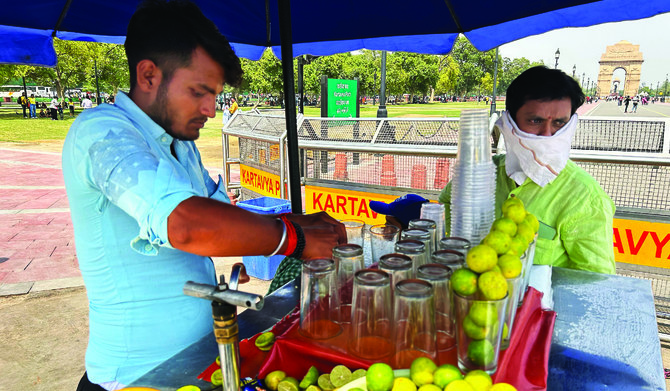
A roadside vendor sells iced lemonade in New Delhi, India, Saturday. (AP)
Short Url
Updated 18 May 2024
Follow

Parts of northern India scorched by extreme heat with New Delhi on high alert

NEW DELHI: Parts of northwest India sweltered under scorching temperatures on Saturday, with the capital New Delhi under a severe weather alert as extreme temperatures strike parts of the country.
India’s weather department expects heat wave conditions to persist across the north for the next few days, and has put several states on high alert. On Friday, parts of New Delhi reported up to 47.1 degrees Celsius. The nearby states of Punjab, Haryana and Rajasthan also saw temperatures soar and are likely to stay high over the next few days, said Soma Sen Roy, a scientist at the India Meteorological Department.
Roy cautioned people against going outdoors under the afternoon sun, drink lots of water and wear loose-fitting clothes while those who are especially vulnerable like the elderly should stay indoors.
The extreme temperatures in northern India coincide with a six-week-long general election, with experts worried that the heat wave could increase health risks as people wait in long lines to cast their vote or candidates campaign aggressively in the outdoors. One minister fainted due to heat last month while addressing an election rally in Maharashtra state.
Satish Kumar, a 57-year-old rickshaw driver in the capital, said his work was suffering because of the heat. “People are not coming outside, (markets) are nearly empty,” he said.
Pravin Kamath, a 28-year-old who runs a cart selling cold drinks, complained that it was so hot he could hardly stand being outdoors. “But I must work. What can I do? I am poor so I have to do it.”
The main summer months — April, May and June — are always hot in most parts of India before monsoon rains bring cooler temperatures. But the heat has become more intense in the past decade and is usually accompanied by severe water shortages, with tens of millions of India’s 1.4 billion people lacking running water.

A study by World Weather Attribution, an academic group that examines the source of extreme heat, found that a searing heat wave in April that struck parts of Asia was made at least 45 times more likely in some parts of the continent by climate change.


Uganda partially restores internet after president wins 7th term

Supporters of President Yoweri Museveni celebrate his winning the polls. (AFP)
Updated 9 sec ago
Follow

Uganda partially restores internet after president wins 7th term

  • “The internet shutdown implemented two days before the elections limited access to information, freedom ‌of association, curtailed economic activities ... it also created suspicion and mistrust on the ‍electoral process,” the team said in ‍their report

KAMPALA: Ugandan authorities have partially restored internet services late after 81-year-old President Yoweri Museveni won a seventh term to extend his rule into a fifth decade with a landslide ​victory rejected by 
the opposition.
Users reported being able to reconnect to the internet and some internet service providers sent out a message to customers saying the regulator had ordered them to restore services excluding social media.
“We have restored internet so that businesses that rely on internet can resume work,” David Birungi, spokesperson for Airtel Uganda, one of the country’s biggest telecom companies said. He added that the state communications regulator had ordered that social media remain shut down.
The state-run Uganda Communications Commission said it had cut off internet to ‌curb “misinformation, disinformation, ‌electoral fraud and related risks.” The opposition, however, criticized the move saying ‌it was ​to ‌cement control over the electoral process and guarantee a win for the incumbent.
The electoral body in the East African country on Saturday declared Museveni the winner of Thursday’s poll with 71.6 percent of the vote, while his rival pop star-turned-politician Bobi Wine was credited with 24 percent 
of the vote.
A joint report from an election observer team from the African Union and other regional blocs criticized the involvement of the military in the election and the authorities’ decision to cut 
off internet.
“The internet shutdown implemented two days before the elections limited access to information, freedom ‌of association, curtailed economic activities ... it also created suspicion and mistrust on the ‍electoral process,” the team said in ‍their report.

In power since 1986 and currently Africa’s third longest-ruling head of state, ‍Museveni’s latest win means he will have been in power for nearly half a century when his new term ends in 2031.

He is widely thought to be preparing his son, Muhoozi Kainerugaba, to take over from him. Kainerugaba is currently head of the military and has expressed presidential ambitions.
Wine, who was taking on ​Museveni for a second time, has rejected the results of the latest vote and alleged mass fraud during the election.
Scattered opposition protests broke out late on Saturday after results were announced, according to a witness and police.
In Magere, a suburb in Kampala’s north where Wine lives, a group of youths burned tires and erected barricades in the road prompting police to respond with tear gas.
Police spokesperson Racheal Kawala said the protests had been quashed and that arrests were made but said the number of those detained would be released later.
Wine’s whereabouts were unknown early on Sunday after he said in a post on X he had escaped a raid by the military on his home. People close to him said he remained at an undisclosed location in Uganda. Wine was briefly held under house arrest following the previous election in 2021.
Wine has said hundreds of his supporters were detained during the months leading up ‌to the vote and that others have been tortured.
Government officials have denied those allegations and say those who have been detained have violated the law and will be put through due process.