

A taste of Indian wada pao, pav bhaji in Pakistan’s culinary hub of Karachi

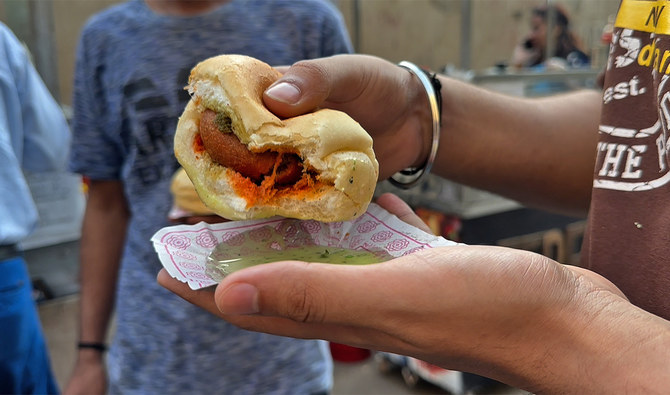
The picture taken on May 14, 2024 shows a customer eating vada pav from Kavita Solanki's food cart in Karachi, Pakistan. (AN photo)
Short Url
Updated 15 May 2024
Follow

A taste of Indian wada pao, pav bhaji in Pakistan’s culinary hub of Karachi

  • The beloved vegetarian Indian street foods were not easy to find in Karachi, promoting Kavita Solanki to start her stall
  • In a city that offers wide range of meat dishes, the young Hindu woman offers change of taste, alternative for vegetarians 

KARACHI: Kavita Solanki had worked for years as a marketing executive when the young Hindu woman decided last October to quit her job and set up a food cart selling two beloved Indian street foods in the Cantonment Area of Pakistan’s financial capital of Karachi. 

Though Karachi is considered the South Asian nation’s culinary hub, and all kinds of foods and cuisines can be found at its thousands of restaurants and street stalls, it was not easy to find wada pao and pav bhaji.

Wada pao comprises a deep fried potato dumpling and chutneys placed inside a bread bun sliced almost in half through the middle. Pav bhaji is a thick spicy vegetable curry served with a soft buttered bread roll. Both dishes originated in the Indian state of Maharashtra.

“I used to search on Google about where I can get pav bhaji and wada pao,” Solanki said as she handed a plate of food to a customer at her stall which has come to be called “Kavita Didi Ka Indian Khana,” or Sister Kavita’s Indian Food, or simply, Kavita Didi's Cart.  

“So, I thought that the thing which is very difficult to find in the city, why not start with that.”


Kavita Solanki (center) is seen interacting with her customers at her food cart in Karachi, Pakistan on April 20, 2024. (Kavita M Solanki/Facebook)

The stall started attracting large crowds within a short span of time after opening, Solanki said. 

“If you say, okay, let's have nihari today, you know you will go to Zahid Nihari,” she said, naming one of the most famous restaurants in Karachi that offers the slow-cooked beef stew dish. “For vegetarian options, people will recommend Kavita Didi, that okay, let's go to Kavita Didi's stall.”

Solanki said people were attracted to her stall not just because wada pao and pav bhaji were difficult to find elsewhere in the city but also due to the authenticity and taste of the food.

“We are giving proper homemade stuff, nothing artificial,” she said. "What we eat at home is what we are bringing here.”

Solanki, who has never been to India and is ethnically Gujrati, said she learnt to make pav bhaji and wada pao from YouTube videos:

“Once we tried it at home, we liked it. So, like every weekend at home, we would be making this for ourselves.”

The stall is also popular for those seeking vegetarian alternatives and a change of taste from meat-based dishes. And her customers include people from all faiths, the entrepreneur said. 

“These are some unique dishes that they offer and it's very clean and very yummy and very nice,” pharmacist Maha Ahmed, a loyal customer, told Arab News.

Sikandar Ali, who works at a private firm, said he was drawn to Solanki's stall after seeing videos on YouTube.

“I had a strong desire to come to Didi's place and taste wada pao. So today, I decided that I would come and have wada pao,” said Ali, who grew up hearing about the street food from his mother, who migrated to Pakistan from India.

“I must say, it tastes absolutely amazing. I had a huge desire to go to India and have wada pao. That same taste I have found in Pakistan, in Karachi.”


Pakistan says ‘national security is non-negotiable’ after Afghanistan strikes

Updated 58 min 52 sec ago
Follow

Pakistan says ‘national security is non-negotiable’ after Afghanistan strikes

  • Islamabad says recent cross-border strikes targeted Afghanistan-based militants behind recent attacks
  • Kabul has condemned strikes, accused Pakistan of violating territorial sovereignty and killing civilians

ISLAMABAD: Pakistan’s Parliamentary Secretary for Information and Broadcasting Danyal Chaudhry said on Monday “national security is non-negotiable,” defending Islamabad’s recent cross-border strikes inside Afghanistan following a number of recent militant attacks.

The remarks come after Pakistan said it launched “intelligence-based selective targeting” of seven militant camps along the Afghan border in response to a mosque bombing in Islamabad and violence in the northwestern border districts of Bajaur and Bannu, among other attacks. Authorities say many of the assaults have been carried out by the Tehreek-e-Taliban Pakistan (TTP) and allied groups that Islamabad alleges are operating from sanctuaries in Afghanistan, whose government denies this.

Kabul has condemned Sunday’s strikes as a violation of its sovereignty and claimed civilians were killed. Pakistan has not responded to that allegation.

Tensions between the two neighbors have escalated sharply despite a fragile ceasefire agreed after deadly clashes in October. 

“Pakistan has always chosen the path of dialogue and peaceful coexistence. But when Afghan soil continues to be used for proxy attacks, we have no choice but to defend our homeland. National security is non-negotiable,” Chaudhry said in a statement.

He said the recent operation had “successfully neutralized militants involved in attacks on Pakistani soil,” adding that “every precaution was taken to protect innocent lives.”

Pakistan has repeatedly accused Afghanistan’s Taliban rulers of allowing TTP militants and fighters linked to the Islamic State Khorasan Province (ISKP), the regional affiliate of the Daesh group, to operate from Afghan territory, claims Kabul denies.

Chaudhry referred to a recent United Nations report, saying militants from 21 countries were now operating from Afghan territory and posed a threat to regional stability.

Afghanistan’s defense ministry earlier condemned what it called a breach of international law and vowed a “measured response at a suitable time.” Its foreign ministry summoned Pakistan’s ambassador over what it described as violations of Afghan airspace.

Islamabad has also accused neighboring India of backing anti-Pakistan militant groups, a charge New Delhi has consistently denied.

The latest exchange has raised concerns of renewed instability along the 2,600-kilometer frontier, where repeated border closures have disrupted trade and strained diplomatic ties. Analysts say the escalation risks undoing recent efforts at de-escalation, including the Saudi-mediated release of three Pakistani soldiers earlier this month.