Norway aims to quadruple aid to Palestinians as famine looms

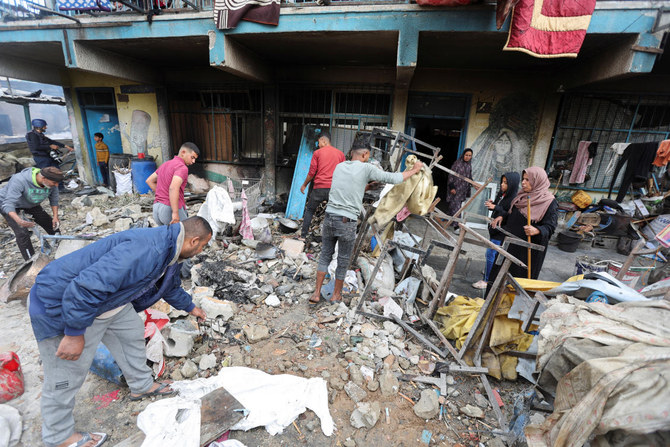
Palestinians inspect the site of an Israeli strike on a school sheltering displaced people in Nuseirat refugee camp in the central Gaza Strip, May 14, 2024. (Reuters)
Short Url
Updated 14 May 2024
Follow

Norway aims to quadruple aid to Palestinians as famine looms

  • “The urgent need of aid in Gaza is enormous after seven months of war,” Norway’s Minister of International Development, Anne Beathe Tvinnereim, said
  • Norway intends to dedicate 0.98 percent of its gross national income to development aid this year

OSLO: The Norwegian government Tuesday proposed 1 billion kroner ($92.5 million) in aid to Palestinians this year as humanitarian agencies warn of a looming famine in the Gaza Strip.
Figures in the revised budget presented on Tuesday, show a roughly quadrupling of the 258 million kroner provided in the initial finance bill adopted last year.
“The urgent need of aid in Gaza is enormous after seven months of war,” Norway’s Minister of International Development, Anne Beathe Tvinnereim, said in a statement.
“The food situation in particular is critical and there is a risk of famine,” she added, criticizing “an entirely man-made crisis” and an equally “critical” situation in the West Bank.
According to the draft budget, Norway intends to dedicate 0.98 percent of its gross national income to development aid this year.
The figures are still subject to change because the center-left government, a minority in parliament, has to negotiate with other parties to get the texts adopted.
For his part, Foreign Minister Espen Barth Eide again warned Israel against a large-scale military operation in Rafah, a city on the southern edge of the besieged Gaza Strip.
“It would be catastrophic for the population. Providing life-saving humanitarian support would become much more difficult and more dangerous,” Barth Eide said.
He added: “The more than 1 million who have sought refuge in Rafah have already fled multiple times from famine, death and horror. They are now being told to move again, but no place in Gaza is safe.”
As part of the response to the unprecedented Hamas attack on Israeli soil on October 7, Israel’s Prime Minister Benjamin Netanyahu said he is determined to launch an operation in Rafah, which he considers to be the last major stronghold of the militant organization.
Many in Rafah have been displaced multiple times during the war, and are now heading back north after Israeli forces called for the evacuation of the city’s eastern past.
On May 7, Israeli tanks and troops entered the city’s east sending desperate Palestinians to flee north.
According to the United Nations agency for Palestinian refugees (UNRWA), “almost 450,000” people have been displaced from Rafah since May 6.


Hallelujah! This Christmas, join us as we wish for peace across the region

Updated 6 sec ago
Follow

Hallelujah! This Christmas, join us as we wish for peace across the region

RIYADH: In continuing with a tradition that began in December 2022, Arab News extends a heartfelt Merry Christmas to our Christian readers and all who celebrate. This year’s special edition spotlights Christmas across the Middle East, emphasizing interfaith harmony, resilience and cultural integration. All wrapped with a special, and sincere, message of hope that we see peace spreading across the region in 2026.
Leading our coverage is an exclusive column from renowned scholar Dr. Mohammad bin Abdulkarim Al-Issa, secretary-general of the Muslim World League and president of the Organization of Muslim Scholars. His message clarifies a vital principle: “There is no Shariah text that prohibits congratulating non-Muslims on their religious holidays, including Christmas.” He frames this goodwill not as a dilution of faith, but as its strength; one that affirms human dignity and fosters the social harmony desperately needed today.
This theme of solidarity amid suffering is echoed from Bethlehem, where Palestinian pastor Rev. Dr. Munther Isaac explains that Palestinian Christianity is inseparable from national identity. In response to Gaza’s devastation, his congregation erected a nativity scene from rubble, the infant Jesus wrapped in a keffiyeh. “It was a message of faith,” he states. “Christ stands in solidarity with the suffering ... because he was born into suffering.”
From this depth emerges stories of renewal. In Damascus, festive lights return as Syrians of all faiths embrace a fragile peace. In Lebanon, celebrations pierce through political gloom with moments of joy. Jordan’s public spaces glow with trees and Fairouz’s Christmas hymns, while the UAE’s multicultural diaspora erupts in bustling, festive unity.
The historical and intellectual depth of the region’s Christian heritage is underscored by Dr. Abdellatif El-Menawy, who notes Egypt’s indispensable role in shaping Christianity from a spiritual message into a civilization. This legacy of deep-rooted faith finds vibrant, modern expression.
Here in Saudi Arabia, the festive season is acknowledged with innovative hospitality, as chefs reimagine Christmas menus through a lens of local flavors and creative culinary identity.
This special edition paints a picture far richer than simple seasonal cheer. It reveals a Middle East where different faiths deepen their own roots by extending respect to others, where celebrations are woven with threads of historical endurance, and where the message of Christmas — one of hope, peace and shared humanity — resonates with cheer and confidence.