

Concern about Russia dominates as Lithuanians vote

Lithuania's President Gitanas Nauseda, right, and European Commission President Ursula von der Leyen arrive for their meeting at the Presidential palace in Vilnius, Lithuania, on May 9, 2024. (AP Photo)
Short Url
Updated 12 May 2024
Follow

Concern about Russia dominates as Lithuanians vote

  • While the top three contenders have diverging views on Lithuania’s relations with China, they agree on helping Ukraine in its war against Russia
  • The Baltic state of 2.8 million people fears it could be next in Russia’s crosshairs if Moscow wins its war against Ukraine

VILNIUS: Lithuania votes Sunday in a presidential election dominated by security concerns with the main candidates all agreed the NATO and EU member should boost defense spending to counter the perceived threat from neighboring Russia.

The Baltic state of 2.8 million people fears it could be next in Russia’s crosshairs if Moscow wins its war against Ukraine, which began with an invasion in 2022.
While the top three contenders agree on defense, they have diverging views on social issues and on Lithuania’s relations with China, which have been strained for years over Taiwan.
“Lithuania’s understanding of the Russian threat is unanimous and unquestionable, so the main candidates are following suit,” Eastern Europe Studies Center director Linas Kojala told AFP.
Polls close at 1700 GMT and the result is expected later on Sunday — although a run-off on May 26 will probably be needed as no candidate is expected to win an overall majority.
Opinion polls give the incumbent, 59-year-old former banker Gitanas Nauseda, a comfortable lead over the other seven candidates, who include Prime Minister Ingrida Simonyte and prominent lawyer Ignas Vegele.
The Lithuanian president steers defense and foreign policy, attending EU and NATO summits, but must consult with the government and parliament on appointing the most senior officials.
Lithuania, a former Soviet republic, is a top donor to Ukraine and a big defense spender, with a military budget currently equal to 2.75 percent of GDP.


Ukraine's President Volodymyr Zelenskyy, left, stands with Lithuania's President Gitanas Nauseda after addressing a media conference in Vilnius on April 11, 2024. (AP Photo/File)

Defense spending

The Simonyte-led government is expected to come forward with proposals within several weeks that could help increase defense spending even further to three percent.
Lithuania notably intends to use the funds to purchase tanks and additional air defense systems, and to host a German brigade, as Berlin plans to complete the stationing of around 5,000 troops by 2027.
None of the top candidates appear to question these plans, but Vegele has pledged to ask for a defense audit to effectively manage finances if he is elected.
Nauseda is projected to receive more than 35 percent of the vote in the first round, according to the latest opinion poll, and is expected to prevail in any eventual run-off.
Vegele, a 48-year-old lawyer who gained prominence after speaking out against mandated vaccination during the pandemic, presents himself as an alternative to established politicians and vows more transparent governance.
Simonyte, 49, is a fiscal conservative with liberal views on social issues. She notably supports same-sex partnerships, which still stir controversy in the predominantly Catholic country.
Simonyte is running for president for a second time after losing to Nauseda in a run-off in 2019.
“Simonyte is supported by conservative party voters and liberal people, while Nauseda is a candidate of the left in terms of economic and social policy,” Vilnius University analyst Ramunas Vilpisauskas told AFP.
Meanwhile, “Vegele will get support from those who simply want change,” he added.
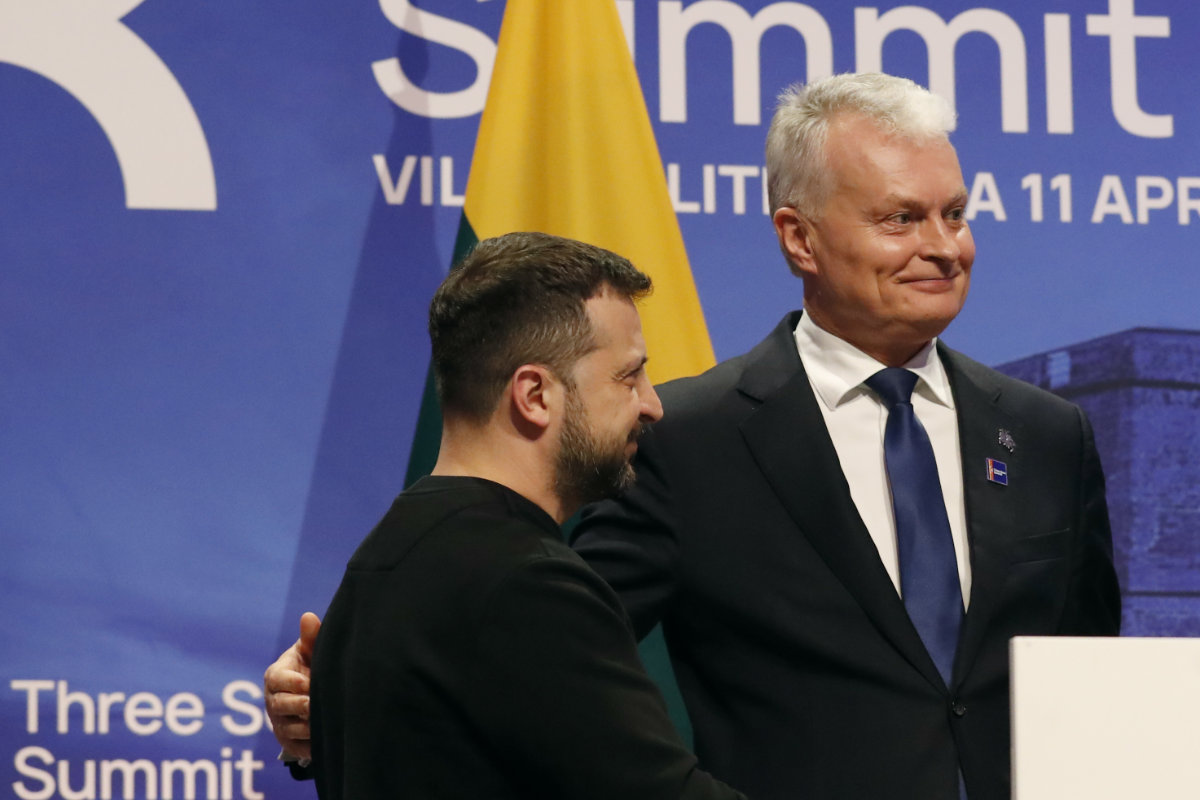


Ukraine's President Volodymyr Zelenskyy, left, stands with Lithuania's President Gitanas Nauseda after addressing a media conference in Vilnius on April 11, 2024. (AP Photo/File)


Divergence over China
The uneasy relationship between Nauseda and his rival Simonyte’s ruling conservatives has at times triggered foreign policy debates, most notably on Lithuania’s relations with China.
Bilateral ties turned tense in 2021, when Vilnius allowed Taiwan to open a de facto embassy under the island’s name in a departure from the common diplomatic practice of using the name of the capital Taipei to avoid angering Beijing.
China, which considers Taiwan a part of its territory and bristles at support for the island that might lend it any sense of international legitimacy, downgraded diplomatic relations with Vilnius and blocked its exports.
This sparked controversy among Lithuanian politicians, with some urging a restoration of relations for the sake of the Lithuanian economy.
“China’s reaction to the opening of the office was harsher than predicted, and that sparked the debate,” Kojala said, adding that China’s response was hurting local businesses.


Benin’s president says mutineers ‘fleeing’ after ECOWAS forces help crush coup attempt

Updated 4 sec ago
Follow

Benin’s president says mutineers ‘fleeing’ after ECOWAS forces help crush coup attempt

  • Group calling itself the Military Committee for Refoundation earlier announced the formation of a junta led by one Lt. Col. Pascal Tigri 
  • Nigeria’s President Tinubu later confirmed that Nigerian troops joined ECOWAS forces in helping crush the coup attempt

COTONOU, Benin: Benin President Patrice Talon on Sunday condemned an attempted coup that was foiled by the country’s army in his first public comments since sporadic gunfire was heard in parts of the administrative capital, Cotonou.
A group of soldiers appeared on Benin ‘s state TV earlier Sunday to announce the dissolution of the government in an apparent coup, which would have been the latest of many in West Africa. The group called itself the Military Committee for Refoundation.
Later, Interior Minister Alassane Seidou announced in a video on Facebook that the attempted coup had been “foiled,” but Talon, whose location was unclear, did not comment.
“I would also like to take this opportunity to express my condolences to the victims of this senseless adventure, as well as to those still being held by the fleeing mutineers,” the president said in a televised address to the nation that ended his silence. “I assure them that we will do everything in our power to find them safe and sound.”

The coup attempt is the latest in a string of military takeovers and attempted takeovers that have rocked West Africa. Last month, a military coup in Guinea-Bissau removed former President Umaro Embalo after a contested election in which both he and the opposition candidate declared themselves winners.

Benin President Patrice Talon addresses the nation on state broadcaster after coup attempt, in Cotonou, Benin, on December 7, 2025. (Benin TV/Reuters TV via REUTERS)

Talon did not provide figures on casualties or hostages in Sunday’s attempted coup.
“In the early morning of Sunday, Dec. 7, 2025, a small group of soldiers launched a mutiny to destabilize the state and its institutions,” Seidou said. “Faced with this situation, the Beninese Armed Forces and their leadership, true to their oath, remained committed to the republic.”
The regional bloc, the Economic Community of West African States, or ECOWAS, said it ordered the deployment of troops from Nigeria, Sierra Leone, Ivory Coast and Ghana to support Benin’s army to “preserve constitutional order and the territorial integrity of the Republic of Benin.”
ECOWAS earlier called the attempted coup “a subversion of the will of the people of Benin.”
Nigeria’s President Bola Tinubu praised the Nigerian armed forces for their involvement in restoring the government in Benin. In a statement by the Nigerian government’s spokesperson, Bayo Onanuga said Benin’s government made two separate requests for air and ground forces.
“It took some hours before the government’s loyal forces, assisted by Nigeria, took control and flushed out the coup plotters from the National TV,” Onanuga said in the statement.
Local media reported the arrest of 13 soldiers who took part in the coup earlier on Sunday, citing sources close to the presidency. It remained unclear if Lt. Col. Pascal Tigri, the coup leader, had been apprehended. Gunfire was heard and soldiers were seen patrolling in some locations in Cotonou, but the city has been relatively calm since the coup attempt was announced.

Illustration courtesy of Gemini

The Military Committee for Refoundation earlier said that Tigri was appointed president of the military committee.
Following its independence from France in 1960, the West African nation witnessed multiple coups. Since 1991, the country has been politically stable following the two-decade rule of Marxist-Leninist Mathieu Kérékou.
The signal to the state television and public radio, which was cut off, was later restored.
Talon has been in power since 2016 and is due to step down next April after a presidential election.
Talon’s party pick, former Finance Minister Romuald Wadagni, is the favorite to win the election. Opposition candidate Renaud Agbodjo was rejected by the electoral commission on the grounds that he did not have sufficient sponsors.
In January, two associates of Talon were sentenced to 20 years in prison for an alleged 2024 coup plot.
Last month, the country’s legislature extended the presidential term of office from five to seven years, keeping the term limit at two.