

UN reports fighting in Sudan’s Darfur involving ‘heavy weaponry’

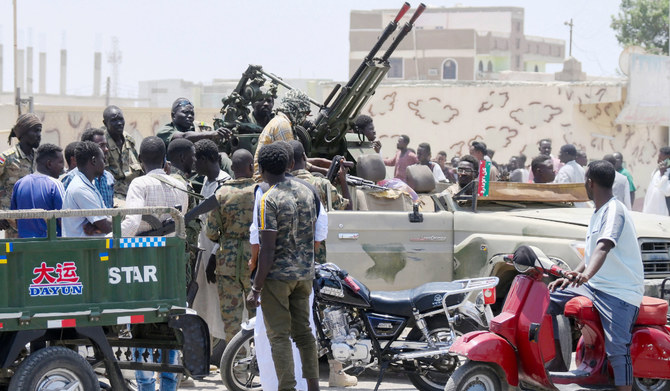
Sudanese greet army soldiers, loyal to army chief Abdel Fattah al-Burhan, in the Red Sea city of Port Sudan on April 16, 2023. (AFP)
Short Url
Updated 12 May 2024
Follow

UN reports fighting in Sudan’s Darfur involving ‘heavy weaponry’

  • The United States last month warned of a looming rebel military offensive on the city, a humanitarian hub that appears to be at the center of a newly opening front in the country’s civil war

PORT SUDAN: A major city in Sudan’s western region of Darfur has been rocked by fighting involving “heavy weaponry,” a senior UN official said Saturday.
Violence erupted in populated areas of El-Fasher, putting about 800,000 people at risk, Clementine Nkweta-Salami, the UN’s humanitarian coordinator for Sudan, said in a statement.
Wounded civilians were being rushed to hospital and civilians were trying to flee the fighting, she added.
“I am gravely concerned by the eruption of clashes in (El-Fasher) despite repeated calls to parties to the conflict to refrain from attacking the city,” said Nkweta-Salami.
“I am equally disturbed by reports of the use of heavy weaponry and attacks in highly populated areas in the city center and the outskirts of (El-Fasher), resulting in multiple casualties,” she added.
For more than a year, Sudan has suffered a war between the army, headed by the country’s de facto leader Abdel Fattah Al-Burhan, and the paramilitary Rapid Support Forces (RSF), commanded by his former deputy Mohamed Hamdan Dagalo.
The war has killed tens of thousands of people and forced more than 8.5 million to flee their homes in what the United Nations has called the “largest displacement crisis in the world.”
The RSF has seized four out of five state capitals in Darfur, a region about the size of France and home to around one quarter of Sudan’s 48 million people.
El-Fasher is the last major city in Darfur that is not under paramilitary control and the United States warned last month of a looming offensive on the city.
UN chief Antonio Guterres said Saturday he was “very concerned about the ongoing war in Sudan.”
“We need an urgent ceasefire and a coordinated international effort to deliver a political process that can get the country back on track,” he said in a post on social media site X.


Iran FM criticizes Israel for ‘doctrine of domination’

Updated 07 February 2026
Follow

Iran FM criticizes Israel for ‘doctrine of domination’

  • Doctrine allows Israel to expand its military arsenal while pressuring other countries in the region to disarm
  • His remarks came a day after renewed nuclear talks with Washington in Oman

DOHA: Iran’s Foreign Minister Abbas Araghchi on Saturday criticized what he said was a “doctrine of domination” that allows Israel to expand its military arsenal while pressuring other countries in the region to disarm.
His remarks came a day after renewed nuclear talks with Washington, with previous talks collapsing when Israel launched an unprecedented bombing campaign against Iran last June that triggered a 12-day war.
Araghchi was speaking at the Al Jazeera Forum conference in Qatar but made no reference to Friday’s talks with the United States.
“Israel’s expansionist project requires that neighboring countries be weakened: militarily, technologically, economically and socially,” Araghchi said.
“Under this project Israel is free to expand its military arsenal without limits ... Yet other countries are demanded to disarm. Others are pressured to reduce defensive capacity. Others are punished for scientific progress,” he added.
“This is a doctrine of domination.”
During the 12-day war Israel targeted senior Iranian military officials, nuclear scientists and sites as well as residential areas, with the US later launching its own attacks on key nuclear facilities.
Iran responded at the time with drone and missile attacks on Israel, as well as by targeting the largest US military base in the Middle East, located in Qatar.
On Friday, Araghchi led the Iranian delegation in indirect nuclear talks with US Middle East envoy Steve Witkoff in Muscat.
The top Iranian diplomat later described the atmosphere as having been “very positive,” while US President Donald Trump said the talks were “very good,” with both sides agreeing to proceed with further negotiations.
The talks followed threats from Washington and its recent deployment of an aircraft carrier group to the region following Iran’s deadly crackdown on anti-government protests last month.
The United States has sought to address Iran’s ballistic missile program and its support for militant groups in the region — issues which Israel has pushed to include in the talks, according to media reports.
Tehran has repeatedly rejected expanding the scope of negotiations beyond the nuclear issue.