


RIYADH: Farasan Islands’ Hareed festival, which concluded recently, marked the start of annual pearl fishing trips, an ancient skill and a major source of the islanders’ prosperity.
Ships once carried 30 to 40 islanders in search of pearls, a lucrative source of income in previous centuries.

Pearls played a major role in Farasan’s commercial and economic activity. (SPA)
Sheikh of the Farasan Islands, Mohammed bin Hadi Al-Rajhi, described the stages of preparation for pearl fishing trips, which began with the shipowner inspecting and preparing his vessel, and providing sailors’ homes with supplies and foodstuffs that will suffice their families for the duration of their absence at sea.
He also prepared food for the trip, including red corn or whole wheat, and drinking water stored in clay vessels.
FASTFACTS
• A pearl merchant, Suleiman Balaous, classified pearls according to size and weight.
• One variety, ‘Al-Dana,’ meaning round, is distinguished by its large weight, bright luster, and absence of flaws.
• Smaller varieties such as ‘Al-Mazouri,’ ‘Al-Ansar,’ and ‘Al- Badla,’ have irregular shapes.
Al-Rajhi, an expert on pearl fishing, added: “The beginning of the month of May witnessed the start of these trips that last for three or four months, which are the summer months when it is easy to obtain pearls, so the fishermen set sail to Al-Maaden (mineral) areas, which abound with oysters containing pearls.”

Ships once carried 30 to 40 islanders in search of pearls, a lucrative source of income in previous centuries. (SPA)
Once the deep dives begin, diving activities were divided over five days, with the first four days’ harvest going to the divers and the fifth day’s harvest going to the shipowner, he said.
Divers used a weight tied to one foot to help them descend to depths of 12 meters and more to extract pearls. The diver communicated with an assistant on the deck of the ship using a rope, which was also used to pull him back to the surface.
In return for this assistance, the diver allocated a portion of his harvest — known as “dangeel,” a net in which the oysters were collected — to the assistant as payment.

Pearls played a major role in Farasan’s commercial and economic activity. (SPA)
Diving would start following the fajr prayer, with work continuing until noon. Afterward, the crew would rest before beginning the “fulq” process, which involved opening the oysters, allowing each diver to inspect their daily harvest.
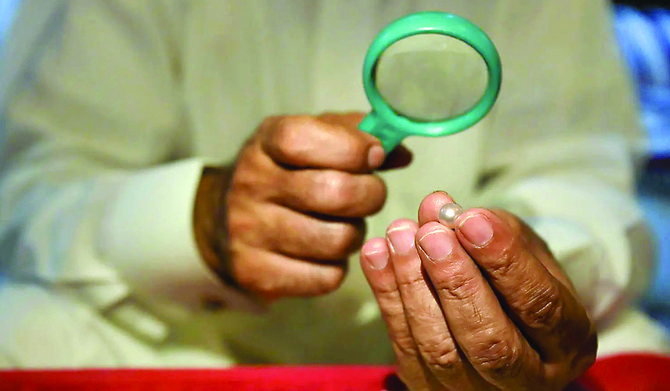
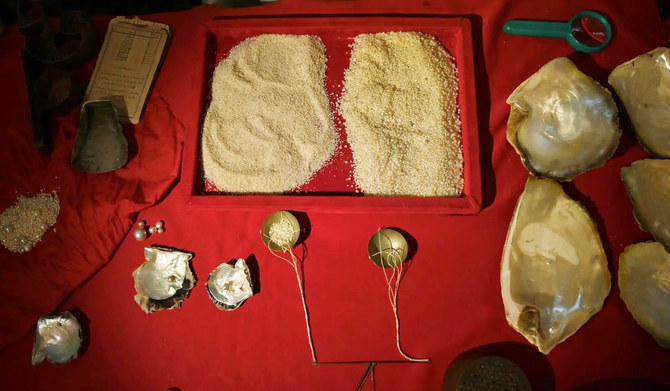
Referring to pearl sorting tools owned by pearl merchants at that time, Al-Rajhi said that merchants had copper sieves of various sizes, to sort large pearls from small varieties.
A pearl merchant, Suleiman Balaous, classified pearls according to size and weight. One variety, “Al-Dana,” meaning round, is distinguished by its large weight, bright luster, and absence of flaws.
Smaller varieties such as “Al-Mazouri,” “Al-Ansar,” and “Al-Badla,” have irregular shapes, while pearls harvested from the Farasan Islands are distinct from those in most pearl diving areas in terms of color and clarity, Al-Rajhi said.
The long months of pearl diving were associated with hardship, fatigue, and risk, and fishermen invented the folk songs of Al-Dana for entertainment. It has emerged as one of the oldest folk arts in Farasan, expressing the sailors’ longing during long absences searching for pearls.
The lucrative pearl trade in former centuries contributed to the formation of a wealthy class whose trade led them to market pearls in Gulf Arab countries, Europe, and particularly in India, which was a major pearl market.
Traders saw Eastern arts and inscriptions on buildings, which influenced their cultural and architectural ideas. They introduced these motifs to the Farasan Islands, where they were reflected in several wealthy individuals’ homes, particularly the two houses of Al-Rifai, one of which belongs to Ahmed Al-Munawar Al-Rifai and was completed in 1922, and the other belongs to Hussein bin Yahya Al-Rifai.
This also influenced the construction of the Najdi Mosque, which was completed in 1928 by Sheikh Ibrahim Al-Tamimi, popularly known as “Al-Najdi,” who worked in the pearl trade and was impressed by Eastern civilization due to his numerous travels to India.
Pearls played a major role in Farasan’s commercial and economic activity until the trade faded with the rise of agricultural and industrial pearls, becoming part of the islands’ heritage and ancient culture.


