

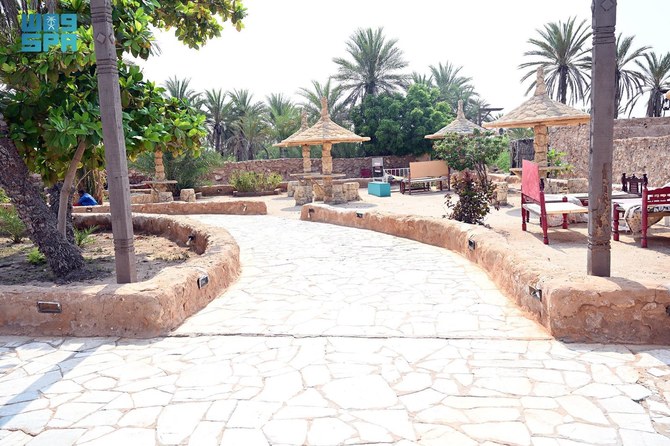
Hareed Festival: A window into the heart of the Farasan Islands

1 / 3
2 / 3
3 / 3
Short Url
Updated 06 May 2024
Follow

Hareed Festival: A window into the heart of the Farasan Islands

  • Annual event highlights tourism potential

Riyadh: The Farasan Islands, a string of coral islands nestled 40 km off the coast of Jazan in the Red Sea, have been abuzz with activity recently as they hosted the 20th Hareed Festival.

This vibrant annual event celebrates the arrival of parrotfish, also called hareed, in the islands’ shallow waters, the Saudi Press Agency reported on Sunday.

The islanders have cherished this event for generations, transforming it into a social gathering that goes well beyond the arrival of the fish.

Visitors to the festival got a glimpse of the islands’ rich cultural heritage as it showcased the area’s unique customs, traditions, folk games, and handicrafts. It also focused its spotlight on Farasan’s remarkable tourism potential and historic sites.

Al-Dana provides one of the highlights. It is a captivating form of vocal art that is one of Farasan’s oldest folk traditions. It forms a poignant expression of longing, a result of the hardships endured by sailors on extended pearl-diving expeditions. The challenges faced by these brave men fueled the art form, which is deeply rooted in Farasan’s cultural identity.

The annual festival also gives an opportunity for Farasan residents to display their traditional handicrafts. Visitors can watch the making of fishing traps and nets, the intricate weaving of palm fronds, the creation of bags and rugs, and hat knitting.

A designated area at the hareed fishing site catered to families and children. Visitors could experience the thrill of catching parrotfish using a traditional method that involved setting up barriers to prevent the fish from escaping. This competition, a centuries-old tradition, allowed families to connect with the region’s fishing heritage.

Farasan’s most renowned tourist attractions highlighted the islands’ potential for tourism.

Al-Qassar village, which is located only 5 km from Farasan Grand Island, is a popular tourist site. This heritage village, which is built of stone and palm leaves, is home to the archipelago’s largest palm oasis.

Al-Qassar has served as a summer retreat for Farasan residents. People travel by camel to spend a three-month break in the village during the season of Al-Asef, the northwestern summer wind that comes after the hareed fishing season.

Famous for its abundance of fresh groundwater, Al-Qassar village comprises around 400 houses. These unique dwellings, with stone walls and roofs made of palm tree planks, leaves, doum palm, or anisotes trisulcus branches, topped with algae and mud, are made by traditional building techniques designed to withstand the elements.

The Hareed Festival is a window into the heart and soul of the inhabitants of the Farasan Islands; a celebration of culture, tradition, and the islands’ natural beauty.


Saudi reserve given ‘dark sky’ listing in boost to astrotourism ambitions 

Updated 15 December 2025
Follow

Saudi reserve given ‘dark sky’ listing in boost to astrotourism ambitions 

  • Imam Turki bin Abdullah Royal Reserve Development Authority announced on Monday that the desert received official accreditation from DarkSky International

RIYADH: Saudi Arabia’s Nafud Desert has been listed as one of more than 250 Dark Sky Sites worldwide, which authorities say marks a commitment to protecting the environment from light pollution. 

Imam Turki bin Abdullah Royal Reserve Development Authority announced on Monday that the desert received official accreditation from DarkSky International, the global body committed to tackling light pollution in urban and rural areas. 

Welcoming the accreditation, Ahmed Al-Qarni, official spokesperson at the royal reserve, told Arab News: “It’s a new achievement in the journey of protecting nature and astronomy in Saudi Arabia. 

“The adoption of the Great Nafud Desert in Imam Turki bin Abdullah Royal Reserve by the International DarkSky Association, as the largest site in the Middle East, (represents) a culmination of a precise scientific path, and another step that enhances the Kingdom’s position as a leading destination in sustainability, nature protection, and astronomical tourism.” 

Abouazza El-Mhamdi, associate professor in the physics and astronomy department at King Saud University’s College of Science, said that the announcement is a “a major achievement for both science and tourism. 

“This accreditation protects the pristine night sky from light pollution, creating an invaluable natural laboratory for astronomers,” he added. 

“It provides an ideal Saudi location for adequate Earth-based telescopes and is a prime candidate for detailed site surveys, enabling sensitive observations of stars and galaxies. 

“At the same time, it establishes the reserve as a premier global destination for stargazing and astrotourism, supporting sustainable economic growth.” 

The reserve development authority also posted on X: “Away from the clamor of the lights ... there is a darkness that shines. 

“We are proud of the adoption of the Great Nafud Desert within the Imam Turki bin Abdullah Royal Reserve as one of the dark sky places certified by the DarkSky International.” 

Located within the reserve east of the Hail-Al Jawf road, the Great Nafud Desert covers an area of about 13,416 sq. km, making it one of the largest accredited Dark Sky Sites in the region and one of the least light-polluted sites in the Kingdom, the Saudi Press Agency reported. 

Fulfilling the organization’s criteria was the result of comprehensive scientific work that included field studies, precise astronomical observations, advanced nighttime analyses, and the implementation of specialized engineering practices for managing nighttime lighting and controlling light pollution sources. 

These efforts, undertaken by the authority, are part of its commitment to protecting the desert’s natural nighttime landscapes, enhancing the sustainability of ecosystems and preparing the site to serve as a global model for preserving the natural sky. 

CEO of the Imam Turki bin Abdullah Royal Reserve Development Authority, Engineer Mohammed Al-Shaalan, said in a statement that the accreditation is a culmination of the interest of the country’s leadership in the environment and the protection of natural sites. 

It also reflects the support of Prince Turki bin Mohammed bin Fahd bin Abdulaziz, chairman of the authority’s board of directors, he added. 

Al-Shaalan said that the accreditation represents a significant step that enhances the reserve’s presence on the international map and contributes to the development of astronomical tourism, scientific research, and specialized environmental experiments. 

The area provides visitors and researchers with unique opportunities to observe the night sky and to monitor astronomical phenomena in a natural environment with low light pollution. 

He added that the authority has developed tourism facilities in the desert such as “The Leaf” camp located near the dark sky zone.